
Guide card
T4 · Stay On Your Side of the Net
Show the text version
          WHYZMEN · GUIDE CARD · SESSION 13                                WHYZMEN · GUIDE CARD · SESSION 13

  T4      Stay on Your Side of the                                 T4      Stay on Your Side of the
          Net                                                              Net
 Use it when… you need to tell a brother something hard.          Use it when… you need to tell a brother something hard.
       “Wounds from a friend can be trusted.”                           “Wounds from a friend can be trusted.”
                            Proverbs 27:6                                                    Proverbs 27:6
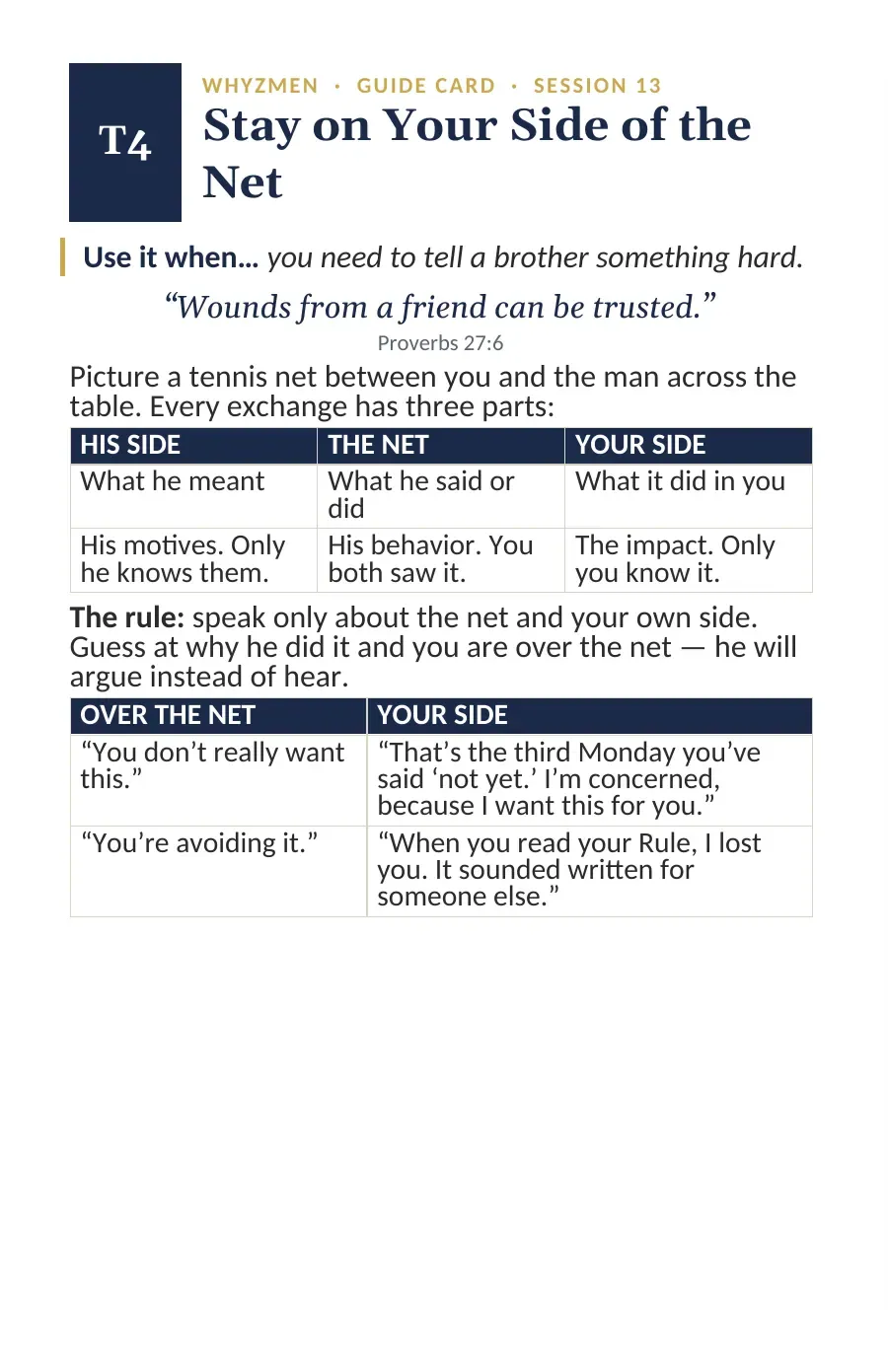
Picture a tennis net between you and the man across the          Picture a tennis net between you and the man across the
table. Every exchange has three parts:                           table. Every exchange has three parts:
HIS SIDE                THE NET             YOUR SIDE            HIS SIDE                THE NET             YOUR SIDE
What he meant           What he said or     What it did in you   What he meant           What he said or     What it did in you
                        did                                                              did
His motives. Only       His behavior. You   The impact. Only     His motives. Only       His behavior. You   The impact. Only
he knows them.          both saw it.        you know it.         he knows them.          both saw it.        you know it.
The rule: speak only about the net and your own side.            The rule: speak only about the net and your own side.
Guess at why he did it and you are over the net — he will        Guess at why he did it and you are over the net — he will
argue instead of hear.                                           argue instead of hear.
OVER THE NET                YOUR SIDE                            OVER THE NET                YOUR SIDE
“You don’t really want      “That’s the third Monday you’ve      “You don’t really want      “That’s the third Monday you’ve
this.”                      said ‘not yet.’ I’m concerned,       this.”                      said ‘not yet.’ I’m concerned,
                            because I want this for you.”                                    because I want this for you.”
“You’re avoiding it.”       “When you read your Rule, I lost     “You’re avoiding it.”       “When you read your Rule, I lost
                            you. It sounded written for                                      you. It sounded written for
                            someone else.”                                                   someone else.”
T4 · Stay on Your Side of the Net (back)                                       T4 · Stay on Your Side of the Net (back)

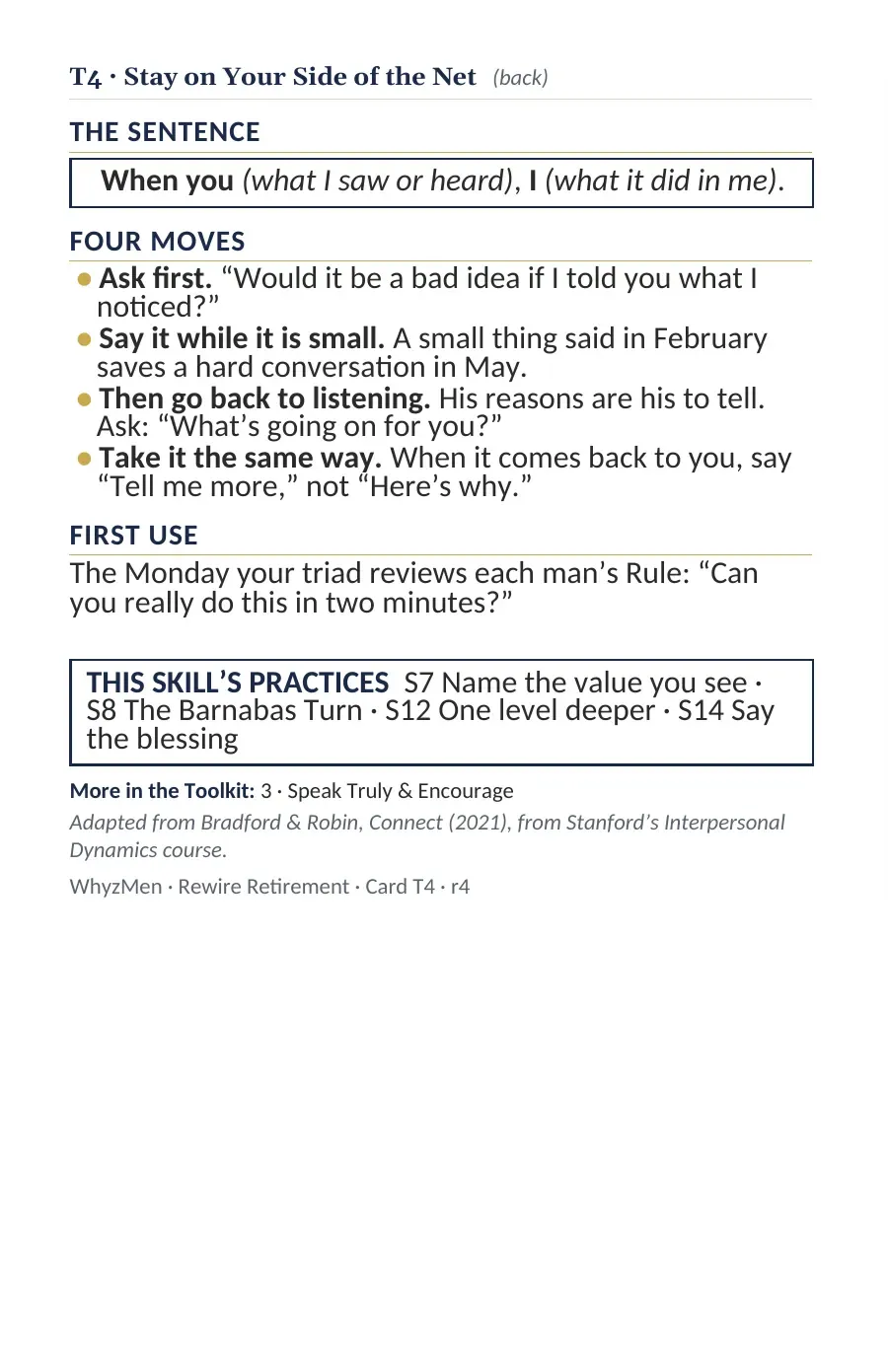
THE SENTENCE                                                                   THE SENTENCE
   When you (what I saw or heard), I (what it did in me).                         When you (what I saw or heard), I (what it did in me).
FOUR MOVES                                                                     FOUR MOVES
• Ask first. “Would it be a bad idea if I told you what I                      • Ask first. “Would it be a bad idea if I told you what I
  noticed?”                                                                      noticed?”
• Say it while it is small. A small thing said in February                     • Say it while it is small. A small thing said in February
  saves a hard conversation in May.                                              saves a hard conversation in May.
• Then go back to listening. His reasons are his to tell.                      • Then go back to listening. His reasons are his to tell.
  Ask: “What’s going on for you?”                                                Ask: “What’s going on for you?”
• Take it the same way. When it comes back to you, say                         • Take it the same way. When it comes back to you, say
  “Tell me more,” not “Here’s why.”                                              “Tell me more,” not “Here’s why.”
FIRST USE                                                                      FIRST USE
The Monday your triad reviews each man’s Rule: “Can                            The Monday your triad reviews each man’s Rule: “Can
you really do this in two minutes?”                                            you really do this in two minutes?”

 THIS SKILL’S PRACTICES S7 Name the value you see ·                             THIS SKILL’S PRACTICES S7 Name the value you see ·
 S8 The Barnabas Turn · S12 One level deeper · S14 Say                          S8 The Barnabas Turn · S12 One level deeper · S14 Say
 the blessing                                                                   the blessing
More in the Toolkit: 3 · Speak Truly & Encourage                               More in the Toolkit: 3 · Speak Truly & Encourage
Adapted from Bradford & Robin, Connect (2021), from Stanford’s Interpersonal   Adapted from Bradford & Robin, Connect (2021), from Stanford’s Interpersonal
Dynamics course.                                                               Dynamics course.
WhyzMen · Rewire Retirement · Card T4 · r4                                     WhyzMen · Rewire Retirement · Card T4 · r4