
Harvest Charter
Harvest Charter: Invitation
Rewire Retirement
MY HARVEST CHARTER
The Invitation
Why invest in writing your Harvest Charter · read this first
“They will still bear fruit in old age, they will stay fresh and green.”
Psalm 92:14
“I have been crucified with Christ and I no longer live, but Christ lives in me.”
Galatians 2:20
Three Books, One Charter
Read one, write one, keep one on the shelf
Your Harvest Charter comes in three books. This one is short and is read once, at the start. The second is the Charter itself: the pages you write in, a few lines at a time, and sign at Commissioning. The third is a shelf of deeper worksheets you can take down whenever one calls to you.
Book | What it is | How you use it |
The Invitation | Why a Harvest Charter is worth your time, what research and Scripture say about it, and the road ahead | Read it before Session 2. Come back to it when you lose heart. |
The Core | Eleven sections in four parts: Foundation, Vision, Action, Legacy | Write in it across the program, about 60 minutes a week. Sign it at Session 15. |
The Appendices | The shelf: Appendices A–N, the longer worksheets | Optional. Take one during the program or in the years after. |
If you want to build a ship, don’t drum up people to collect wood and don’t assign them tasks and work, but rather teach them to long for the endless immensity of the sea. — attributed to Antoine de Saint-Exupéry
The Core is the wood and the tasks. This book is the sea.
Why Invest in Writing Your Harvest Charter?
Twenty years is too long to improvise
A man who reaches 65 today can expect, on average, about eighteen more years; one who reaches 75, about eleven more (Social Security Administration, 2023 period life table). That is longer than most men spent at any one employer. Yet most of us spent forty years planning for the money and almost no time planning for the life.
Retirement quietly takes away five things work used to supply without our asking: identity, structure, relationships, mastery and purpose. Nobody hands them back. They have to be rebuilt on purpose, or they drift. Your Harvest Charter is where you decide, in writing, how each will be supplied in this season, and by Whom.
You planned your money for forty years. Who helped you plan your life?
What You Will Have at the End
By Commissioning you will hold a document of about twenty pages, in your own handwriting, that gives you:
•An answer to “Who am I now?” that does not need a title, a rank or a number.
•A mission small enough to fit on a T-shirt and worth ten years of your life.
•A picture of an ordinary Tuesday five years from now that you would recognize if you were living it, and that your wife has read and added to.
•One or two big goals and a few first steps, chosen after you have looked at your whole life, not just the loudest part of it.
•A Rule of Life that fits on a card, so Christ has a real place in your actual week.
•Two men who know your story and have your permission to ask the hard question.
•Something to leave in the people you love, not only to them.
What it costs: about sixty minutes a week. No man writes the whole Charter at once. Most weeks a session hands you one section, a few lines at a time.
What the Research Finds
Scripture made these claims long before anyone measured them. Careful research now points the same way. Here is what the studies find, and where each finding shows up in your Charter.
The finding | What it means for you | Where it lives in your Charter |
Purpose and length of life. Among about 7,000 Americans over 50, those with the lowest sense of purpose were about 2.4 times as likely to die over the next four years as those with the highest (Alimujiang et al., 2019). A 14-year study of 6,000 adults found the same at every age, retired or not (Hill & Turiano, 2014). | Purpose is not a luxury of youth. It matters more, not less, when the job ends. | §2.1 My Mission |
People and length of life. Across 148 studies and 308,000 people, those with stronger social ties had a 50% greater likelihood of survival, comparable to well-known risks such as smoking (Holt-Lunstad et al., 2010). In Harvard’s 80-year study of adult life, the men most satisfied in their relationships at 50 were the healthiest at 80 (Waldinger & Schulz, 2023). | Friendship is not a nice extra. It is part of how a man stays well. | §3.2 My Triad; §2.2 Our Tuesday |
Writing your best future. People who wrote for 20 minutes on four days about their “best possible self” reported higher well-being weeks later, and five months later had fewer illness visits than a control group (King, 2001). | Describing a good future in writing does something that thinking about it does not. | §2.2 A Tuesday in 2031 |
Telling your story. Writing about life’s hard chapters is linked to better health (Pennebaker & Beall, 1986). Adults who tell their story as redemption, bad turned toward good, tend to be more generative: more invested in the next generation (McAdams et al., 2001). | How you tell your story shapes what you do with the rest of it. | §1.1 My Story; §4.1 Legacy |
A when, a where and a how. Across 94 tests, people who decided in advance when, where and how they would act reached their goals far more often, a medium-to-large effect (Gollwitzer & Sheeran, 2006). | Good intentions need an address on the calendar. | §3.1 First Steps; §3.2 My Rule |
Subtraction. Asked to improve something, people systematically overlook taking something away, and add instead (Adams, Klotz et al., Nature, 2021). | Before you add anything to this season, name what you will set down. | §3.1 What I am setting down |
Serving others. Older adults who tutored children in Baltimore schools through Experience Corps showed gains in the brain regions used for planning and organizing, in a small early study (Carlson et al., 2009). | Service done with your gifts is good for the people you serve, and for you. | Triad project; the Service domain |
Marriage in transition. Among 534 married adults aged 50 to 74, conflict ran highest among the newly retired; couples who had settled into retirement together reported the most satisfaction (Moen, Kim & Hofmeister, 2001). | Your retirement lands in your marriage. Plan the season together. | §2.2 Our Tuesday |
A fair word about the evidence. Most of these studies show strong associations, not guarantees, and a Charter will not add years to your life by itself. But look at what the studies describe: purpose, people, a written picture of a good future, a plan with a when and a where, room made by subtraction. That is what the Charter asks you to build. Full citations are in the Theoretical Note at the back of this book.
Scripture said it first Purpose: “We are God’s handiwork, created in Christ Jesus to do good works, which God prepared in advance for us to do” (Ephesians 2:10). People: “A cord of three strands is not quickly broken” (Ecclesiastes 4:12). That is your triad. A written vision: “Write down the revelation and make it plain on tablets so that a herald may run with it” (Habakkuk 2:2). A plan held open-handed: “In their hearts humans plan their course, but the Lord establishes their steps” (Proverbs 16:9). Subtraction: “Let us throw off everything that hinders” (Hebrews 12:1). Science explains the mechanism of what Scripture already claims about us. Neither competes with the other. |
What Is a Harvest Charter?
A personal constitution for your Jubilee season
“The unexamined life is not worth living.” — Socrates
“But the examined life is hard to live.” — Bob Buford
“There are far, far better things ahead than any we leave behind.” — C. S. Lewis
“See, I am doing a new thing! Now it springs up; do you not perceive it?” — Isaiah 43:19
Your Harvest Charter is a personal constitution for your Jubilee season: a living document that captures who you are, where you are going, and how you will get there. It is not a retirement plan. It is a mission statement for the most important season of your life.
The word matters. Jubilee, drawn from Leviticus 25, is not winding down. It is joyful release and earned abundance. The harvest metaphor is biblical and bodily: seeds planted across a lifetime now come to fruition. Galatians 6:9 reminds us, “At the proper time we will reap a harvest if we do not give up.” This document is your charter for the reaping.
Written From Christ, Not Toward Him
A document like this carries a quiet risk, and the men who reviewed it named it plainly. Left alone, a personal constitution becomes a self-improvement plan with Scripture in the margins: the first summit rebuilt at a smaller scale, in better vocabulary. The correction they offered is not a program. It is a verse.
“I have been crucified with Christ and I no longer live, but Christ lives in me. The life I now live in the body, I live by faith in the Son of God, who loved me and gave himself for me.” — Galatians 2:20
Read the grammar of it. The “I” is not improved, rebalanced or promoted. It is crucified. And then a life goes on being lived anyway: in the body, in the calendar, on an ordinary Tuesday. But it is sourced somewhere else. That is the whole difference between a Charter written toward Christ, a set of religious goals to be achieved, and a Charter written from Christ, as the expression of a life already handed over.
Every section of the Core assumes the second. You are not building a self in these pages. You are describing the man Christ is living through in this season, and then clearing the ground so that He is not obstructed.
Two consequences for a Harvest Charter 1. Identity is received before it is achieved. Every goal in this Charter is a response, not a résumé. A man who forgets this will write an excellent document that quietly re-establishes the first summit at a smaller scale. 2. The self is not deleted; it is re-sourced. Paul goes on arguing, traveling, working with his hands and writing letters we still read. “The life I now live in the body” is emphatically a life. Surrender is the source of your action here, never a substitute for it. |
Three Misreadings to Avoid
1. Quietism: “let go and let God.” Galatians 2:20 does not abolish agency. The same letter tells the Galatians to “carry each other’s burdens” (6:2) and, three verses later, that “each one should carry their own load” (6:5). A crucified man works harder, not less; he simply works from a different place. If your Charter gets vaguer as you apply this verse, you have misapplied it.
2. Self-erasure: treating “no longer I” as license for smallness. Paul’s letters are full of the word “I,” and it is rarely timid. Nothing in this verse asks you to think poorly of yourself, to refuse to lead, or to mistake passivity for humility. A crucified man is free, not diminished. If your career ended in a way you would not have chosen, watch this one especially.
3. Spiritual veneer: the same ambition in new vocabulary. This is the common one, and the hardest to catch from the inside, because everything sounds right. The goals are worthy. The language is scriptural. Nothing has actually changed hands. The open-hand question in §3.1 exists to find it (the full check is Appendix D.3).
A caution the pastors asked us to print “Crucified with Christ” is not self-erasure, and it is not passivity. The self is not deleted; it is re-sourced. Nothing in this Charter asks you to think less of yourself. As Rick Warren put it, humility is not thinking less of yourself; it is thinking of yourself less often. This document asks you to think of Christ in you more. You still have agency. You still choose. The choosing is simply done prayerfully now, and from a different place. |
Why a Written Document?
“Write down the revelation and make it plain on tablets so that a herald may run with it.” — Habakkuk 2:2
•Clarity. Writing forces precision. Vague intentions become concrete commitments.
•Memory. You will forget. A document does not. When you drift, you have something to return to.
•Accountability. A goal someone else can read is a goal someone else can ask about. Your triad cannot ask about a plan that lives only in your head.
•Discipleship. What is written can be shepherded. A pastor, a wife or a triad can read a page; none of them can read your intentions.
•Legacy. Your grandchildren will one day have a window into who you were.
What Stands Beneath Your Charter
One ground, seven borrowed lenses
Your Charter stands on one ground and is built with seven lenses. The lenses are borrowed and replaceable; the ground is not. You need none of these names to write a fine Charter.
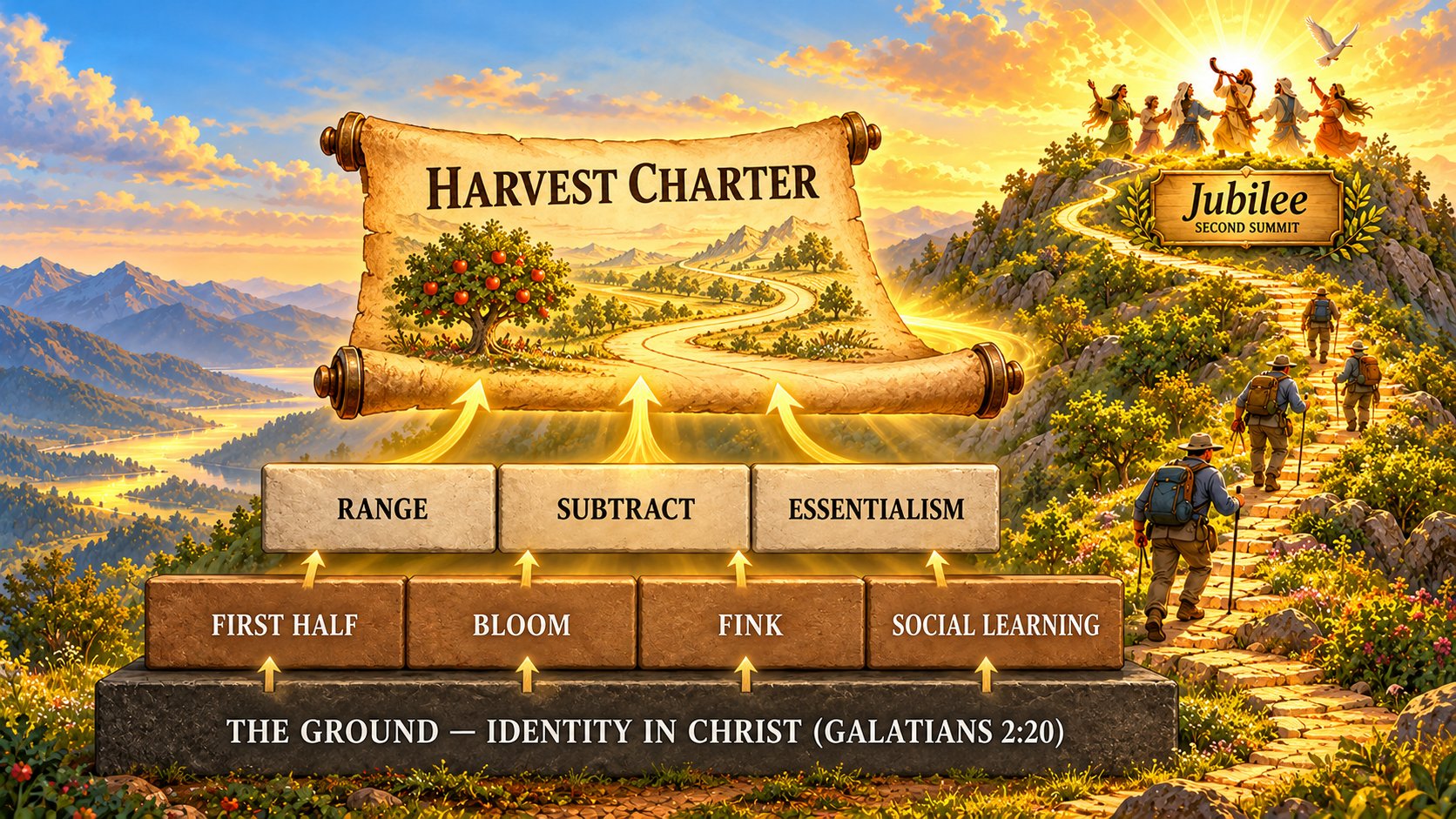
The Ground and the seven lenses beneath the Harvest Charter
What each one contributes
•The Ground: Identity in Christ (Galatians 2:20). Whose you are comes before what you do (§1.4, §3.2, §3.1).
•First Half: the Two Summits. The first summit was built by doing; the second is found by becoming.
•Bloom: thinking upward. From remembering your story up to creating a coherent life.
•Fink: whole-person learning. Real learning changes what you care about, not only what you know.
•Social Learning: men learn from men. Your triad is the smallest workable unit of imitation.
•Range: breadth becomes insight. A long, varied life is raw material, not clutter.
•Subtract: what must be released. Set something down before you pick anything up.
•Essentialism: less, but better. Three priority domains, one or two big goals, a Rule that fits on a card.
More on each lens, with citations: A Theoretical Note, at the back.
Your Whole Life, and the One or Two Big Things
Walk around the whole tree before you choose where to prune
A pilot walks all the way around the plane before he flies one heading. Your Charter asks the same: look honestly at every domain of your life, then choose only a few and pursue them well.
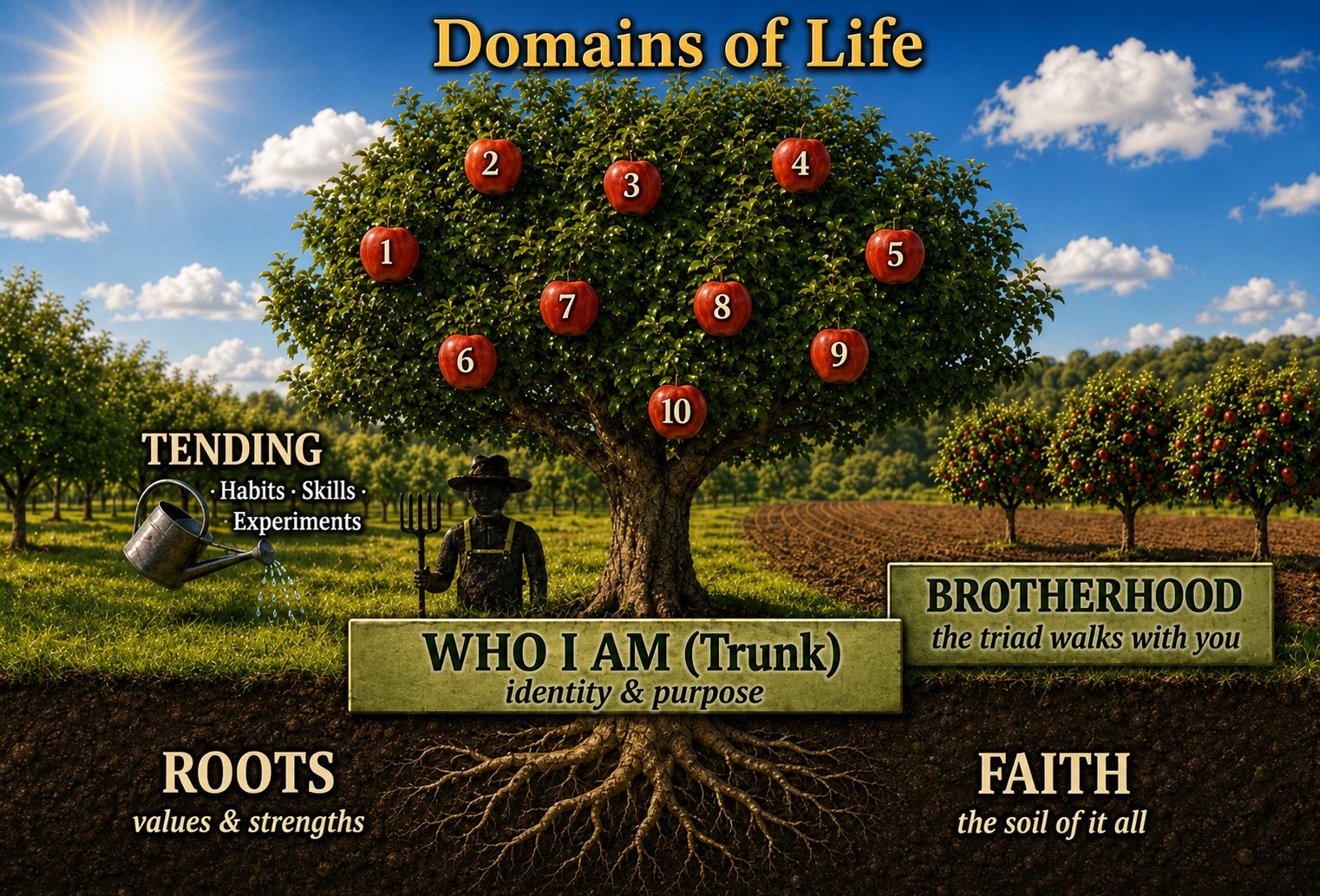
Domain | What it covers | Domain | What it covers |
1 · Faith & Spiritual Life | Prayer, study, reflection and quiet in an actual week | 6 · Service & Contribution | Mentoring, volunteering, generosity |
2 · Marriage & Family | Time together, household, children and grandchildren | 7 · Growth & Learning | New skills, reading, creative pursuits |
3 · Friendships & Community | Deep friendship, hospitality, civic life | 8 · Recreation, Adventure & Joy | Play, travel, sport and rest |
4 · Health & Wellbeing | Exercise, sleep, stress: capacity, not appearance | 9 · Finances & Stewardship | Giving, wealth transfer, the weekly use of hours |
5 · Identity & Purpose | Mission and values after the title is gone | 10 · Practical Readiness | Estate documents, home and health logistics |
Two moves, in this order
First, see the whole. At Session 13 you tick one box for each of the ten domains (§3.1): flourishing, tended, or needs attention. It takes five minutes and it is often the most honest page in the Charter. A domain that is quietly going dark usually shows up here first.
Then, choose the few: “less, but better” (McKeown). Circle three priority domains, the ones your Tuesday page already points to, and name one or two big goals for the next 12 to 24 months. Most men need only one. A big goal is the one your Tuesday cannot happen without. The other seven domains are tended, not abandoned.
A line for every domain, a mini-mission and one practice each, is on the shelf: Appendix C.9.
Questions for Your Climb
The questions your Charter answers, part by part
WHOSE AM I? (The Ground)
•My Identity in Christ — what is already true of me before I accomplish anything (§1.4)
•My Discipleship Rhythm — how Christ actually gets access to my week (§3.2)
WHO AM I? (Part One · Foundation)
•My Threshold — what I am setting down, carrying forward and mourning as one chapter ends (§1.0)
•My Story — where I have come from and what it means (§1.1)
•My Compass — the thread through my story and the two values I will not compromise (§1.2)
•My Strengths & Gifts — what energizes me and serves others, and how my caring has shifted (§1.3)
•My Faith Foundation — what God has been building in me and what He is asking now (§1.4)
WHERE AM I GOING? (Part Two · Vision)
•My Next Chapter — the direction I sense once I know what I am made of (§2.0)
•My Mission — who sent me, what I do, and ten words or fewer to carry it (§2.1)
•My Tuesday, and Ours — an ordinary day five years from now, and what my wife and I want together (§2.2)
HOW WILL I GET THERE? (Part Three · Action)
•My Whole Life, Then the Few — all ten domains seen; three priorities; one or two big goals (§3.1)
•What I Am Setting Down — what I release to make room (§3.1)
•My First Steps — one experiment, with a when, a where and a who (§3.1)
•My Rule & My Triad — one practice for each rhythm, and two men walking it with me (§3.2)
WHAT DO I LEAVE BEHIND? (Part Four · Legacy)
•My Legacy — one sentence, and one letter or a one-page testament (§4.1)
•My Harvest — stories, letters and lessons for those who come after me (the shelf: Appendices A, I, J, K)
Your RoadMap
Eleven sections, four parts, a few lines at a time · tick as you go
§ | Section | Written at | Length | ✓ |
Part One · Foundation — Who am I, and whose? | ||||
1.0 | My Threshold | Session 2 · rewritten Session 9 | Four lines, then three | ☐ |
1.1 | My Story: The Journey So Far | Markers S3 · story S5 · read aloud S6 | 200–300 words | ☐ |
1.2 | My Compass: Life Theme & Two Core Values | Essays after S6 · values S7 | Two short essays; two values | ☐ |
1.3 | Strengths & Gifts, with The Signature | Session 8 · gifts named S9 | Two lists; 2–3 sentences | ☐ |
1.4 | My Faith Foundation | The Wilderness Between (framed S9) | 300–400 words | ☐ |
Part Two · Vision — Where am I going? | ||||
2.0 | My Next Chapter | The Wilderness Between · workshopped S11 | A page | ☐ |
2.1 | My Mission and My True North | S11 draft · Clearness Monday · final S13 | Three rungs | ☐ |
2.2 | A Tuesday in 2031, and Our Tuesday | Session 12, finished that week, with your wife | One page, plus shared lines | ☐ |
Part Three · Action — How will I get there? | ||||
3.1 | My First Steps | Session 13 | Ten-domain scan; three priorities; one or two big goals | ☐ |
3.2 | My Rule & My Triad | Begun S4 · finished S13 · reviewed S14 | Fits on a card | ☐ |
Part Four · Legacy — What do I leave behind? | ||||
4.1 | One Letter or a One-Page Testament | Session 14 | A sentence, then a page | ☐ |
Finishing | ||||
✍ | Charter at a Glance | Session 13, copied from what you wrote | One page | ☐ |
✍ | Signed and witnessed | Session 15 · Commissioning | Signatures | ☐ |
After Commissioning
When | What |
Weekly | The triad check-in you agreed at Session 13. |
One month | First Fruits, the dinner with wives: keep, change or drop your experiment and your Rule, and bring your Our Tuesday page. Each triad tells its project story. |
90 days | The 90-Day Checkpoint: one page, alone, then shared with your triad (Appendix F.1). |
Six months | A triad half-day: re-score your gauges, reread your Tuesday page, and ask, “Which part am I now living?” |
Every year | The Jubilee Review, on the anniversary of your Commissioning: read the whole Charter, amendments in red. |
Where You Are Headed
What one finished page can look like
At Session 13 you copy the heart of your Charter onto one page, the Charter at a Glance. There is no new writing; every line comes from something you have already written. It is the page your pastor reads before blessing you at Commissioning, and the page you will reread most often in the years after.
Below is an illustration of a finished page, written for an imagined man: call him Frank, 68, a retired plant manager, married to Ann. He is a composite, not a real participant. Your page will sound like you, not like him.
Charter at a Glance | Frank’s page (an illustration) |
My mission, the T-shirt line (§2.1) | Mentor. Mend. Make room. |
My True North, in the top pocket (§2.1) | Be all there for the person in front of me. |
My two Core Values (§1.2) | 1. Faithfulness. I keep my word, small promises first. 2. Craftsmanship. I do the next thing well, whoever is watching. |
The Signature (§1.3) | I build things that last and people who can run them. I am at my best teaching with my hands, beside a man rather than over him. |
My faith, in one honest sentence (§1.4) | I spent forty years working for God’s approval; I am learning to work from it. |
My Rule (§3.2) | Daily: coffee and a psalm with Ann before I pick up the phone. Weekly: Thursday shop night with two young dads from church. Monthly: first Saturday, a long drive with Ann, no agenda. |
My triad (§3.2) | Mike and Luis: a text on Mondays, coffee every other Friday. |
Something we want together (§2.2) | One dinner a month at our table for a couple we would like to know better. |
My Legacy sentence (§4.1) | I hope my grandsons will carry the habit of showing up. |
“Begin with the end in mind.” — Stephen R. Covey
Before You Begin
What to gather, how to work, and how to read the pages
Gather as you go
•CliftonStrengths results (Top 5), before Session 8 · gallup.com/cliftonstrengths
•VIA Character Strengths results (free), before Session 7 · viacharacter.org
•Your spiritual gifts, named by your table at Session 9
•Your WhyzMen Readiness Assessment
•A Bible you are willing to write in
•Photos, old journals or letters from key moments, if you have them
Each week
•Protect the time. About 60 minutes a week, on the calendar.
•Open with a question. Before you write, ask not “What should I do?” but “Lord, what are You already doing?” “Apart from me you can do nothing” (John 15:5).
•Write what is true, not what sounds good. Your first draft will be wrong in places. That is expected. Some sections require sitting with discomfort; that is the work.
•Write only the section whose turn it is. The RoadMap tells you when. Unfinished is allowed until Session 13.
•Do not write it alone. A Charter drafted in isolation tends to flatter the man who wrote it. Your triad and your wife are part of the writing.
Reading the Charter on paper
Your Charter is a paper document, and paper rewards flipping back. Some sections are written early and read again later, on purpose. Two small markers tell you when.
↻ DEEPENING CHECKPOINT · From one section to another
A place where you are asked to reread an earlier page before you write. You are not rewriting it; you are applying it. Keep the Charter open to both pages at once.
Written at tells you the session where a section is written.
When something changes after you have written it, do not erase it. Date the change, initial it in the margin, and let the old line stay visible. A constitution is amended, never erased, and ten years on the amendments are a legacy of their own.
“At the proper time we will reap a harvest if we do not give up.” — Galatians 6:9
A Theoretical Note
For the man who wants the detail behind the diagram
The program leads with Scripture; research explains the mechanism. These are the borrowed lenses behind the Charter, in more detail than you need to write it.
Two Summits (the First Half)
Every man climbs a first summit, built through decades of career, achievement and an identity forged by doing. The Two Summits framework, drawn from Richard Rohr, Bob Buford, Arthur Brooks, David Brooks and others, holds that a second summit awaits, defined not by what you accomplished but by who you are becoming: by meaning, wisdom and legacy. Crossing the gap between them is the most important journey of a man’s second half. It is not a problem to be solved; it is a crossing this program is designed to help you make.
Bloom’s Taxonomy: thinking upward
Your Charter takes you up the ladder of cognition: from remembering your story, to understanding your transition, to applying strengths and values, to analyzing how they fit together, to evaluating what deserves your second half, to creating a coherent life. The Charter itself is a Level 6 act of creation.
Fink’s Taxonomy: whole-person learning
L. Dee Fink insists that significant learning is not only cognitive. It is also relational (the Human Dimension), affective (Caring), and ongoing (Learning How to Learn). The Charter engages all six of Fink’s elements, which is why it aims to be transformative rather than merely informative.
Social Learning: put it to work
Albert Bandura’s Social Learning Theory holds that people learn not in isolation but by watching, imitating and being shaped by those around them. In WhyzMen this is the engine of the program: when a man in a triad gives an honest field report, crosses the gap visibly, or names what he is setting down, every man in the room learns, not from a lecture but from a life. Bandura is describing in research language what the New Testament simply calls discipleship: “Follow my example, as I follow the example of Christ” (1 Corinthians 11:1).
Range: breadth becomes insight
David Epstein’s research shows that breadth accumulated over a lifetime becomes an advantage in complex decisions. Those years were also experiments, feeding you information about yourself and your relation to the world. Excavated honestly, your varied experience is one of your richest raw materials for this season (Appendix B).
Subtract: what must be released to create margin
Leidy Klotz and colleagues found that people systematically fail even to consider removal as a way to improve something; given a Lego structure to stabilize, almost everyone adds pieces rather than removing one. Retirement is the season where subtraction becomes essential, and the Charter formally invites it. As John the Baptist put it, “He must become greater; I must become less” (John 3:30).
Essentialism: less, but better
Greg McKeown’s discipline is the disciplined pursuit of less, but better. Jubilee is the first season of your life in which you can apply this filter to everything, because no one is assigning your priorities anymore. If it is not a clear yes, it is a no. Christ’s version is older and sharper: let your yes be yes and your no be no (Matthew 5:37).
About the research
The findings in “What the Research Finds” were checked against the original studies. Most are observational: they show that purpose, relationships and planning travel with better health and longer life, not that any one of them causes it. The Experience Corps brain study was small and its authors called it preliminary. We have stated each claim no more strongly than its source does.
You may have heard that a famous Harvard or Yale study showed that the few graduates who wrote their goals down out-earned all the rest. No such study has ever been found. A small study by Gail Matthews at Dominican University of California did find that people who wrote their goals down and sent weekly progress reports to a friend accomplished more than those who only thought about their goals. It was presented as a conference paper rather than published in a peer-reviewed journal, so we lean on it lightly. The stronger evidence for planning is the implementation-intention research above.
References
Adams, G. S., Converse, B. A., Hales, A. H., & Klotz, L. E. (2021). People systematically overlook subtractive changes. Nature, 592, 258–261.
Alimujiang, A., Wiensch, A., Boss, J., et al. (2019). Association between life purpose and mortality among US adults older than 50 years. JAMA Network Open, 2(5), e194270.
Carlson, M. C., Erickson, K. I., Kramer, A. F., et al. (2009). Evidence for neurocognitive plasticity in at-risk older adults: The Experience Corps program. Journals of Gerontology: Medical Sciences, 64A(12), 1275–1282.
Gollwitzer, P. M., & Sheeran, P. (2006). Implementation intentions and goal achievement: A meta-analysis of effects and processes. Advances in Experimental Social Psychology, 38, 69–119.
Hill, P. L., & Turiano, N. A. (2014). Purpose in life as a predictor of mortality across adulthood. Psychological Science, 25(7), 1482–1486.
Holt-Lunstad, J., Smith, T. B., & Layton, J. B. (2010). Social relationships and mortality risk: A meta-analytic review. PLoS Medicine, 7(7), e1000316.
King, L. A. (2001). The health benefits of writing about life goals. Personality and Social Psychology Bulletin, 27(7), 798–807.
Matthews, G. (2015). The impact of commitment, accountability, and written goals on goal achievement. Conference presentation, Dominican University of California.
McAdams, D. P., Reynolds, J., Lewis, M., Patten, A. H., & Bowman, P. J. (2001). When bad things turn good and good things turn bad. Personality and Social Psychology Bulletin, 27(4), 474–485.
Moen, P., Kim, J. E., & Hofmeister, H. (2001). Couples’ work/retirement transitions, gender, and marital quality. Social Psychology Quarterly, 64(1), 55–71.
Pennebaker, J. W., & Beall, S. K. (1986). Confronting a traumatic event: Toward an understanding of inhibition and disease. Journal of Abnormal Psychology, 95(3), 274–281.
Social Security Administration, Office of the Chief Actuary. Actuarial Life Table: 2023 period life table, as used in the 2026 Trustees Report.
Waldinger, R., & Schulz, M. (2023). The Good Life: Lessons from the World’s Longest Scientific Study of Happiness. Simon & Schuster.
Scripture quotations are from the Holy Bible, New International Version®, NIV®. Copyright © 1973, 1978, 1984, 2011 by Biblica, Inc.® Used by permission. All rights reserved worldwide.
WhyzMen: Rewire Retirement · Navigating Transition · Building Brotherhood · Igniting Jubilee