
Session 3 · Going Deeper
Bruce Feiler Companion
Show the text version
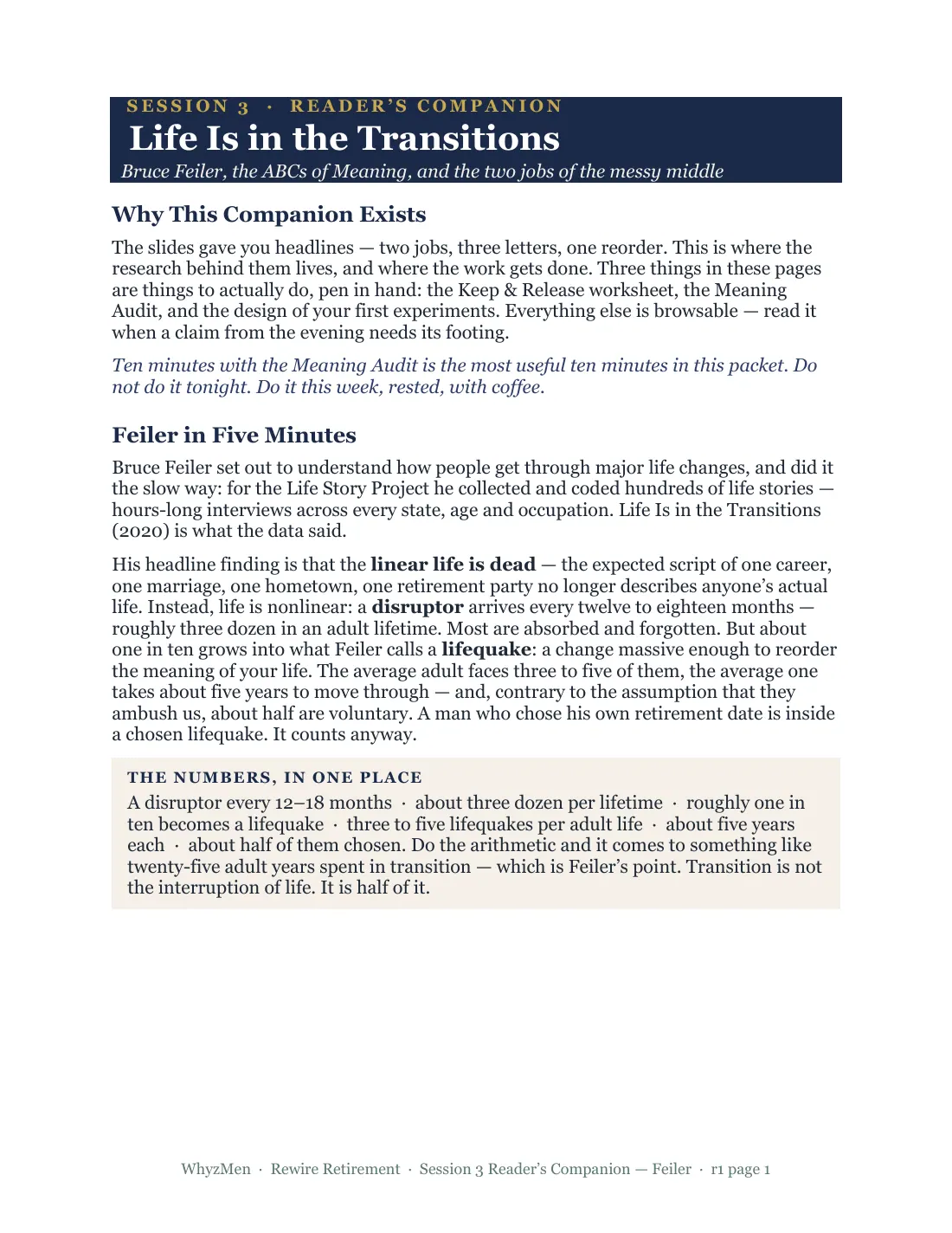
 SESSION 3         ·   READER’S COMPANION

  Life Is in the Transitions
 Bruce Feiler, the ABCs of Meaning, and the two jobs of the messy middle

Why This Companion Exists
The slides gave you headlines — two jobs, three letters, one reorder. This is where the
research behind them lives, and where the work gets done. Three things in these pages
are things to actually do, pen in hand: the Keep & Release worksheet, the Meaning
Audit, and the design of your first experiments. Everything else is browsable — read it
when a claim from the evening needs its footing.
Ten minutes with the Meaning Audit is the most useful ten minutes in this packet. Do
not do it tonight. Do it this week, rested, with coffee.

Feiler in Five Minutes
Bruce Feiler set out to understand how people get through major life changes, and did it
the slow way: for the Life Story Project he collected and coded hundreds of life stories —
hours-long interviews across every state, age and occupation. Life Is in the Transitions
(2020) is what the data said.
His headline finding is that the linear life is dead — the expected script of one career,
one marriage, one hometown, one retirement party no longer describes anyone’s actual
life. Instead, life is nonlinear: a disruptor arrives every twelve to eighteen months —
roughly three dozen in an adult lifetime. Most are absorbed and forgotten. But about
one in ten grows into what Feiler calls a lifequake: a change massive enough to reorder
the meaning of your life. The average adult faces three to five of them, the average one
takes about five years to move through — and, contrary to the assumption that they
ambush us, about half are voluntary. A man who chose his own retirement date is inside
a chosen lifequake. It counts anyway.

 THE N UM BE R S, IN ON E PL A CE
 A disruptor every 12–18 months · about three dozen per lifetime · roughly one in
 ten becomes a lifequake · three to five lifequakes per adult life · about five years
 each · about half of them chosen. Do the arithmetic and it comes to something like
 twenty-five adult years spent in transition — which is Feiler’s point. Transition is not
 the interruption of life. It is half of it.


        WhyzMen · Rewire Retirement · Session 3 Reader’s Companion — Feiler · r1 page 1
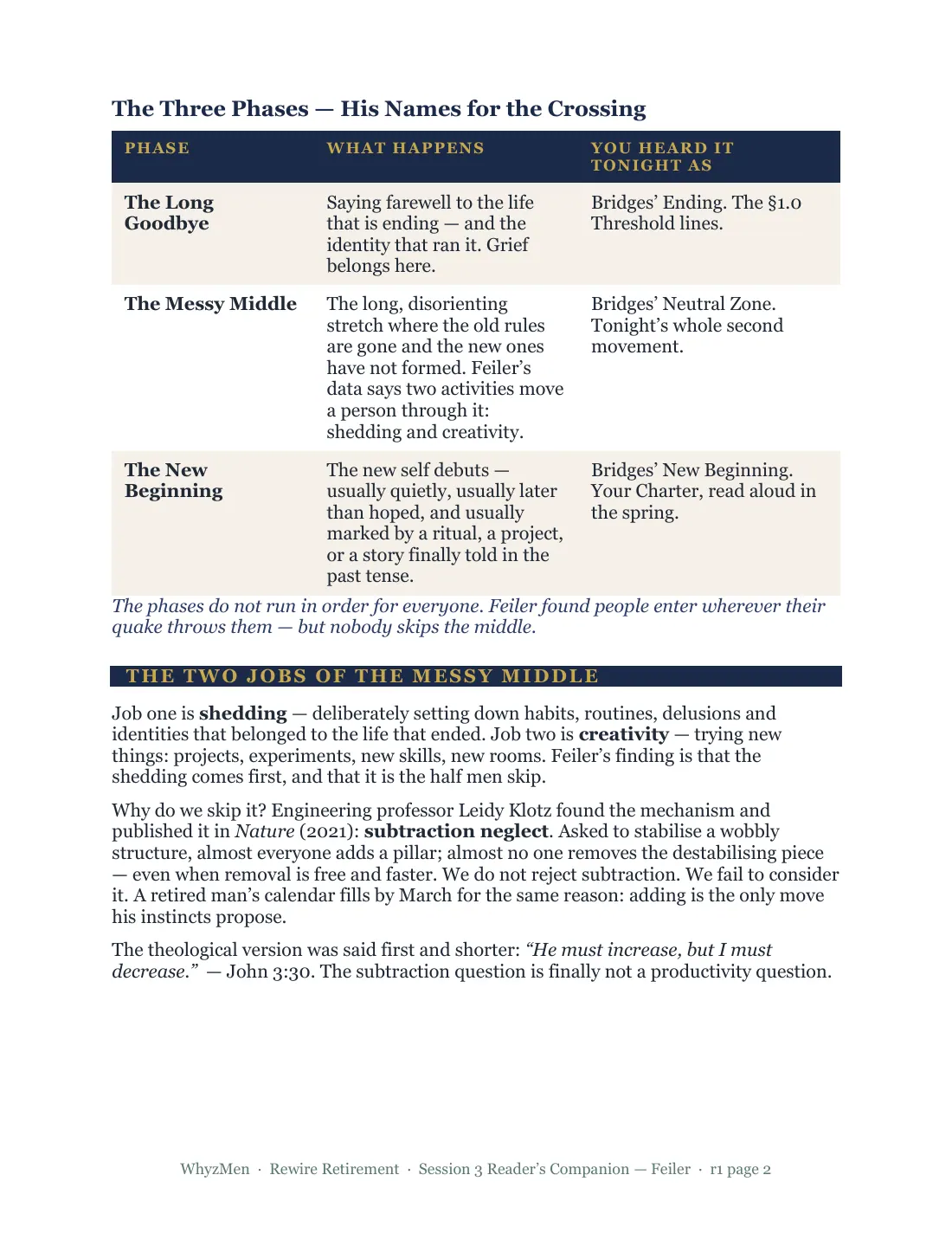
The Three Phases — His Names for the Crossing
 PH AS E                   W HA T H A P PEN S                 YO U HE AR D I T
                                                              TON IG HT A S

 The Long                  Saying farewell to the life        Bridges’ Ending. The §1.0
 Goodbye                   that is ending — and the           Threshold lines.
                           identity that ran it. Grief
                           belongs here.

 The Messy Middle          The long, disorienting             Bridges’ Neutral Zone.
                           stretch where the old rules        Tonight’s whole second
                           are gone and the new ones          movement.
                           have not formed. Feiler’s
                           data says two activities move
                           a person through it:
                           shedding and creativity.

 The New                   The new self debuts —              Bridges’ New Beginning.
 Beginning                 usually quietly, usually later     Your Charter, read aloud in
                           than hoped, and usually            the spring.
                           marked by a ritual, a project,
                           or a story finally told in the
                           past tense.
The phases do not run in order for everyone. Feiler found people enter wherever their
quake throws them — but nobody skips the middle.

 THE TWO JOBS OF THE MESSY MIDDLE
Job one is shedding — deliberately setting down habits, routines, delusions and
identities that belonged to the life that ended. Job two is creativity — trying new
things: projects, experiments, new skills, new rooms. Feiler’s finding is that the
shedding comes first, and that it is the half men skip.
Why do we skip it? Engineering professor Leidy Klotz found the mechanism and
published it in Nature (2021): subtraction neglect. Asked to stabilise a wobbly
structure, almost everyone adds a pillar; almost no one removes the destabilising piece
— even when removal is free and faster. We do not reject subtraction. We fail to consider
it. A retired man’s calendar fills by March for the same reason: adding is the only move
his instincts propose.
The theological version was said first and shorter: “He must increase, but I must
decrease.” — John 3:30. The subtraction question is finally not a productivity question.


        WhyzMen · Rewire Retirement · Session 3 Reader’s Companion — Feiler · r1 page 2
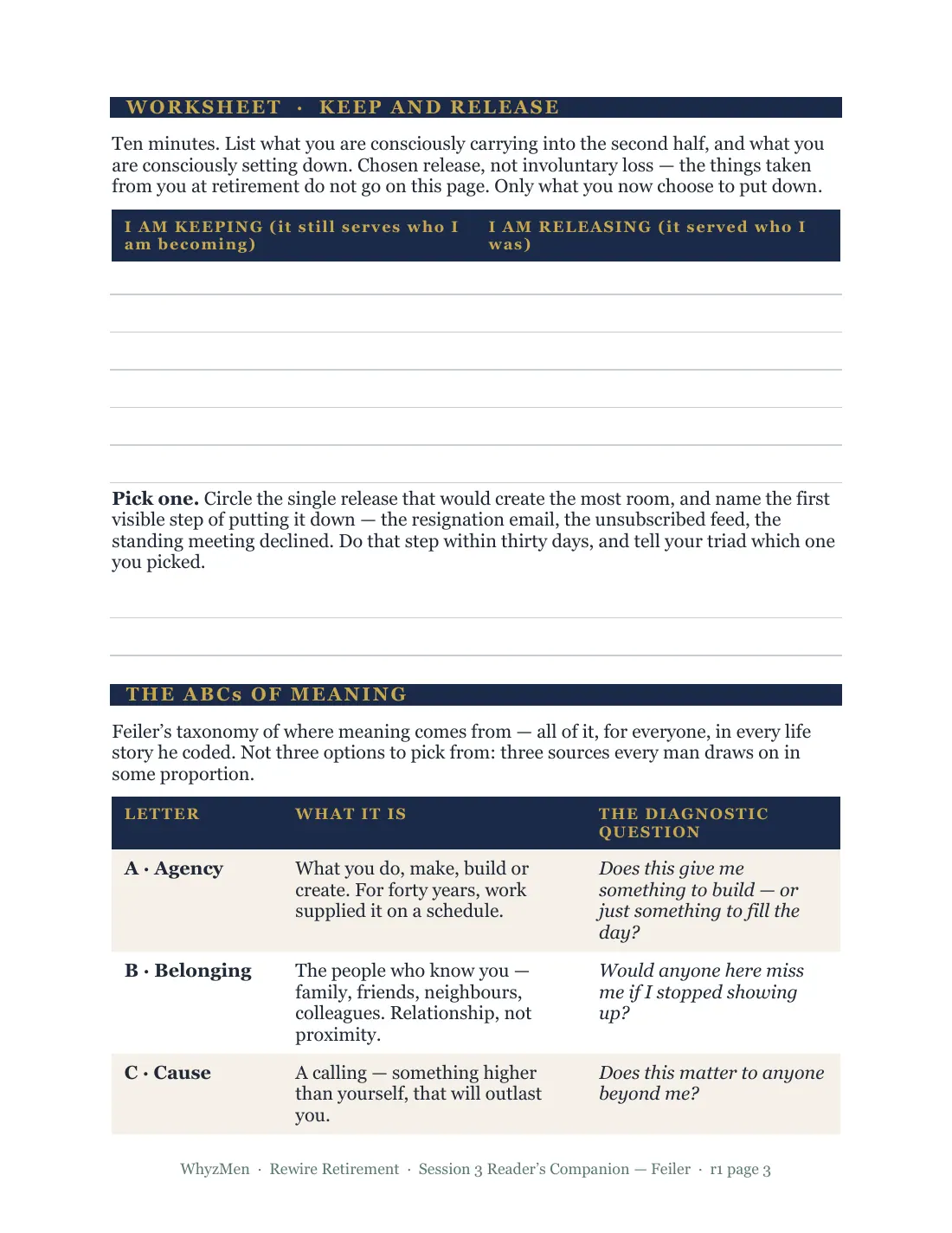
 WORKSHEET · KEEP AND RELEASE
Ten minutes. List what you are consciously carrying into the second half, and what you
are consciously setting down. Chosen release, not involuntary loss — the things taken
from you at retirement do not go on this page. Only what you now choose to put down.

 I AM KE E PIN G ( it s til l s e rv es w ho I   I AM R EL EA SIN G ( i t s e rv e d w ho I
 a m b eco m i ng )                              was )


Pick one. Circle the single release that would create the most room, and name the first
visible step of putting it down — the resignation email, the unsubscribed feed, the
standing meeting declined. Do that step within thirty days, and tell your triad which one
you picked.


 THE ABCs OF MEANING
Feiler’s taxonomy of where meaning comes from — all of it, for everyone, in every life
story he coded. Not three options to pick from: three sources every man draws on in
some proportion.

 LET TE R               W HA T IT IS                           THE DI AGN O STI C
                                                               QU ES TI ON

 A · Agency             What you do, make, build or            Does this give me
                        create. For forty years, work          something to build — or
                        supplied it on a schedule.             just something to fill the
                                                               day?

 B · Belonging          The people who know you —              Would anyone here miss
                        family, friends, neighbours,           me if I stopped showing
                        colleagues. Relationship, not          up?
                        proximity.

 C · Cause              A calling — something higher           Does this matter to anyone
                        than yourself, that will outlast       beyond me?
                        you.

        WhyzMen · Rewire Retirement · Session 3 Reader’s Companion — Feiler · r1 page 3
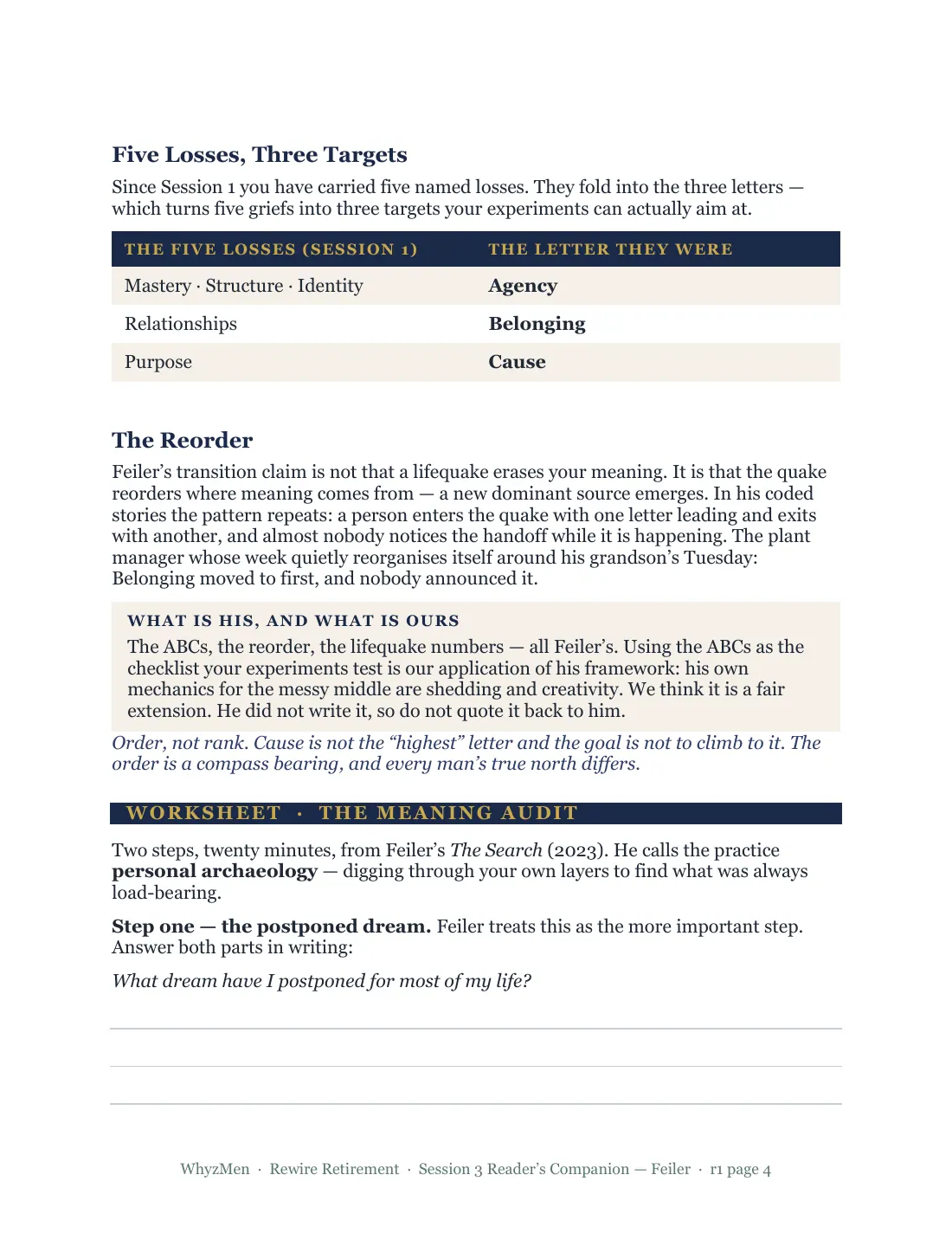
Five Losses, Three Targets
Since Session 1 you have carried five named losses. They fold into the three letters —
which turns five griefs into three targets your experiments can actually aim at.

 THE FI V E LO SS ES ( SES SI ON 1)              THE L ETT E R T HE Y W ER E

 Mastery · Structure · Identity                  Agency

 Relationships                                   Belonging

 Purpose                                         Cause


The Reorder
Feiler’s transition claim is not that a lifequake erases your meaning. It is that the quake
reorders where meaning comes from — a new dominant source emerges. In his coded
stories the pattern repeats: a person enters the quake with one letter leading and exits
with another, and almost nobody notices the handoff while it is happening. The plant
manager whose week quietly reorganises itself around his grandson’s Tuesday:
Belonging moved to first, and nobody announced it.

 W HA T IS HI S, A N D W HA T IS O U RS
 The ABCs, the reorder, the lifequake numbers — all Feiler’s. Using the ABCs as the
 checklist your experiments test is our application of his framework: his own
 mechanics for the messy middle are shedding and creativity. We think it is a fair
 extension. He did not write it, so do not quote it back to him.
Order, not rank. Cause is not the “highest” letter and the goal is not to climb to it. The
order is a compass bearing, and every man’s true north differs.

 WORKSHEET · THE MEANING AUDIT
Two steps, twenty minutes, from Feiler’s The Search (2023). He calls the practice
personal archaeology — digging through your own layers to find what was always
load-bearing.
Step one — the postponed dream. Feiler treats this as the more important step.
Answer both parts in writing:
What dream have I postponed for most of my life?


        WhyzMen · Rewire Retirement · Session 3 Reader’s Companion — Feiler · r1 page 4
If I do not pursue it in this third act, will it still be available later?


The honest answer to the second question is usually no — and that is what moves a
dream out of the someday column.
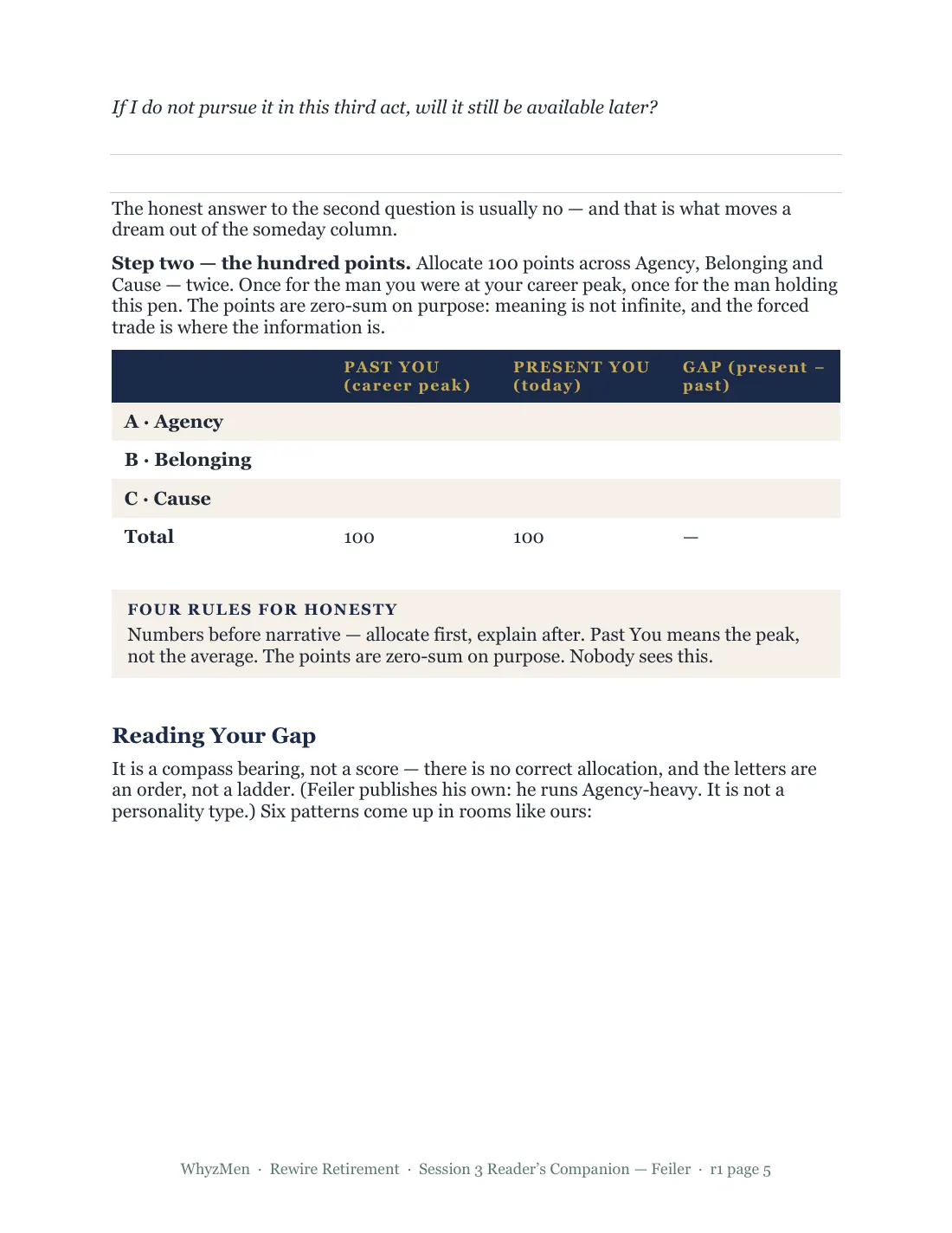
Step two — the hundred points. Allocate 100 points across Agency, Belonging and
Cause — twice. Once for the man you were at your career peak, once for the man holding
this pen. The points are zero-sum on purpose: meaning is not infinite, and the forced
trade is where the information is.

                               PA ST Y OU              P RES ENT Y O U       GA P (p r es e nt −
                               (c a r e er p e a k )   (to d ay )            pas t)

 A · Agency

 B · Belonging

 C · Cause

 Total                         100                     100                   —


  FO U R R UL ES FO R HON ES TY
  Numbers before narrative — allocate first, explain after. Past You means the peak,
  not the average. The points are zero-sum on purpose. Nobody sees this.


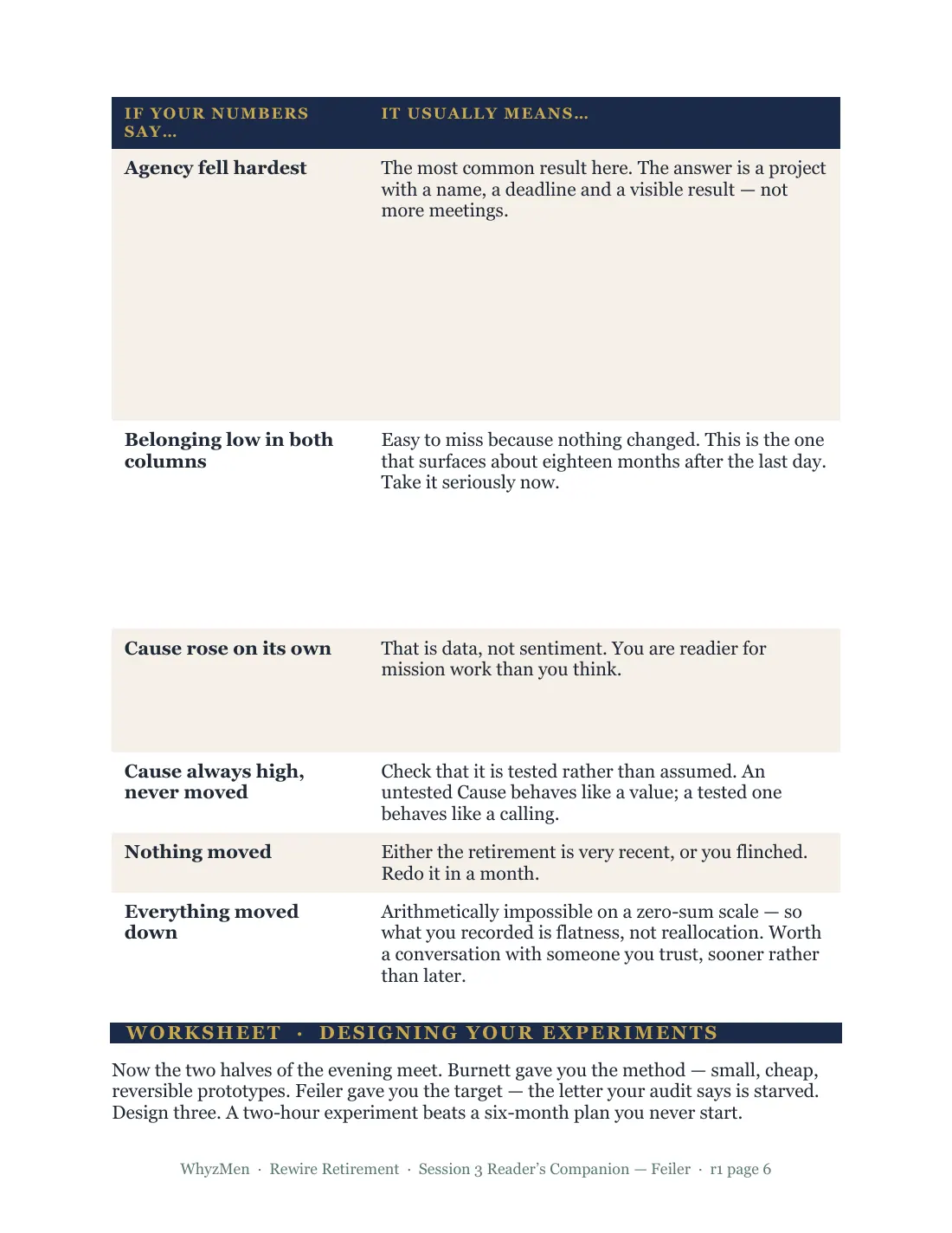
Reading Your Gap
It is a compass bearing, not a score — there is no correct allocation, and the letters are
an order, not a ladder. (Feiler publishes his own: he runs Agency-heavy. It is not a
personality type.) Six patterns come up in rooms like ours:


         WhyzMen · Rewire Retirement · Session 3 Reader’s Companion — Feiler · r1 page 5
 IF YO U R N U MB E RS            IT U SU AL LY M EA N S…
 SAY …

 Agency fell hardest              The most common result here. The answer is a project
                                  with a name, a deadline and a visible result — not
                                  more meetings.


 Belonging low in both            Easy to miss because nothing changed. This is the one
 columns                          that surfaces about eighteen months after the last day.
                                  Take it seriously now.


 Cause rose on its own            That is data, not sentiment. You are readier for
                                  mission work than you think.


 Cause always high,               Check that it is tested rather than assumed. An
 never moved                      untested Cause behaves like a value; a tested one
                                  behaves like a calling.

 Nothing moved                    Either the retirement is very recent, or you flinched.
                                  Redo it in a month.

 Everything moved                 Arithmetically impossible on a zero-sum scale — so
 down                             what you recorded is flatness, not reallocation. Worth
                                  a conversation with someone you trust, sooner rather
                                  than later.


 WORKSHEET · DESIGNING YOUR EXPERIMENTS
Now the two halves of the evening meet. Burnett gave you the method — small, cheap,
reversible prototypes. Feiler gave you the target — the letter your audit says is starved.
Design three. A two-hour experiment beats a six-month plan you never start.

        WhyzMen · Rewire Retirement · Session 3 Reader’s Companion — Feiler · r1 page 6
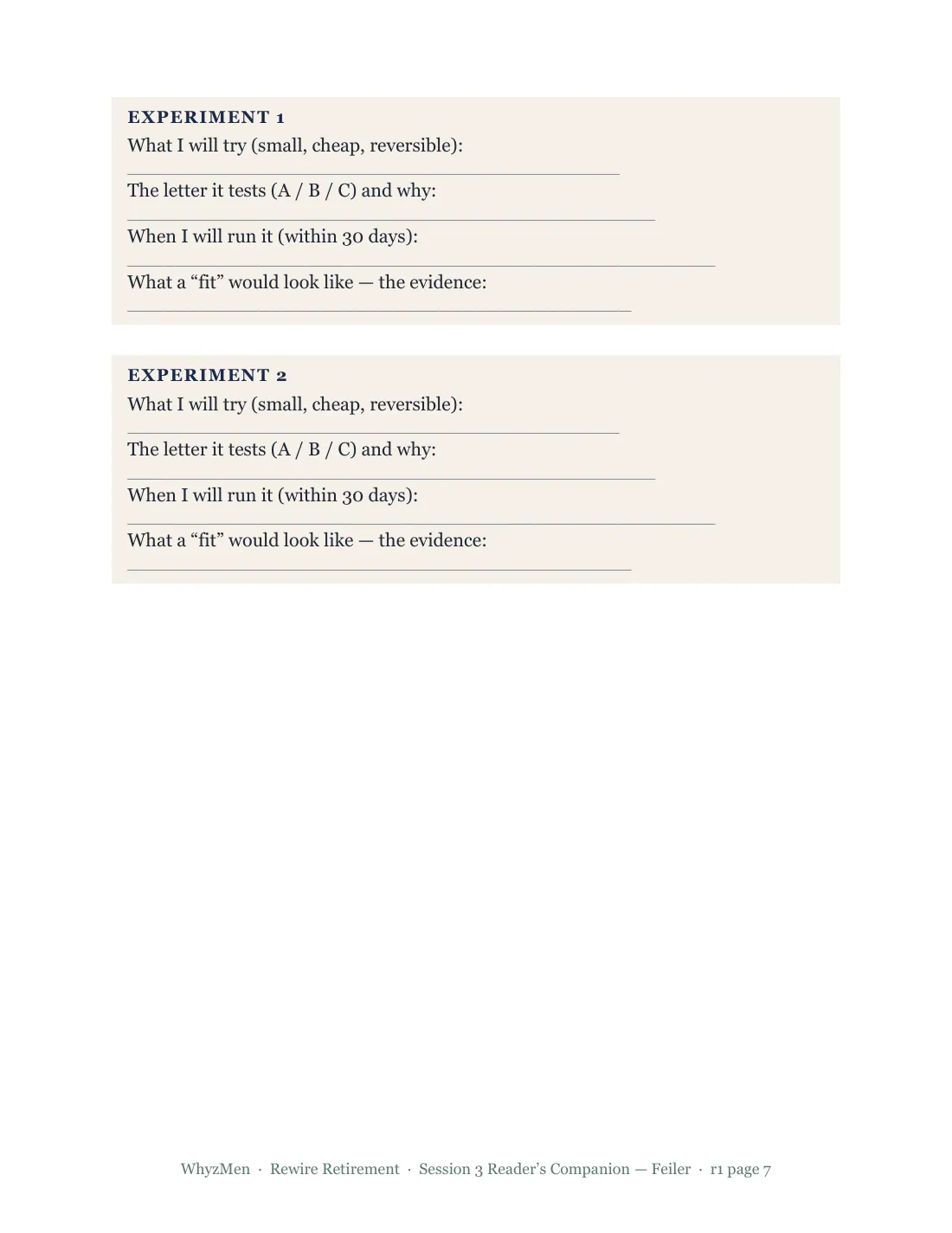
EXPERIMENT 1
What I will try (small, cheap, reversible):
_________________________________________
The letter it tests (A / B / C) and why:
____________________________________________
When I will run it (within 30 days):
_________________________________________________
What a “fit” would look like — the evidence:
__________________________________________


EXPERIMENT 2
What I will try (small, cheap, reversible):
_________________________________________
The letter it tests (A / B / C) and why:
____________________________________________
When I will run it (within 30 days):
_________________________________________________
What a “fit” would look like — the evidence:
__________________________________________


    WhyzMen · Rewire Retirement · Session 3 Reader’s Companion — Feiler · r1 page 7
 EXPERIMENT 3
 What I will try (small, cheap, reversible):
 _________________________________________
 The letter it tests (A / B / C) and why:
 ____________________________________________
 When I will run it (within 30 days):
 _________________________________________________
 What a “fit” would look like — the evidence:
 __________________________________________


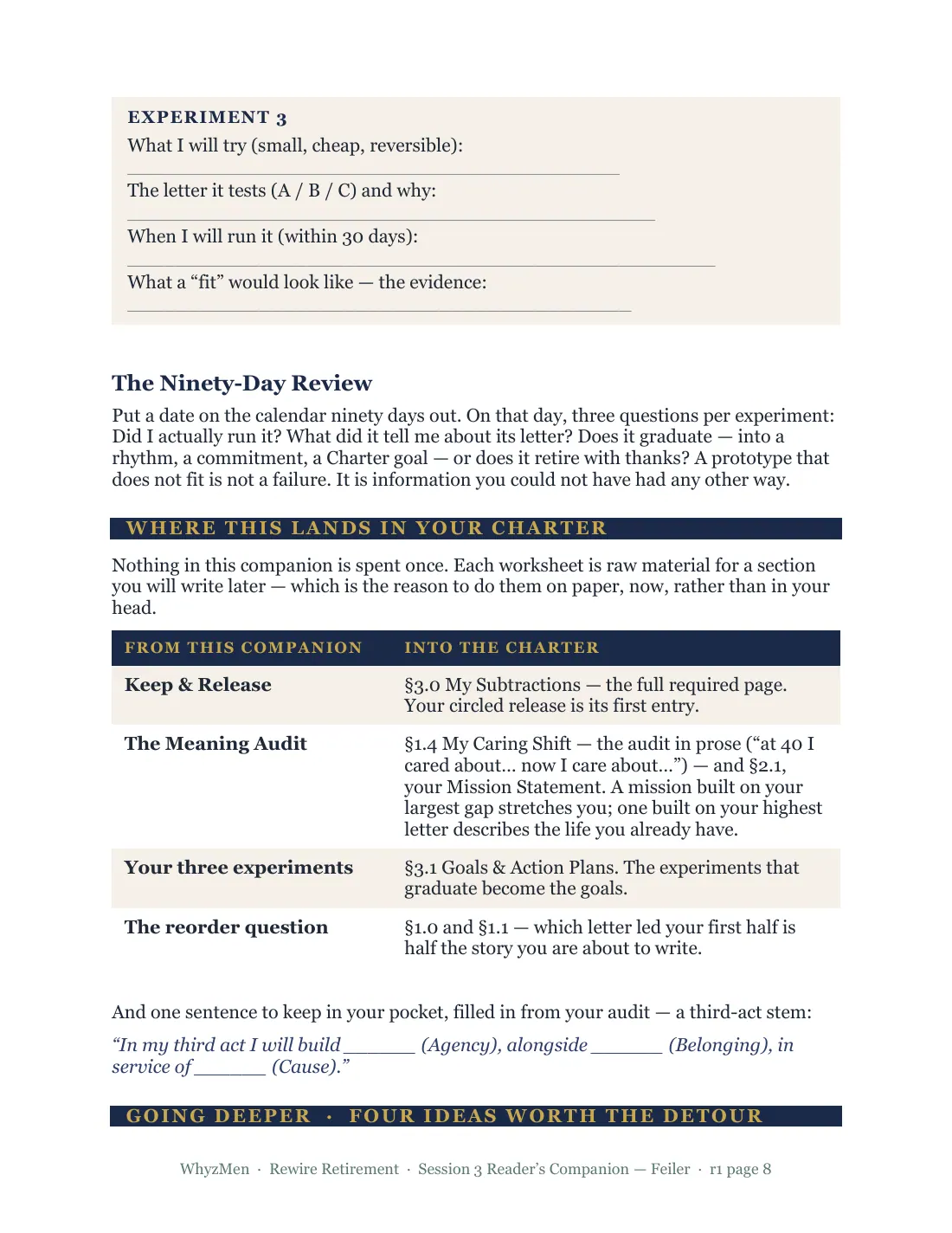
The Ninety-Day Review
Put a date on the calendar ninety days out. On that day, three questions per experiment:
Did I actually run it? What did it tell me about its letter? Does it graduate — into a
rhythm, a commitment, a Charter goal — or does it retire with thanks? A prototype that
does not fit is not a failure. It is information you could not have had any other way.

 WHERE THIS LANDS IN YOUR CHARTER
Nothing in this companion is spent once. Each worksheet is raw material for a section
you will write later — which is the reason to do them on paper, now, rather than in your
head.

 FR OM T HI S C OM P A N IO N        INT O THE CH A RTE R

 Keep & Release                      §3.0 My Subtractions — the full required page.
                                     Your circled release is its first entry.

 The Meaning Audit                   §1.4 My Caring Shift — the audit in prose (“at 40 I
                                     cared about… now I care about…”) — and §2.1,
                                     your Mission Statement. A mission built on your
                                     largest gap stretches you; one built on your highest
                                     letter describes the life you already have.

 Your three experiments              §3.1 Goals & Action Plans. The experiments that
                                     graduate become the goals.

 The reorder question                §1.0 and §1.1 — which letter led your first half is
                                     half the story you are about to write.


And one sentence to keep in your pocket, filled in from your audit — a third-act stem:
“In my third act I will build ______ (Agency), alongside ______ (Belonging), in
service of ______ (Cause).”

 GOING DEEPER · FOUR IDEAS WORTH THE DETOUR

        WhyzMen · Rewire Retirement · Session 3 Reader’s Companion — Feiler · r1 page 8
The Should Train and the Want Train
In The Search, Feiler’s interviews keep surfacing the same fork: a life scripted by
shoulds — inherited expectations about what work and success must look like — versus
one steered by wants. His advice for the third act is blunt: get off the should train. The
first half almost had to run on shoulds; it is the half with tuition bills. The second half
running on them is a choice.

Comforters, Nudgers and Slappers
When Feiler asked people what kind of feedback they wanted mid-transition, three
helper types emerged: comforters (“I love you, you’ve got this”), nudgers (“I love you —
and have you considered…”), and slappers (“I love you. Get up.”). Men in transition
need all three and tend to recruit only comforters. A working triad supplies the other
two on purpose. Know which one you are asking for — and which one you are avoiding.

Happiness Is a Moment; Meaning Is a Story
Feiler’s distinction rhymes with the Brooks slide you saw tonight: happiness is a
present-tense emotion, but meaning connects past, present and future into a single
story. That is why the Three Markers homework and the ABCs are one assignment, not
two — the markers recover the story; the letters name what the story was carrying.

The End of the Linear Career
Feiler’s data dismantles the assumption that work is a ladder climbed once and then left.
People change jobs and directions far more often than the script admits, and the
“career” assembled afterward is a story told in retrospect. The liberating implication for
a retired man: whatever you build next does not have to match, continue, or justify what
came before. Nonlinear is normal. It always was.

 SOURCES AND FURTHER READING
Bruce Feiler, Life Is in the Transitions: Mastering Change at Any Age (Penguin Press,
2020) — the Life Story Project, the lifequake, the ABCs, shedding and creativity.
Bruce Feiler, The Search: Finding Meaningful Work in a Post-Career World (Penguin
Press, 2023) — the Meaning Audit, personal archaeology, the should/want distinction,
the nonlinear career.
Leidy Klotz, Subtract: The Untapped Science of Less (Flatiron, 2021), and Adams,
Converse, Hales & Klotz, “People systematically overlook subtractive changes,” Nature
592 (2021) — subtraction neglect.
William Bridges, Transitions: Making Sense of Life’s Changes (1980; 40th-anniversary
ed. 2019) — endings, the neutral zone, new beginnings.
Bill Burnett & Dave Evans, Designing Your Life (Knopf, 2016) — prototyping a life; the
Odyssey Plans.
Fact-check note for facilitators: “hundreds of life stories” is deliberate — published
counts differ. “About half” of lifequakes voluntary is Feiler’s own phrasing. Both are
the safe things to say aloud.

        WhyzMen · Rewire Retirement · Session 3 Reader’s Companion — Feiler · r1 page 9