
Session 3 · Going Deeper
James Hollis on the Second Half of Life
Show the text version
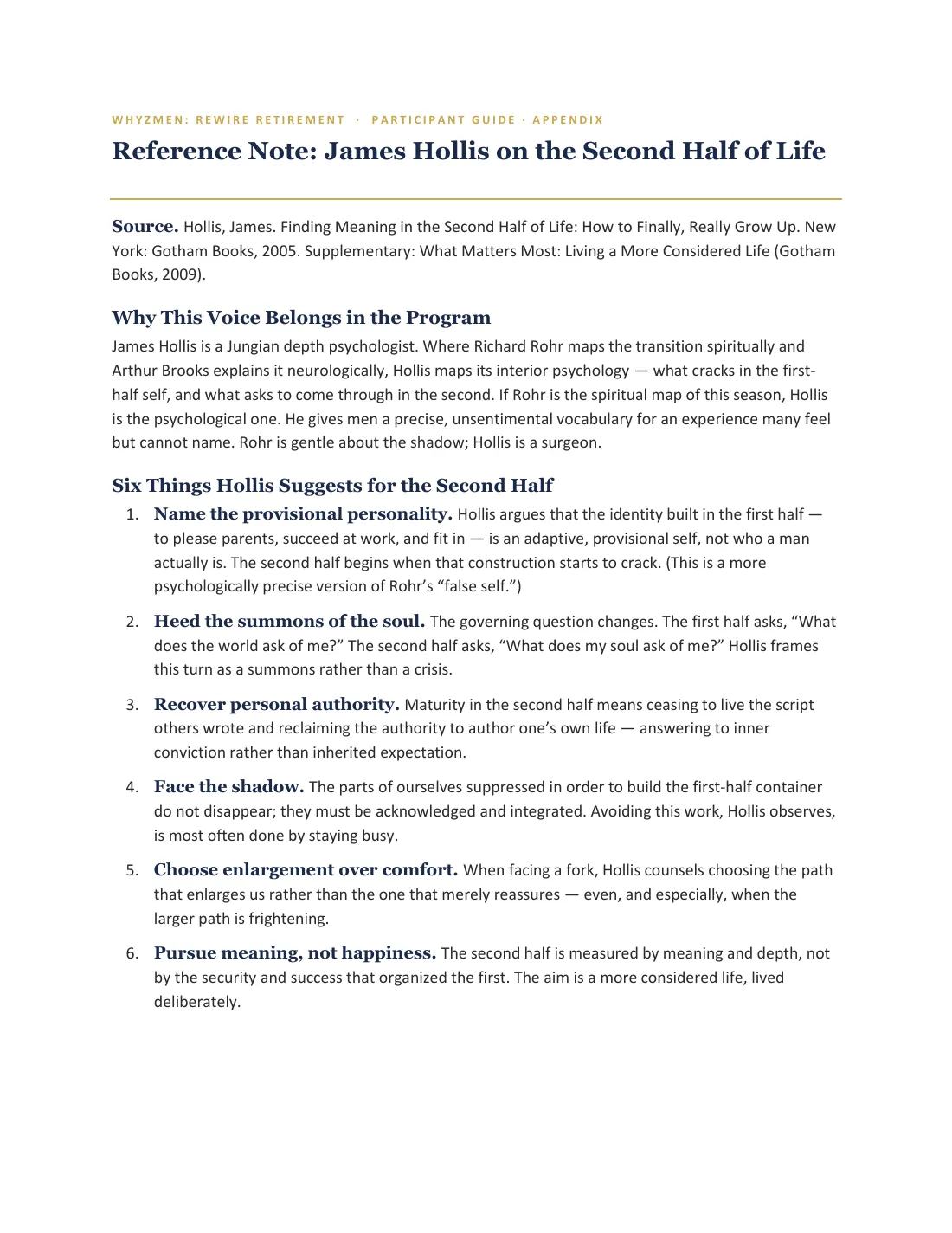
WHYZMEN: REWIRE RETIREMENT · PARTICIPANT GUIDE · APPENDIX

Reference Note: James Hollis on the Second Half of Life

Source. Hollis, James. Finding Meaning in the Second Half of Life: How to Finally, Really Grow Up. New
York: Gotham Books, 2005. Supplementary: What Matters Most: Living a More Considered Life (Gotham
Books, 2009).

Why This Voice Belongs in the Program
James Hollis is a Jungian depth psychologist. Where Richard Rohr maps the transition spiritually and
Arthur Brooks explains it neurologically, Hollis maps its interior psychology — what cracks in the first-
half self, and what asks to come through in the second. If Rohr is the spiritual map of this season, Hollis
is the psychological one. He gives men a precise, unsentimental vocabulary for an experience many feel
but cannot name. Rohr is gentle about the shadow; Hollis is a surgeon.

Six Things Hollis Suggests for the Second Half
  1. Name the provisional personality. Hollis argues that the identity built in the first half —
     to please parents, succeed at work, and fit in — is an adaptive, provisional self, not who a man
     actually is. The second half begins when that construction starts to crack. (This is a more
     psychologically precise version of Rohr’s “false self.”)

  2. Heed the summons of the soul. The governing question changes. The first half asks, “What
     does the world ask of me?” The second half asks, “What does my soul ask of me?” Hollis frames
     this turn as a summons rather than a crisis.

  3. Recover personal authority. Maturity in the second half means ceasing to live the script
     others wrote and reclaiming the authority to author one’s own life — answering to inner
     conviction rather than inherited expectation.

  4. Face the shadow. The parts of ourselves suppressed in order to build the first-half container
     do not disappear; they must be acknowledged and integrated. Avoiding this work, Hollis observes,
     is most often done by staying busy.

  5. Choose enlargement over comfort. When facing a fork, Hollis counsels choosing the path
     that enlarges us rather than the one that merely reassures — even, and especially, when the
     larger path is frightening.

  6. Pursue meaning, not happiness. The second half is measured by meaning and depth, not
     by the security and success that organized the first. The aim is a more considered life, lived
     deliberately.
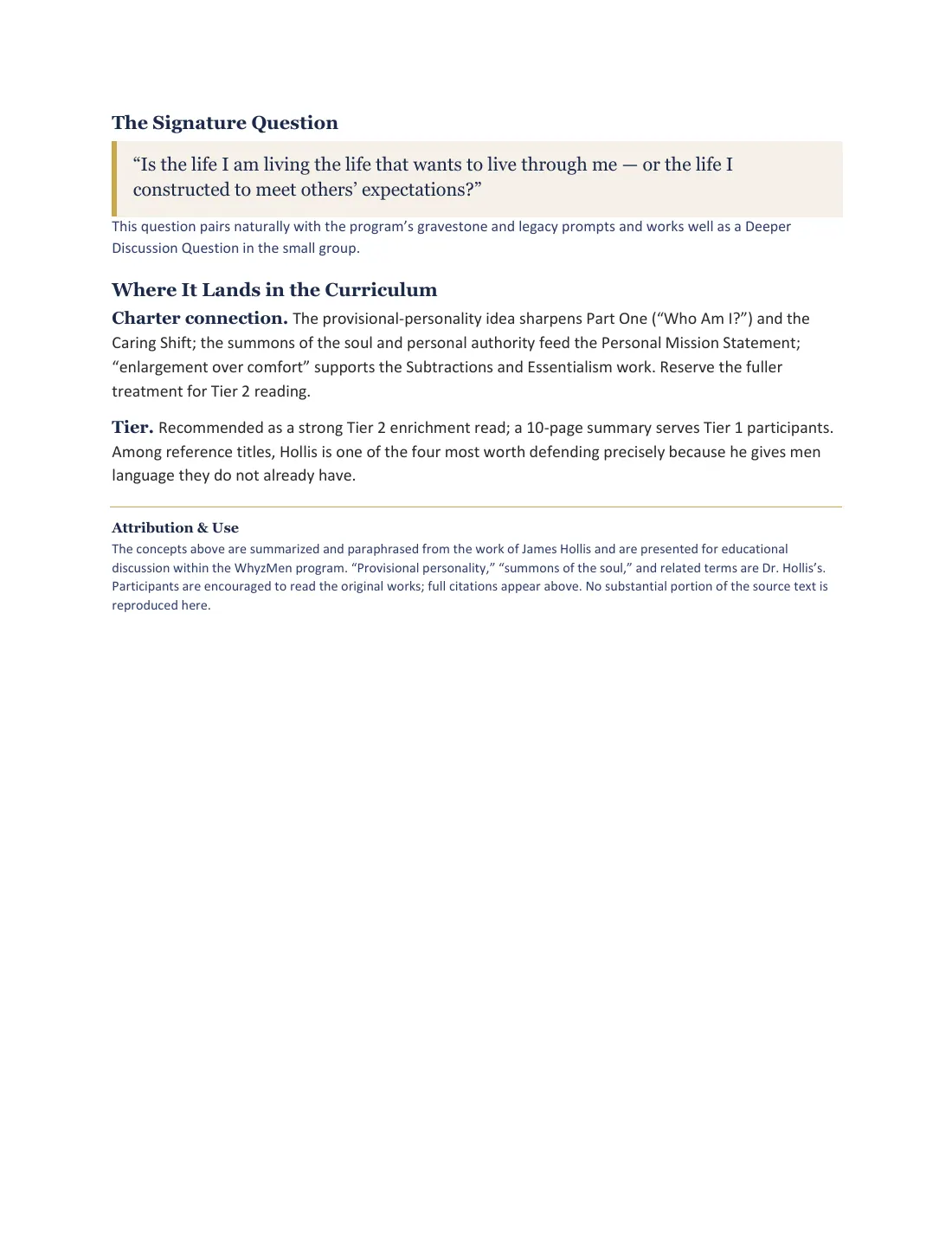
The Signature Question

   “Is the life I am living the life that wants to live through me — or the life I
   constructed to meet others’ expectations?”
This question pairs naturally with the program’s gravestone and legacy prompts and works well as a Deeper
Discussion Question in the small group.

Where It Lands in the Curriculum
Charter connection. The provisional-personality idea sharpens Part One (“Who Am I?”) and the
Caring Shift; the summons of the soul and personal authority feed the Personal Mission Statement;
“enlargement over comfort” supports the Subtractions and Essentialism work. Reserve the fuller
treatment for Tier 2 reading.

Tier. Recommended as a strong Tier 2 enrichment read; a 10-page summary serves Tier 1 participants.
Among reference titles, Hollis is one of the four most worth defending precisely because he gives men
language they do not already have.


Attribution & Use
The concepts above are summarized and paraphrased from the work of James Hollis and are presented for educational
discussion within the WhyzMen program. “Provisional personality,” “summons of the soul,” and related terms are Dr. Hollis’s.
Participants are encouraged to read the original works; full citations appear above. No substantial portion of the source text is
reproduced here.