
Session 4 · Recommended Reading
From Knowing to Doing
Show the text version
REWIRE RETIREMENT                  ·   REFERENCE


From Knowing to Doing
The G.I. Joe Fallacy · A Rule of Life · Atomic Habits

One reference in five short parts. First met in Session 4, built into your Harvest Charter at Session 13,
tended for the rest of the climb. Read it straight through once; after that, open it to the part the week
calls for.

    “Do not merely listen to the word, and so deceive yourselves. Do what
    it says.” — James 1:22


HOW TO USE THIS REFERENCE

 Part                              The question it answers                   Where you meet it

 One · Knowing Is Not Half the     Why don’t I do what I already know?       Session 4; any week a good
 Battle                                                                      intention stalls

 Two · A Rule of Life (Reading     What structure will I choose for this     Session 4 (the marriage Rule) ·
 1)                                season?                                   Session 13 (§3.1c)

 Three · Atomic Habits             How does a practice survive an            Every Practice of the Week ·
 (Reading 2)                       ordinary Tuesday?                         Session 13 (§3.2)

 Four · The Story You Practice     How do my habits connect to my            Sessions 5, 9, 12–15
                                   story, my identity and my Charter?

 Five · Across the Climb           When does this come back?                 Keep it in the notebook


Going Deeper · optional. No one is behind for reading only Part One. The pocket page at the back holds the
whole reference on one side of a sheet.


Wise Men Still Seek, Knowing Their Why’s                     Rewire Retirement · From Knowing to Doing · r1 · 1
PART ONE

Knowing Is Not Half the Battle
The G.I. Joe Fallacy


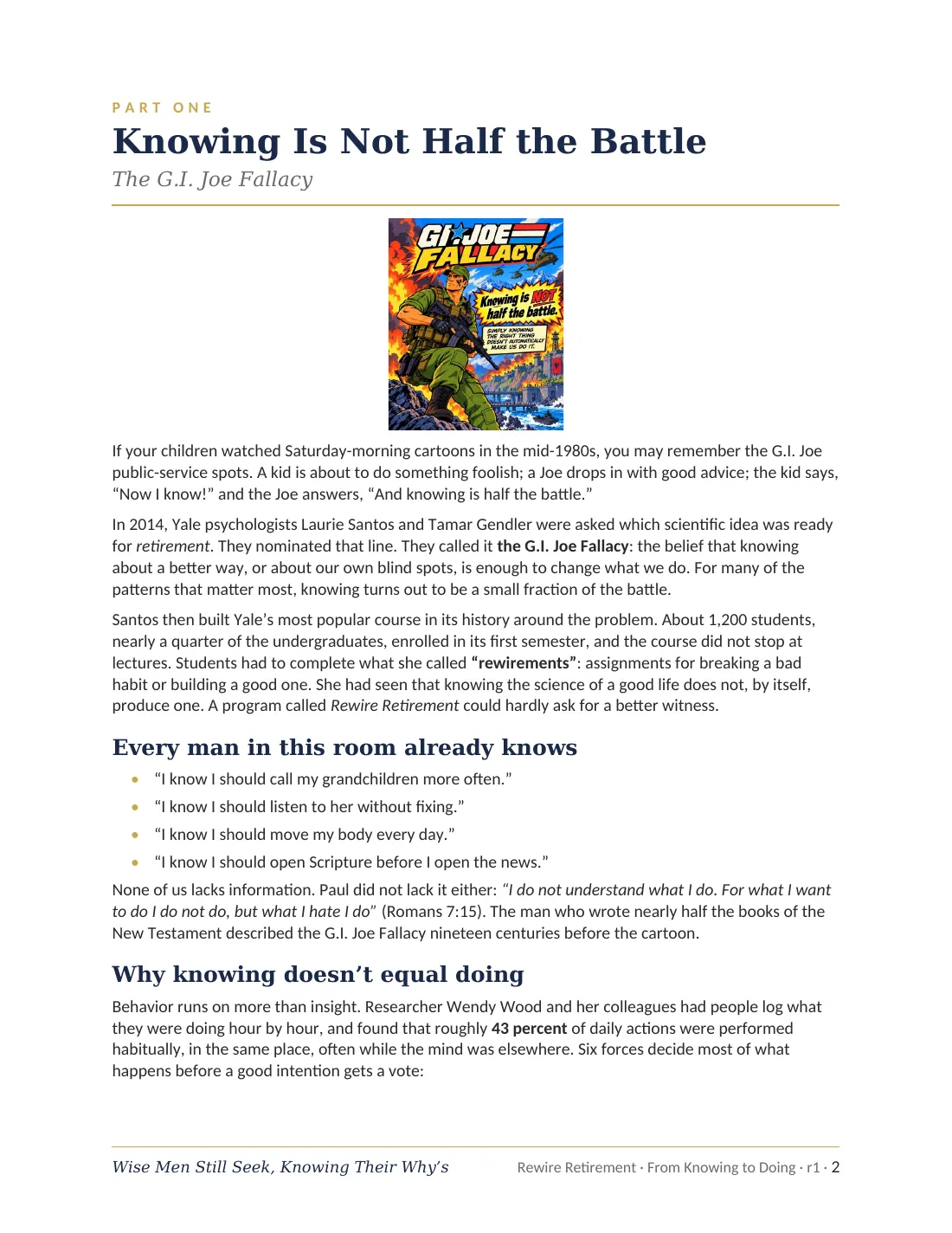
If your children watched Saturday-morning cartoons in the mid-1980s, you may remember the G.I. Joe
public-service spots. A kid is about to do something foolish; a Joe drops in with good advice; the kid says,
“Now I know!” and the Joe answers, “And knowing is half the battle.”
In 2014, Yale psychologists Laurie Santos and Tamar Gendler were asked which scientific idea was ready
for retirement. They nominated that line. They called it the G.I. Joe Fallacy: the belief that knowing
about a better way, or about our own blind spots, is enough to change what we do. For many of the
patterns that matter most, knowing turns out to be a small fraction of the battle.
Santos then built Yale’s most popular course in its history around the problem. About 1,200 students,
nearly a quarter of the undergraduates, enrolled in its first semester, and the course did not stop at
lectures. Students had to complete what she called “rewirements”: assignments for breaking a bad
habit or building a good one. She had seen that knowing the science of a good life does not, by itself,
produce one. A program called Rewire Retirement could hardly ask for a better witness.

Every man in this room already knows
  • “I know I should call my grandchildren more often.”
  • “I know I should listen to her without fixing.”
  • “I know I should move my body every day.”
  • “I know I should open Scripture before I open the news.”
None of us lacks information. Paul did not lack it either: “I do not understand what I do. For what I want
to do I do not do, but what I hate I do” (Romans 7:15). The man who wrote nearly half the books of the
New Testament described the G.I. Joe Fallacy nineteen centuries before the cartoon.

Why knowing doesn’t equal doing
Behavior runs on more than insight. Researcher Wendy Wood and her colleagues had people log what
they were doing hour by hour, and found that roughly 43 percent of daily actions were performed
habitually, in the same place, often while the mind was elsewhere. Six forces decide most of what
happens before a good intention gets a vote:


Wise Men Still Seek, Knowing Their Why’s                    Rewire Retirement · From Knowing to Doing · r1 · 2
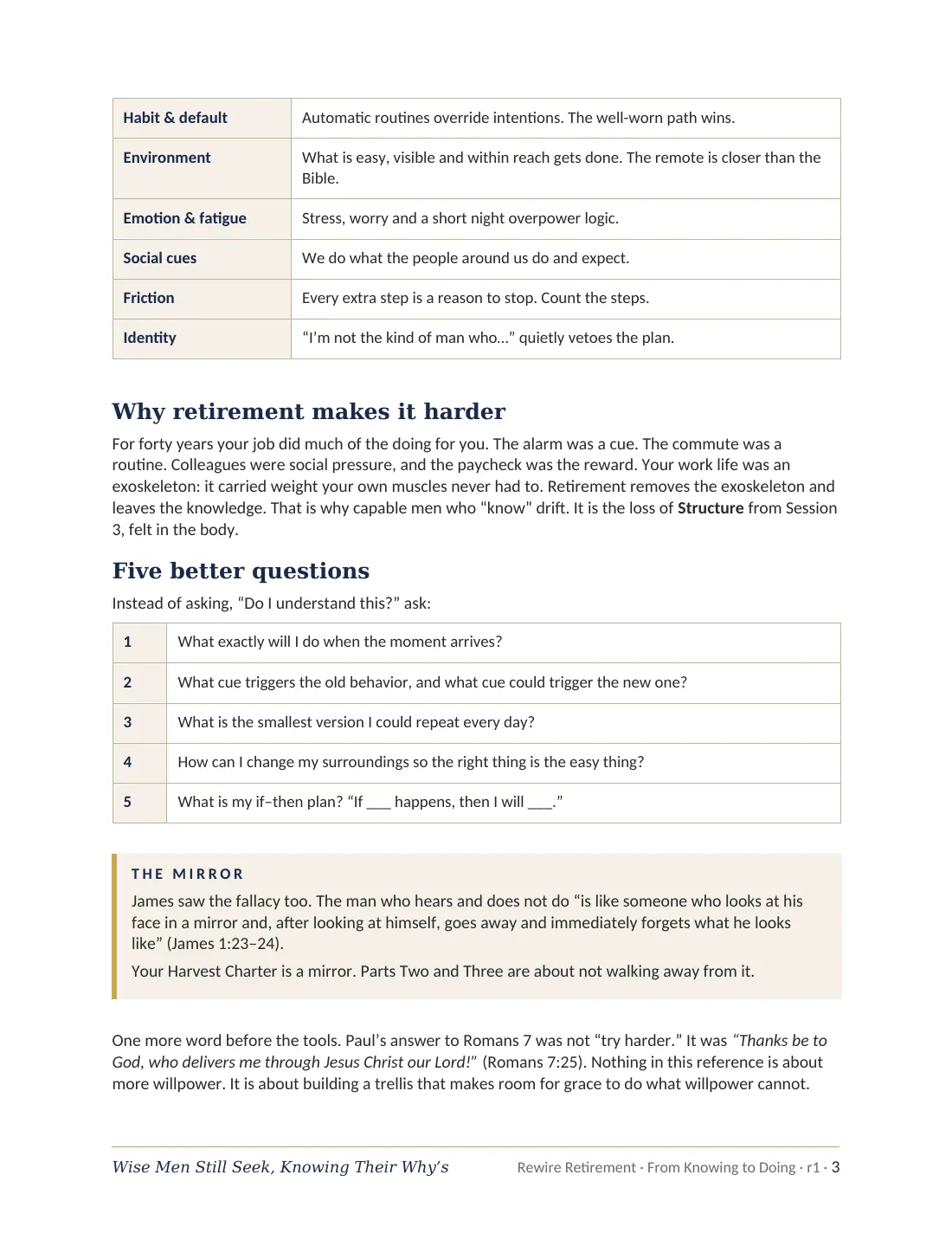
 Habit & default               Automatic routines override intentions. The well-worn path wins.

 Environment                   What is easy, visible and within reach gets done. The remote is closer than the
                               Bible.

 Emotion & fatigue             Stress, worry and a short night overpower logic.

 Social cues                   We do what the people around us do and expect.

 Friction                      Every extra step is a reason to stop. Count the steps.

 Identity                      “I’m not the kind of man who…” quietly vetoes the plan.


Why retirement makes it harder
For forty years your job did much of the doing for you. The alarm was a cue. The commute was a
routine. Colleagues were social pressure, and the paycheck was the reward. Your work life was an
exoskeleton: it carried weight your own muscles never had to. Retirement removes the exoskeleton and
leaves the knowledge. That is why capable men who “know” drift. It is the loss of Structure from Session
3, felt in the body.

Five better questions
Instead of asking, “Do I understand this?” ask:

 1          What exactly will I do when the moment arrives?

 2          What cue triggers the old behavior, and what cue could trigger the new one?

 3          What is the smallest version I could repeat every day?

 4          How can I change my surroundings so the right thing is the easy thing?

 5          What is my if–then plan? “If ___ happens, then I will ___.”


  THE MIRROR
  James saw the fallacy too. The man who hears and does not do “is like someone who looks at his
  face in a mirror and, after looking at himself, goes away and immediately forgets what he looks
  like” (James 1:23–24).
  Your Harvest Charter is a mirror. Parts Two and Three are about not walking away from it.


One more word before the tools. Paul’s answer to Romans 7 was not “try harder.” It was “Thanks be to
God, who delivers me through Jesus Christ our Lord!” (Romans 7:25). Nothing in this reference is about
more willpower. It is about building a trellis that makes room for grace to do what willpower cannot.


Wise Men Still Seek, Knowing Their Why’s                        Rewire Retirement · From Knowing to Doing · r1 · 3
PART TWO          ·   READING 1

A Rule of Life
The trellis, not the cage

You already have a rule
Stephen Macchia, whose Crafting a Rule of Life sits behind this reading, makes a simple observation:
everyone already lives by a rule. It is just unwritten. You wake at a certain time, spend your mornings a
certain way, give your free hours to certain things. For most of the first half, that rule was written by
someone else: an employer, a career ladder, the school calendar of your children.
That first-half rule was provisional, in every sense we named in Session 3: supplied by culture, set by
requirements, organized around providing, temporary by design. Retirement tore it up overnight. So the
question is not whether you will live by a rule in this season. You will. The question is who writes it.

Where the word comes from
“Rule” translates the Latin regula, which first meant a straight stick: the frame a vine is trained to grow
along. In the sixth century, Benedict of Nursia wrote a Rule for his monks of short chapters and plain
sense, and in its closing chapter he called it “a little rule for beginners.” It has guided communities for
nearly 1,500 years. Not a cage. A trellis.
Jesus kept a rule. He went to the synagogue on the Sabbath “as was his custom” (Luke 4:16), and to the
Mount of Olives to pray “as usual” (Luke 22:39). And when the king outlawed prayer, Daniel went home
and “three times a day he got down on his knees and prayed… just as he had done before” (Daniel 6:10).
His rule was already in place when the pressure came. That is what a rule is for: it holds when resolve
would not.

What it is, and what it is not
 It is not                                              It is

 A rigid daily schedule                                 A framework for living on purpose

 A self-improvement project                             A way to align time, energy and values with who
                                                        God made you

 Something you finish                                   Something you practice, and prune

 One more thing on your plate                           Choosing what matters most, on purpose


Wise Men Still Seek, Knowing Their Why’s                        Rewire Retirement · From Knowing to Doing · r1 · 4
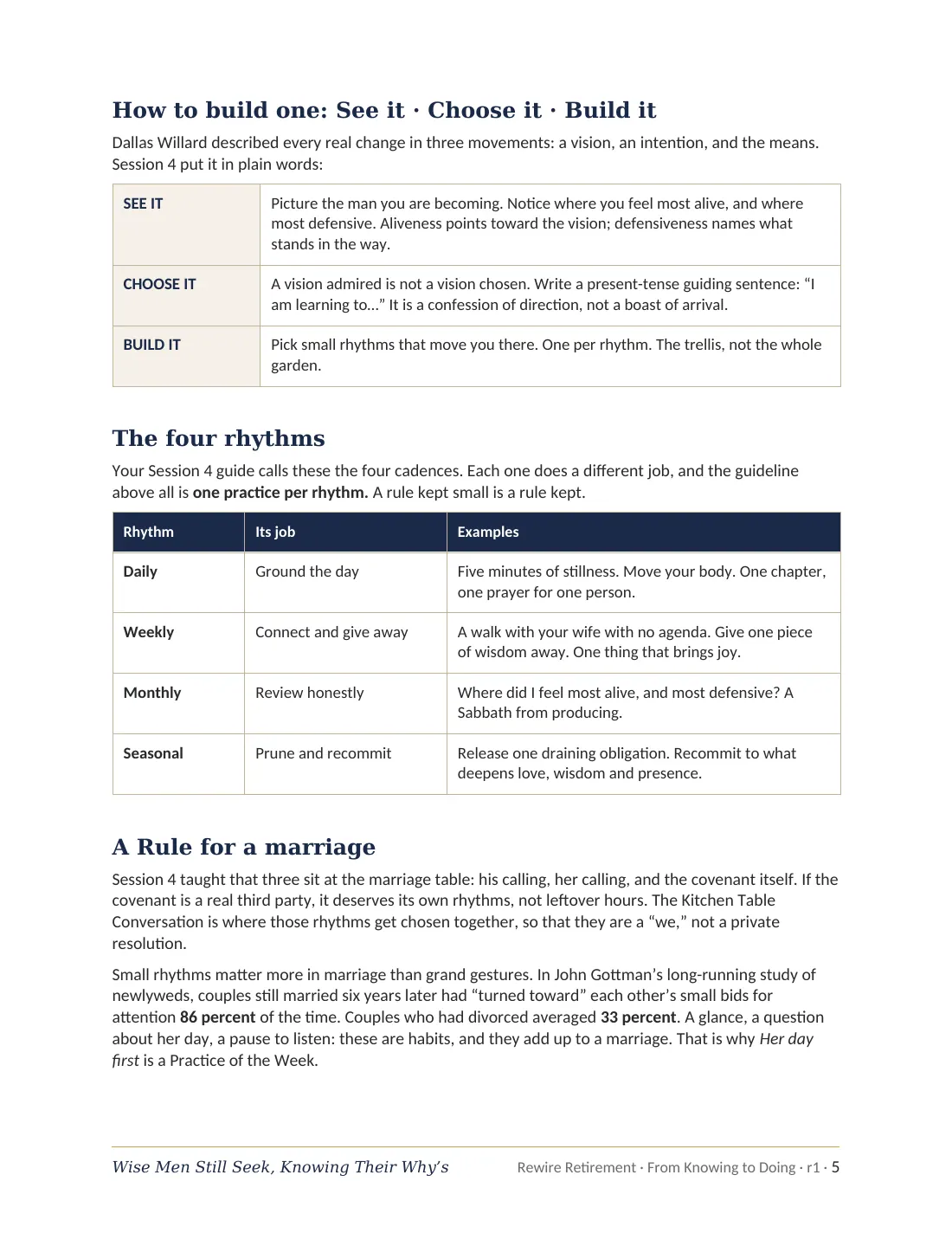
How to build one: See it · Choose it · Build it
Dallas Willard described every real change in three movements: a vision, an intention, and the means.
Session 4 put it in plain words:

 SEE IT                 Picture the man you are becoming. Notice where you feel most alive, and where
                        most defensive. Aliveness points toward the vision; defensiveness names what
                        stands in the way.

 CHOOSE IT              A vision admired is not a vision chosen. Write a present-tense guiding sentence: “I
                        am learning to…” It is a confession of direction, not a boast of arrival.

 BUILD IT               Pick small rhythms that move you there. One per rhythm. The trellis, not the whole
                        garden.


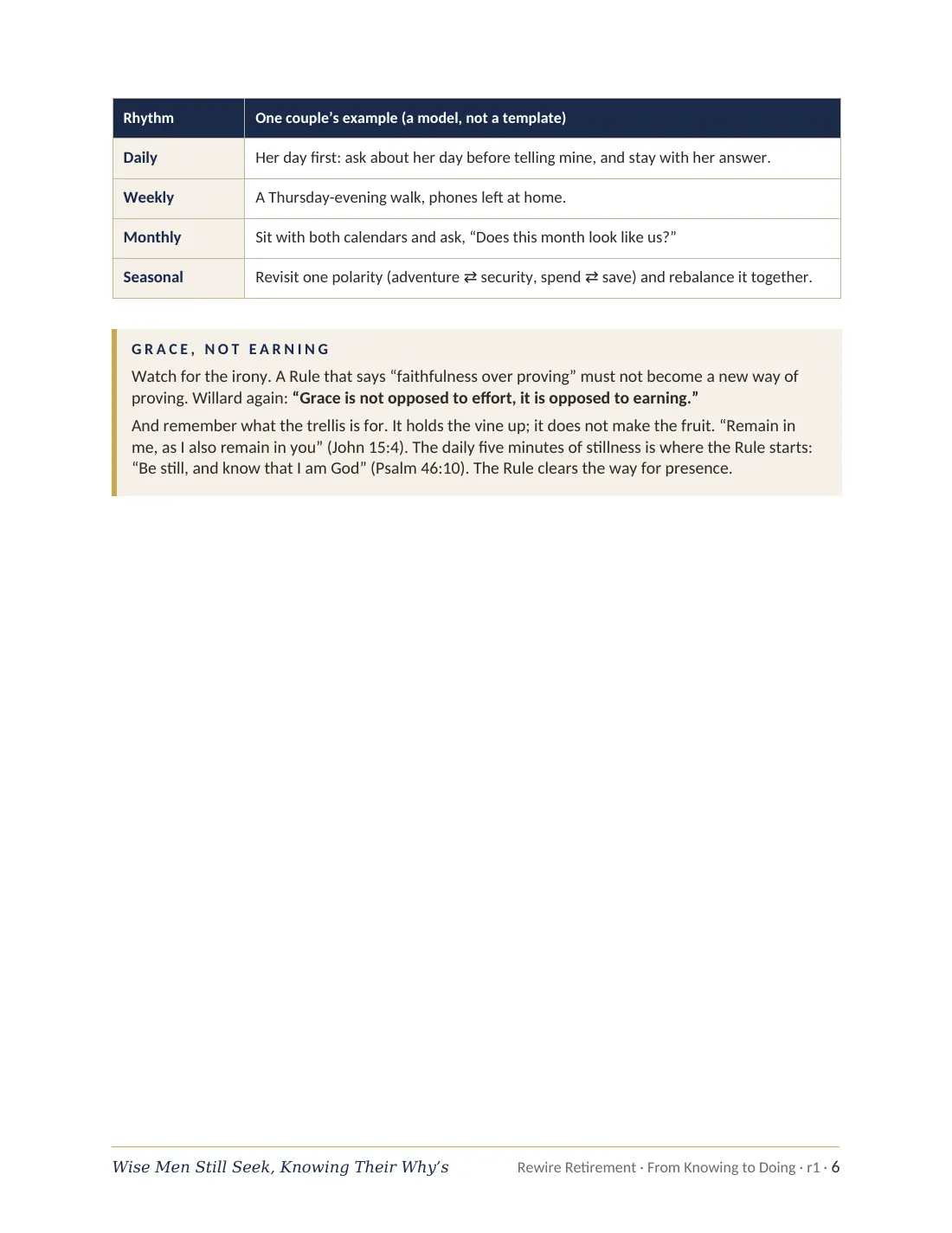
The four rhythms
Your Session 4 guide calls these the four cadences. Each one does a different job, and the guideline
above all is one practice per rhythm. A rule kept small is a rule kept.

 Rhythm               Its job                        Examples

 Daily                Ground the day                 Five minutes of stillness. Move your body. One chapter,
                                                     one prayer for one person.

 Weekly               Connect and give away          A walk with your wife with no agenda. Give one piece
                                                     of wisdom away. One thing that brings joy.

 Monthly              Review honestly                Where did I feel most alive, and most defensive? A
                                                     Sabbath from producing.

 Seasonal             Prune and recommit             Release one draining obligation. Recommit to what
                                                     deepens love, wisdom and presence.


A Rule for a marriage
Session 4 taught that three sit at the marriage table: his calling, her calling, and the covenant itself. If the
covenant is a real third party, it deserves its own rhythms, not leftover hours. The Kitchen Table
Conversation is where those rhythms get chosen together, so that they are a “we,” not a private
resolution.
Small rhythms matter more in marriage than grand gestures. In John Gottman’s long-running study of
newlyweds, couples still married six years later had “turned toward” each other’s small bids for
attention 86 percent of the time. Couples who had divorced averaged 33 percent. A glance, a question
about her day, a pause to listen: these are habits, and they add up to a marriage. That is why Her day
first is a Practice of the Week.


Wise Men Still Seek, Knowing Their Why’s                      Rewire Retirement · From Knowing to Doing · r1 · 5
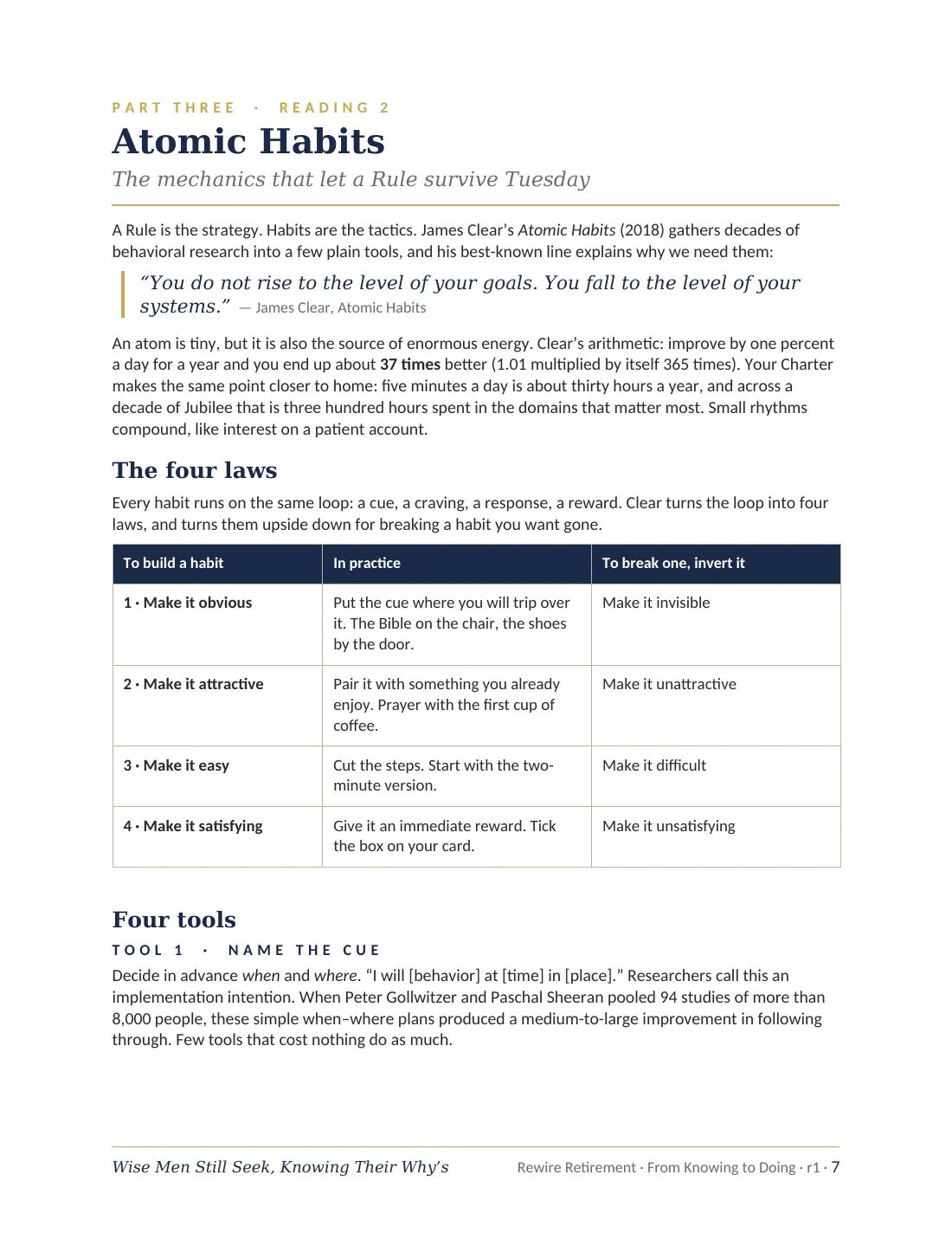
 Rhythm             One couple’s example (a model, not a template)

 Daily              Her day first: ask about her day before telling mine, and stay with her answer.

 Weekly             A Thursday-evening walk, phones left at home.

 Monthly            Sit with both calendars and ask, “Does this month look like us?”

 Seasonal           Revisit one polarity (adventure ⇄ security, spend ⇄ save) and rebalance it together.


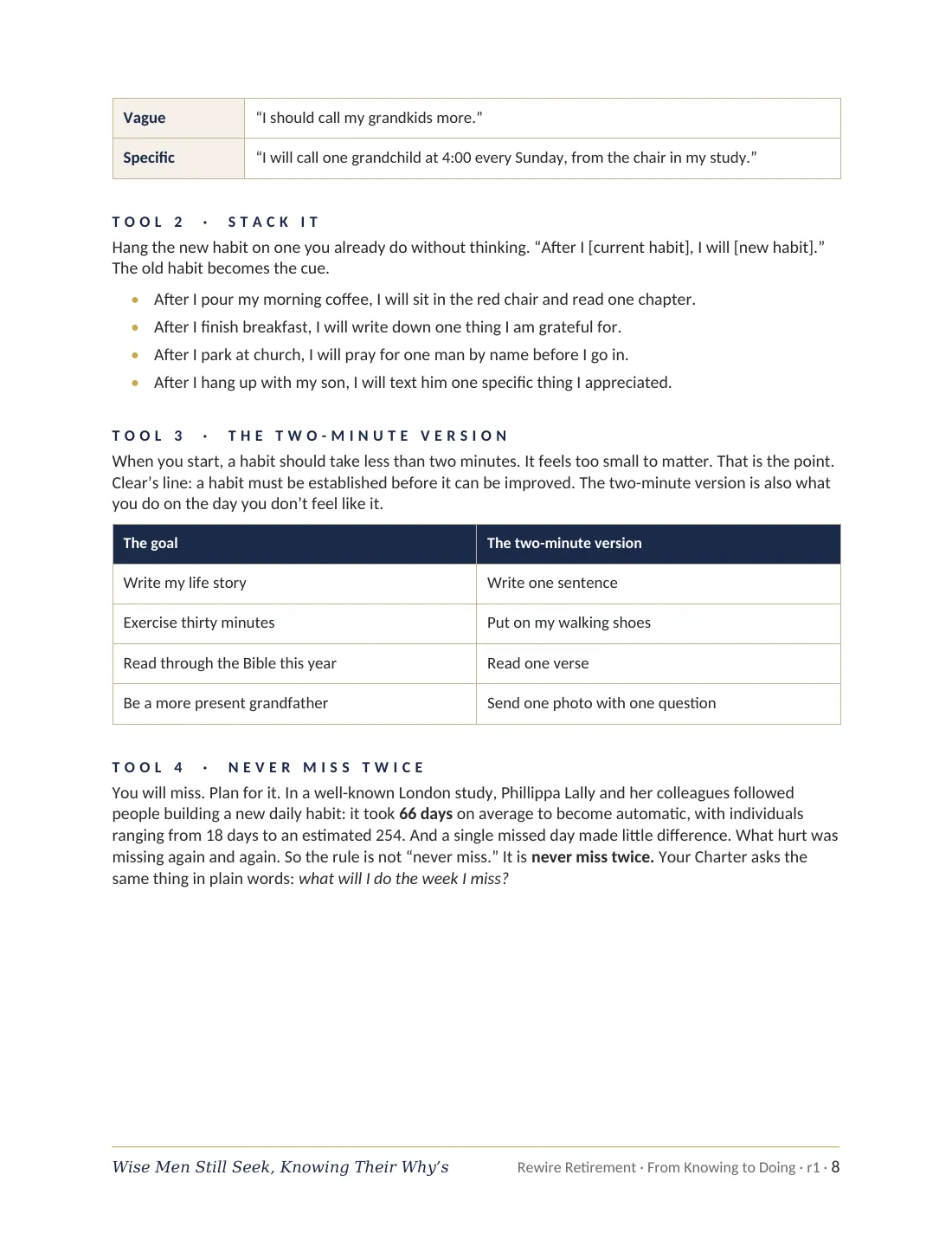
  GRACE, NOT EARNING
  Watch for the irony. A Rule that says “faithfulness over proving” must not become a new way of
  proving. Willard again: “Grace is not opposed to effort, it is opposed to earning.”
  And remember what the trellis is for. It holds the vine up; it does not make the fruit. “Remain in
  me, as I also remain in you” (John 15:4). The daily five minutes of stillness is where the Rule starts:
  “Be still, and know that I am God” (Psalm 46:10). The Rule clears the way for presence.


Wise Men Still Seek, Knowing Their Why’s                    Rewire Retirement · From Knowing to Doing · r1 · 6
PART THREE             ·   READING 2

Atomic Habits
The mechanics that let a Rule survive Tuesday

A Rule is the strategy. Habits are the tactics. James Clear’s Atomic Habits (2018) gathers decades of
behavioral research into a few plain tools, and his best-known line explains why we need them:
    “You do not rise to the level of your goals. You fall to the level of your
    systems.” — James Clear, Atomic Habits
An atom is tiny, but it is also the source of enormous energy. Clear’s arithmetic: improve by one percent
a day for a year and you end up about 37 times better (1.01 multiplied by itself 365 times). Your Charter
makes the same point closer to home: five minutes a day is about thirty hours a year, and across a
decade of Jubilee that is three hundred hours spent in the domains that matter most. Small rhythms
compound, like interest on a patient account.

The four laws
Every habit runs on the same loop: a cue, a craving, a response, a reward. Clear turns the loop into four
laws, and turns them upside down for breaking a habit you want gone.

 To build a habit               In practice                              To break one, invert it

 1 · Make it obvious            Put the cue where you will trip over     Make it invisible
                                it. The Bible on the chair, the shoes
                                by the door.

 2 · Make it attractive         Pair it with something you already       Make it unattractive
                                enjoy. Prayer with the first cup of
                                coffee.

 3 · Make it easy               Cut the steps. Start with the two-       Make it difficult
                                minute version.

 4 · Make it satisfying         Give it an immediate reward. Tick        Make it unsatisfying
                                the box on your card.


Four tools
TOOL 1       ·      NAME THE CUE
Decide in advance when and where. “I will [behavior] at [time] in [place].” Researchers call this an
implementation intention. When Peter Gollwitzer and Paschal Sheeran pooled 94 studies of more than
8,000 people, these simple when–where plans produced a medium-to-large improvement in following
through. Few tools that cost nothing do as much.


Wise Men Still Seek, Knowing Their Why’s                    Rewire Retirement · From Knowing to Doing · r1 · 7
 Vague                 “I should call my grandkids more.”

 Specific              “I will call one grandchild at 4:00 every Sunday, from the chair in my study.”


TOOL 2       ·   STACK IT
Hang the new habit on one you already do without thinking. “After I [current habit], I will [new habit].”
The old habit becomes the cue.
  • After I pour my morning coffee, I will sit in the red chair and read one chapter.
  • After I finish breakfast, I will write down one thing I am grateful for.
  • After I park at church, I will pray for one man by name before I go in.
  • After I hang up with my son, I will text him one specific thing I appreciated.


TOOL 3       ·   THE TWO-MINUTE VERSION
When you start, a habit should take less than two minutes. It feels too small to matter. That is the point.
Clear’s line: a habit must be established before it can be improved. The two-minute version is also what
you do on the day you don’t feel like it.

 The goal                                                   The two-minute version

 Write my life story                                        Write one sentence

 Exercise thirty minutes                                    Put on my walking shoes

 Read through the Bible this year                           Read one verse

 Be a more present grandfather                              Send one photo with one question


TOOL 4       ·   NEVER MISS TWICE
You will miss. Plan for it. In a well-known London study, Phillippa Lally and her colleagues followed
people building a new daily habit: it took 66 days on average to become automatic, with individuals
ranging from 18 days to an estimated 254. And a single missed day made little difference. What hurt was
missing again and again. So the rule is not “never miss.” It is never miss twice. Your Charter asks the
same thing in plain words: what will I do the week I miss?


Wise Men Still Seek, Knowing Their Why’s                        Rewire Retirement · From Knowing to Doing · r1 · 8
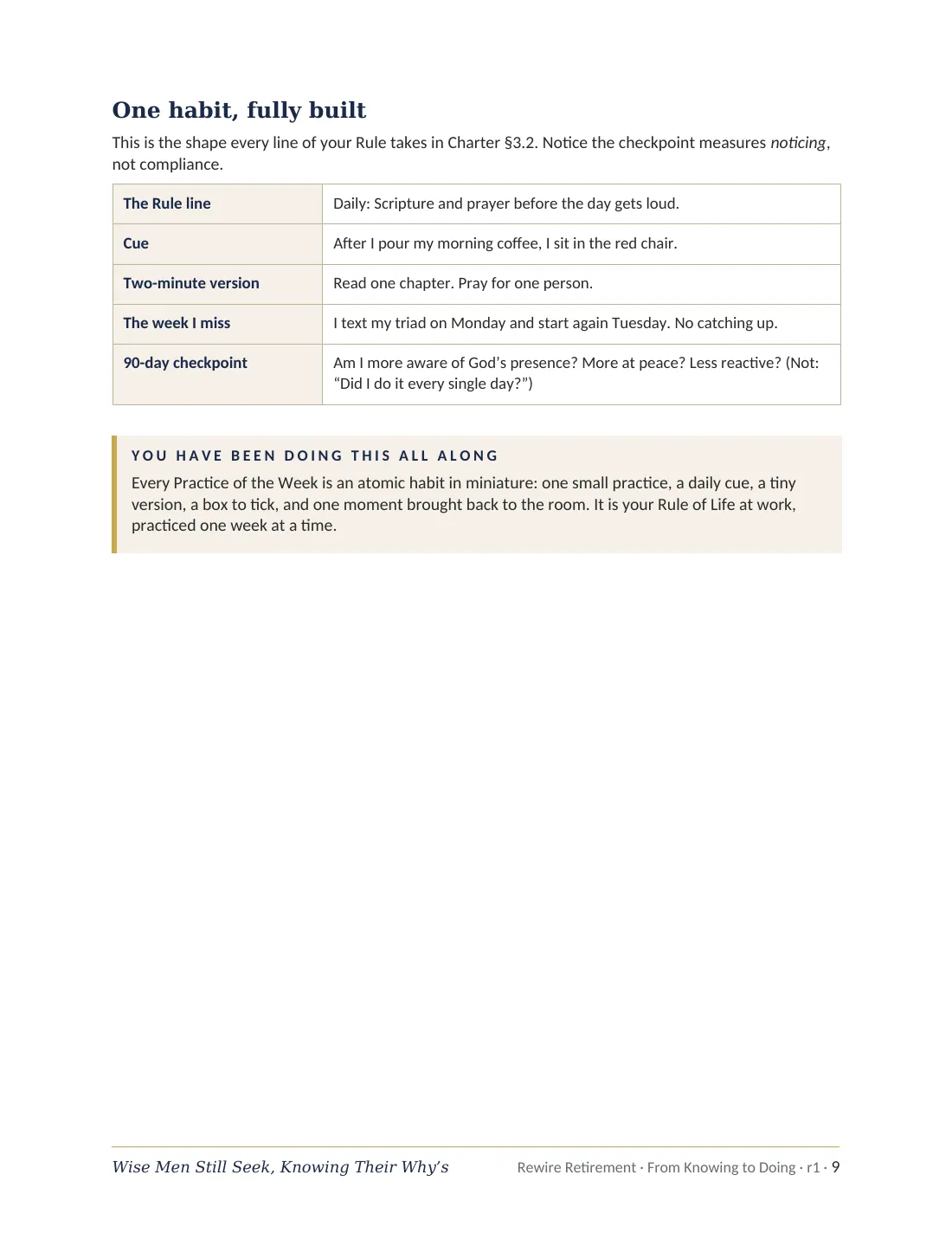
One habit, fully built
This is the shape every line of your Rule takes in Charter §3.2. Notice the checkpoint measures noticing,
not compliance.

 The Rule line                  Daily: Scripture and prayer before the day gets loud.

 Cue                            After I pour my morning coffee, I sit in the red chair.

 Two-minute version             Read one chapter. Pray for one person.

 The week I miss                I text my triad on Monday and start again Tuesday. No catching up.

 90-day checkpoint              Am I more aware of God’s presence? More at peace? Less reactive? (Not:
                                “Did I do it every single day?”)


  YOU HAVE BEEN DOING THIS ALL ALONG
  Every Practice of the Week is an atomic habit in miniature: one small practice, a daily cue, a tiny
  version, a box to tick, and one moment brought back to the room. It is your Rule of Life at work,
  practiced one week at a time.


Wise Men Still Seek, Knowing Their Why’s                     Rewire Retirement · From Knowing to Doing · r1 · 9
PART FOUR

The Story You Practice
Habits, identity, and the Harvest Charter

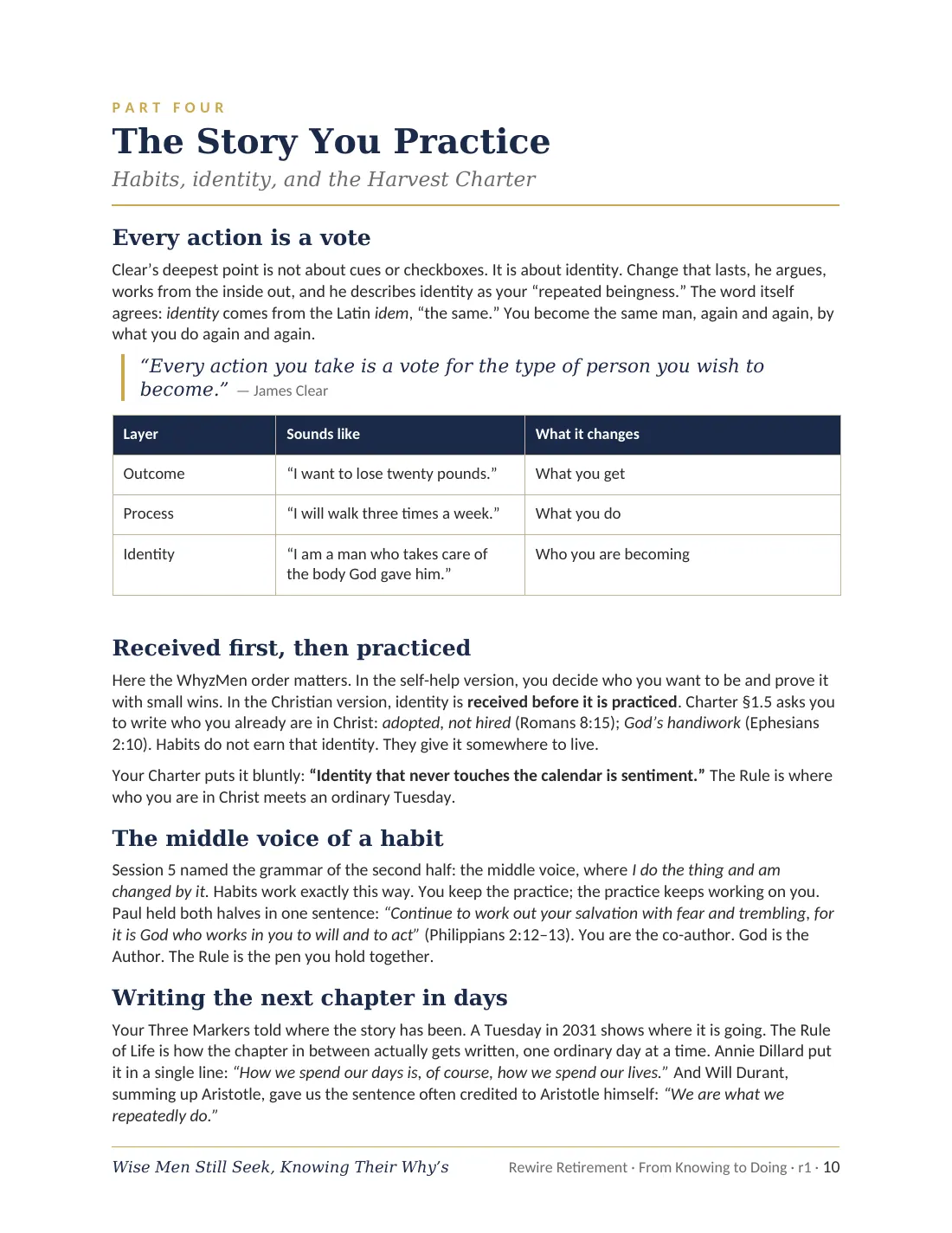
Every action is a vote
Clear’s deepest point is not about cues or checkboxes. It is about identity. Change that lasts, he argues,
works from the inside out, and he describes identity as your “repeated beingness.” The word itself
agrees: identity comes from the Latin idem, “the same.” You become the same man, again and again, by
what you do again and again.
    “Every action you take is a vote for the type of person you wish to
    become.” — James Clear

 Layer                    Sounds like                             What it changes

 Outcome                  “I want to lose twenty pounds.”         What you get

 Process                  “I will walk three times a week.”       What you do

 Identity                 “I am a man who takes care of           Who you are becoming
                          the body God gave him.”


Received first, then practiced
Here the WhyzMen order matters. In the self-help version, you decide who you want to be and prove it
with small wins. In the Christian version, identity is received before it is practiced. Charter §1.5 asks you
to write who you already are in Christ: adopted, not hired (Romans 8:15); God’s handiwork (Ephesians
2:10). Habits do not earn that identity. They give it somewhere to live.
Your Charter puts it bluntly: “Identity that never touches the calendar is sentiment.” The Rule is where
who you are in Christ meets an ordinary Tuesday.

The middle voice of a habit
Session 5 named the grammar of the second half: the middle voice, where I do the thing and am
changed by it. Habits work exactly this way. You keep the practice; the practice keeps working on you.
Paul held both halves in one sentence: “Continue to work out your salvation with fear and trembling, for
it is God who works in you to will and to act” (Philippians 2:12–13). You are the co-author. God is the
Author. The Rule is the pen you hold together.

Writing the next chapter in days
Your Three Markers told where the story has been. A Tuesday in 2031 shows where it is going. The Rule
of Life is how the chapter in between actually gets written, one ordinary day at a time. Annie Dillard put
it in a single line: “How we spend our days is, of course, how we spend our lives.” And Will Durant,
summing up Aristotle, gave us the sentence often credited to Aristotle himself: “We are what we
repeatedly do.”


Wise Men Still Seek, Knowing Their Why’s                      Rewire Retirement · From Knowing to Doing · r1 · 10
So a useful question to ask of any practice is the lens from Session 3: is this provisional, or true? First-
half habits were often provisions: worn because the role required them. A second-half Rule is chosen
from the true self, so it can outlast every role.

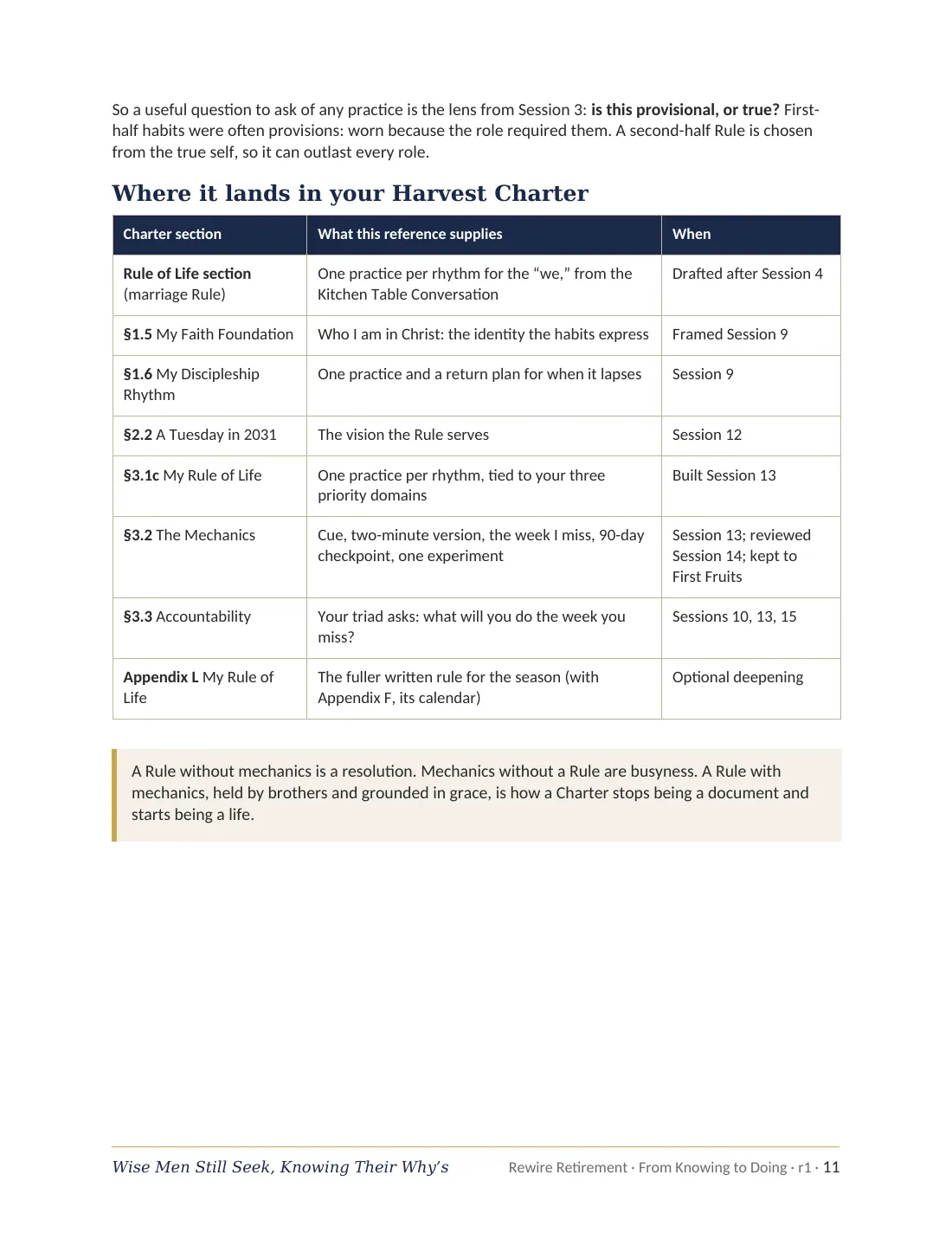
Where it lands in your Harvest Charter
 Charter section               What this reference supplies                            When

 Rule of Life section          One practice per rhythm for the “we,” from the          Drafted after Session 4
 (marriage Rule)               Kitchen Table Conversation

 §1.5 My Faith Foundation      Who I am in Christ: the identity the habits express     Framed Session 9

 §1.6 My Discipleship          One practice and a return plan for when it lapses       Session 9
 Rhythm

 §2.2 A Tuesday in 2031        The vision the Rule serves                              Session 12

 §3.1c My Rule of Life         One practice per rhythm, tied to your three             Built Session 13
                               priority domains

 §3.2 The Mechanics            Cue, two-minute version, the week I miss, 90-day        Session 13; reviewed
                               checkpoint, one experiment                              Session 14; kept to
                                                                                       First Fruits

 §3.3 Accountability           Your triad asks: what will you do the week you          Sessions 10, 13, 15
                               miss?

 Appendix L My Rule of         The fuller written rule for the season (with            Optional deepening
 Life                          Appendix F, its calendar)


  A Rule without mechanics is a resolution. Mechanics without a Rule are busyness. A Rule with
  mechanics, held by brothers and grounded in grace, is how a Charter stops being a document and
  starts being a life.


Wise Men Still Seek, Knowing Their Why’s                      Rewire Retirement · From Knowing to Doing · r1 · 11
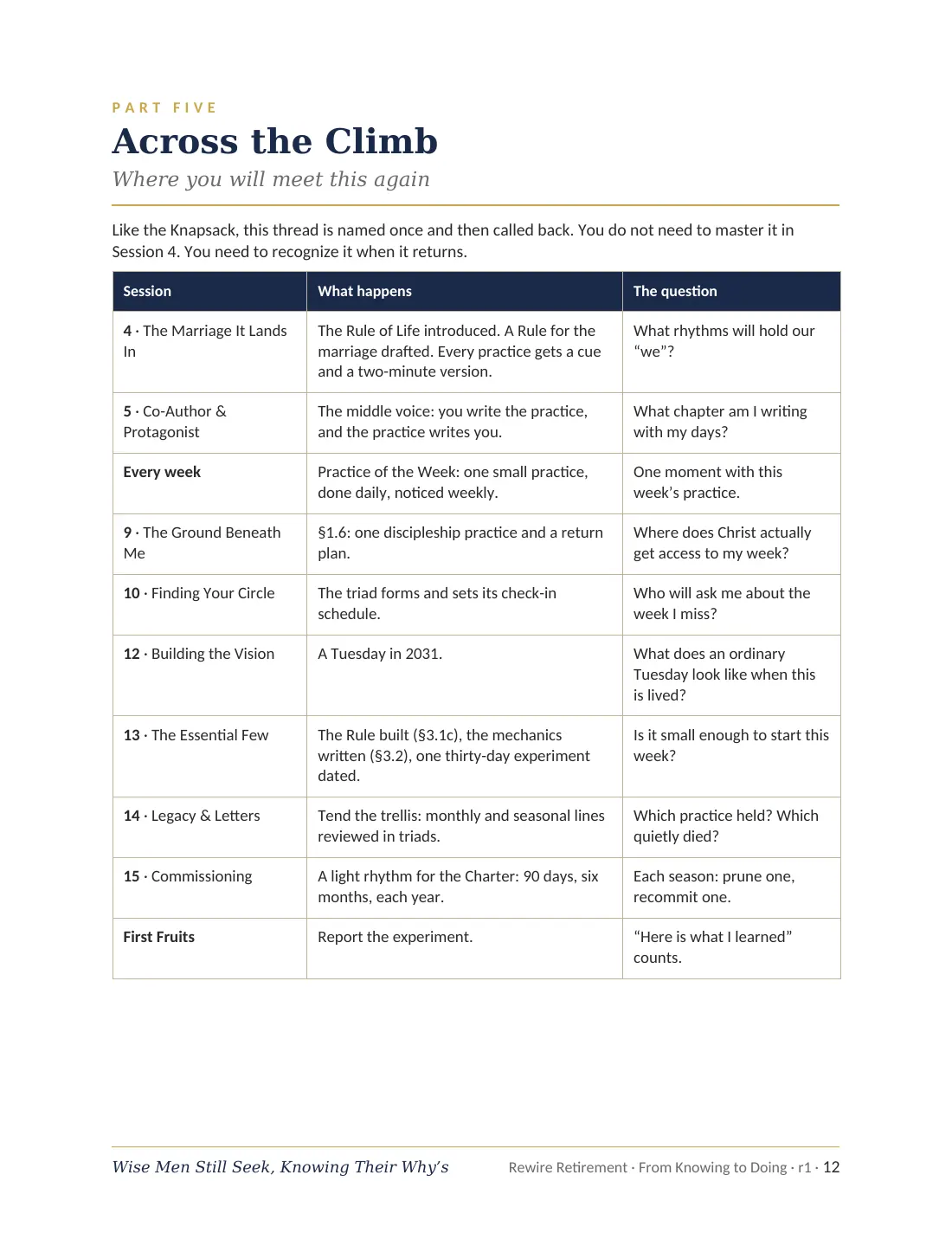
PART FIVE

Across the Climb
Where you will meet this again

Like the Knapsack, this thread is named once and then called back. You do not need to master it in
Session 4. You need to recognize it when it returns.

 Session                     What happens                                    The question

 4 · The Marriage It Lands   The Rule of Life introduced. A Rule for the     What rhythms will hold our
 In                          marriage drafted. Every practice gets a cue     “we”?
                             and a two-minute version.

 5 · Co-Author &             The middle voice: you write the practice,       What chapter am I writing
 Protagonist                 and the practice writes you.                    with my days?

 Every week                  Practice of the Week: one small practice,       One moment with this
                             done daily, noticed weekly.                     week’s practice.

 9 · The Ground Beneath      §1.6: one discipleship practice and a return    Where does Christ actually
 Me                          plan.                                           get access to my week?

 10 · Finding Your Circle    The triad forms and sets its check-in           Who will ask me about the
                             schedule.                                       week I miss?

 12 · Building the Vision    A Tuesday in 2031.                              What does an ordinary
                                                                             Tuesday look like when this
                                                                             is lived?

 13 · The Essential Few      The Rule built (§3.1c), the mechanics           Is it small enough to start this
                             written (§3.2), one thirty-day experiment       week?
                             dated.

 14 · Legacy & Letters       Tend the trellis: monthly and seasonal lines    Which practice held? Which
                             reviewed in triads.                             quietly died?

 15 · Commissioning          A light rhythm for the Charter: 90 days, six    Each season: prune one,
                             months, each year.                              recommit one.

 First Fruits                Report the experiment.                          “Here is what I learned”
                                                                             counts.


Wise Men Still Seek, Knowing Their Why’s                  Rewire Retirement · From Knowing to Doing · r1 · 12
Going Deeper · optional
  • James Clear, Atomic Habits (Avery, 2018). The source of Part Three; chapters 1–2 alone are worth
    the book.
  • Stephen A. Macchia, Crafting a Rule of Life (InterVarsity Press, 2012). The guided version of Part
    Two.
  • The Rule of St. Benedict (sixth century). Short, humane, and still in print.
  • Dallas Willard, Renovation of the Heart (NavPress, 2002). Vision, intention, means.
  • John Mark Comer, Practicing the Way (WaterBrook, 2024). A rule of life for ordinary disciples.
  • Wendy Wood, Good Habits, Bad Habits (2019). The research on how much of life runs on
    autopilot.
  • Laurie Santos & Tamar Gendler, “Knowing Is Half the Battle,” Edge.org (2014); Ariella Kristal &
    Laurie Santos, “G.I. Joe Phenomena,” Harvard Business School Working Paper 21-084 (2021).
  • Phillippa Lally et al., “How are habits formed,” European Journal of Social Psychology (2010); Peter
    Gollwitzer & Paschal Sheeran, “Implementation Intentions and Goal Achievement” (2006).
  • Annie Dillard, The Writing Life (1989) · Will Durant, The Story of Philosophy (1926).


Wise Men Still Seek, Knowing Their Why’s                  Rewire Retirement · From Knowing to Doing · r1 · 13
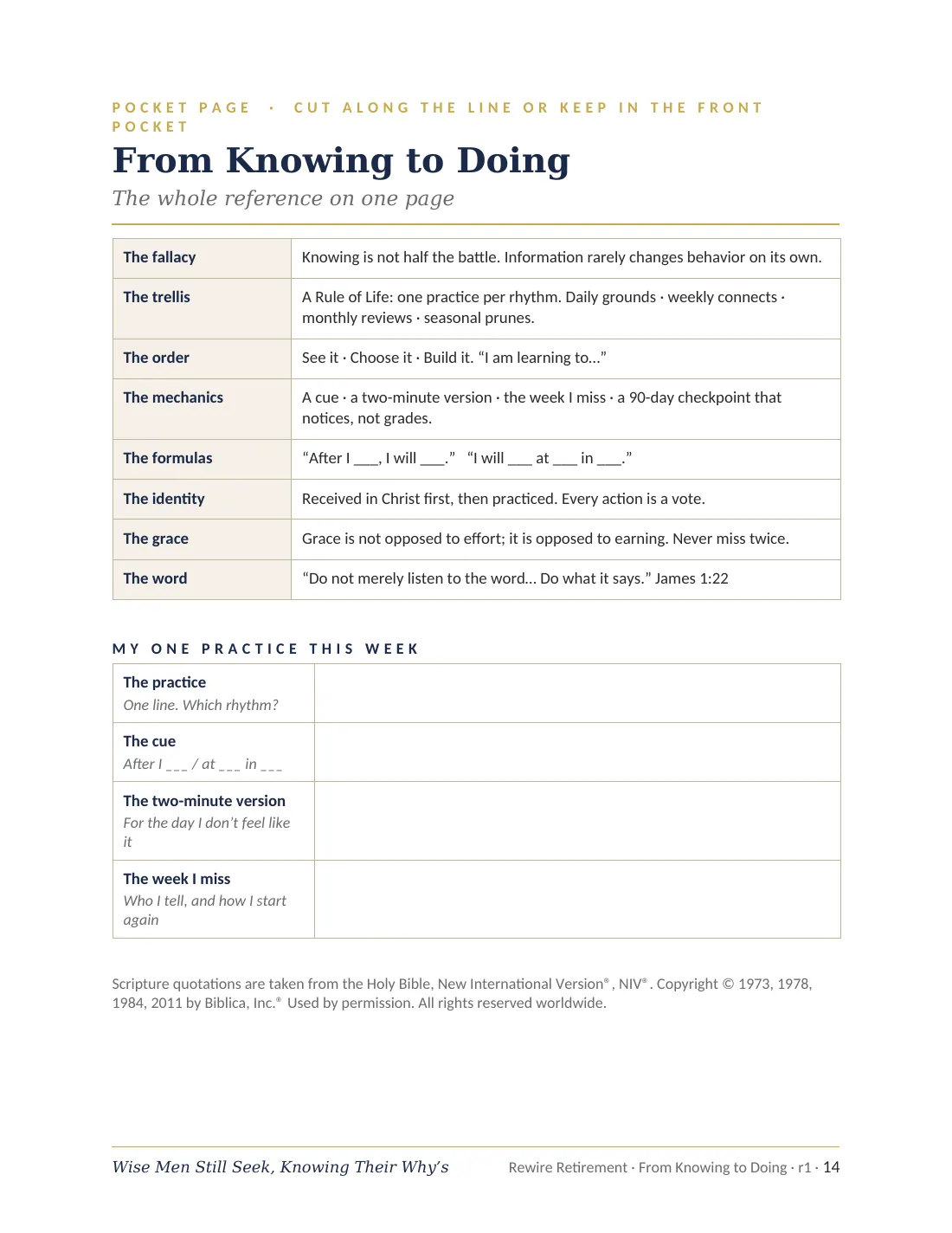
POCKET PAGE               ·      CUT ALONG THE LINE OR KEEP IN THE FRONT
POCKET

From Knowing to Doing
The whole reference on one page

 The fallacy                     Knowing is not half the battle. Information rarely changes behavior on its own.

 The trellis                     A Rule of Life: one practice per rhythm. Daily grounds · weekly connects ·
                                 monthly reviews · seasonal prunes.

 The order                       See it · Choose it · Build it. “I am learning to…”

 The mechanics                   A cue · a two-minute version · the week I miss · a 90-day checkpoint that
                                 notices, not grades.

 The formulas                    “After I ___, I will ___.” “I will ___ at ___ in ___.”

 The identity                    Received in Christ first, then practiced. Every action is a vote.

 The grace                       Grace is not opposed to effort; it is opposed to earning. Never miss twice.

 The word                        “Do not merely listen to the word… Do what it says.” James 1:22


MY ONE PRACTICE THIS WEEK

 The practice
 One line. Which rhythm?

 The cue
 After I ___ / at ___ in ___

 The two-minute version
 For the day I don’t feel like
 it

 The week I miss
 Who I tell, and how I start
 again


Scripture quotations are taken from the Holy Bible, New International Version®, NIV®. Copyright © 1973, 1978,
1984, 2011 by Biblica, Inc.® Used by permission. All rights reserved worldwide.


Wise Men Still Seek, Knowing Their Why’s                          Rewire Retirement · From Knowing to Doing · r1 · 14