
Session 5 · Going Deeper
Dan Allender on Story
Show the text version
WHYZMEN · Rewire Retirement | Participant Reference · Dan Allender on Story

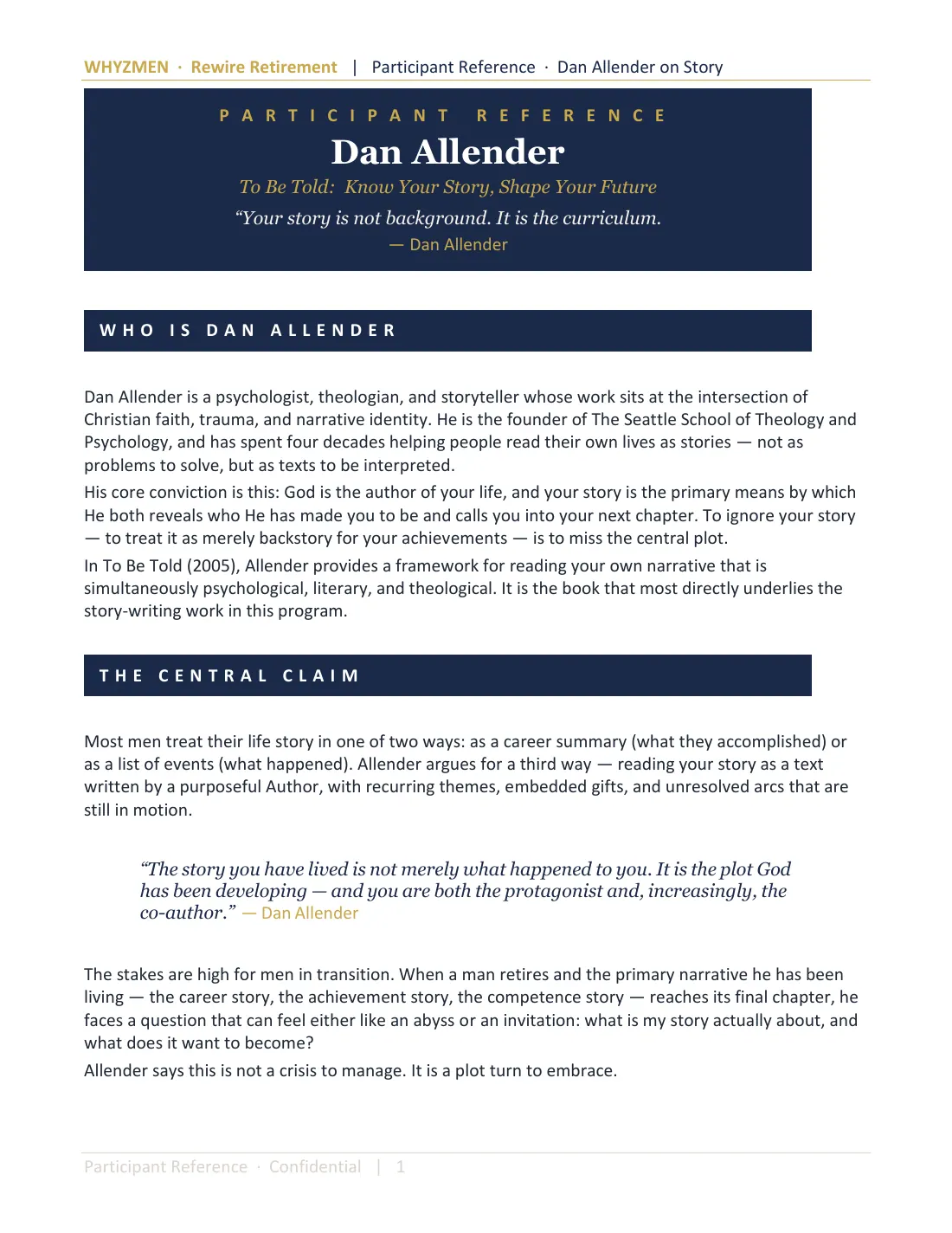
                  P A R T I C I P A N T              R E F E R E N C E

                                 Dan Allender
                     To Be Told: Know Your Story, Shape Your Future
                    “Your story is not background. It is the curriculum.
                                       — Dan Allender


  WHO IS DAN ALLENDER


Dan Allender is a psychologist, theologian, and storyteller whose work sits at the intersection of
Christian faith, trauma, and narrative identity. He is the founder of The Seattle School of Theology and
Psychology, and has spent four decades helping people read their own lives as stories — not as
problems to solve, but as texts to be interpreted.
His core conviction is this: God is the author of your life, and your story is the primary means by which
He both reveals who He has made you to be and calls you into your next chapter. To ignore your story
— to treat it as merely backstory for your achievements — is to miss the central plot.
In To Be Told (2005), Allender provides a framework for reading your own narrative that is
simultaneously psychological, literary, and theological. It is the book that most directly underlies the
story-writing work in this program.


  THE CENTRAL CLAIM


Most men treat their life story in one of two ways: as a career summary (what they accomplished) or
as a list of events (what happened). Allender argues for a third way — reading your story as a text
written by a purposeful Author, with recurring themes, embedded gifts, and unresolved arcs that are
still in motion.


       “The story you have lived is not merely what happened to you. It is the plot God
       has been developing — and you are both the protagonist and, increasingly, the
       co-author.” — Dan Allender


The stakes are high for men in transition. When a man retires and the primary narrative he has been
living — the career story, the achievement story, the competence story — reaches its final chapter, he
faces a question that can feel either like an abyss or an invitation: what is my story actually about, and
what does it want to become?
Allender says this is not a crisis to manage. It is a plot turn to embrace.


Participant Reference · Confidential | 1
WHYZMEN · Rewire Retirement | Participant Reference · Dan Allender on Story

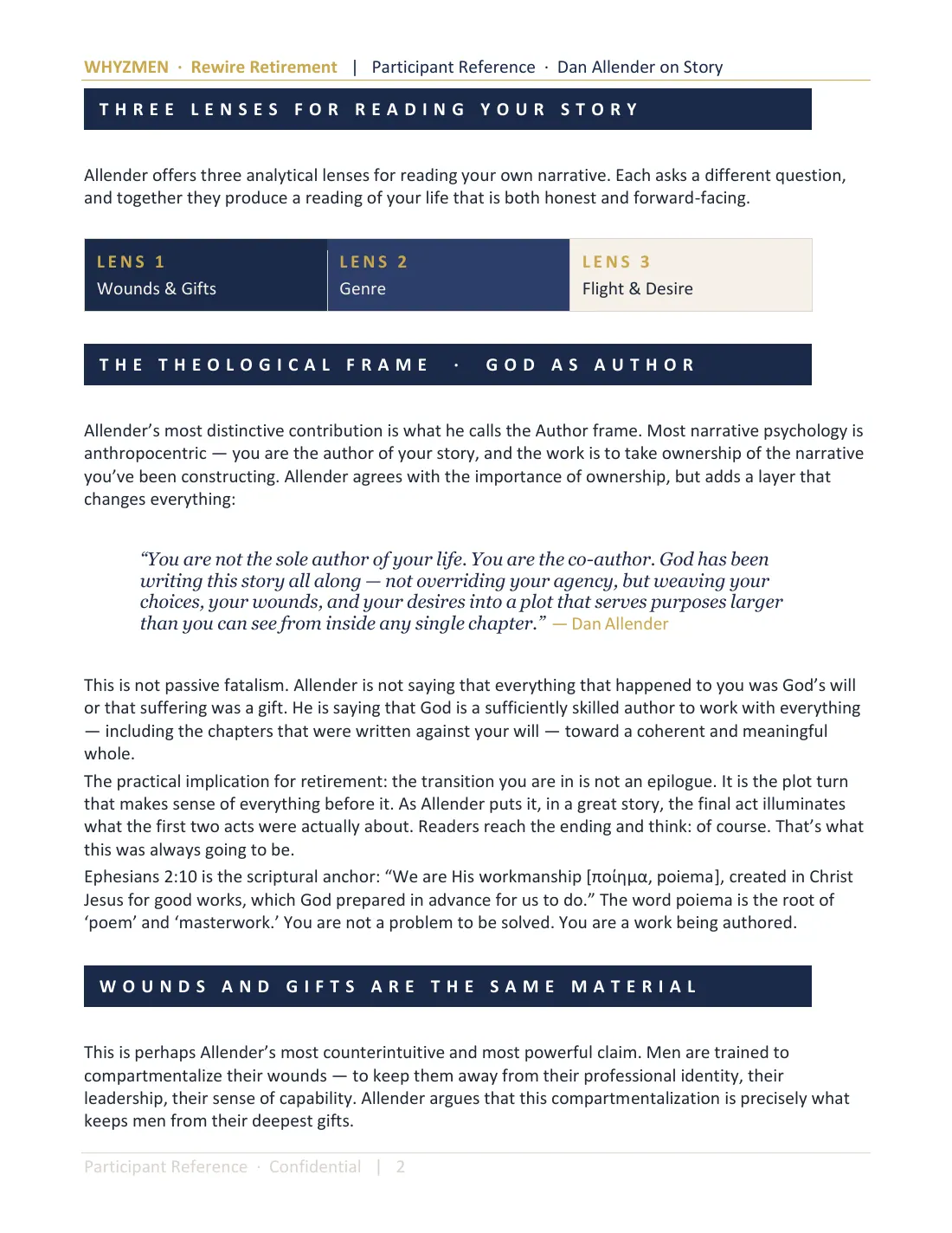
  THREE LENSES FOR READING YOUR STORY


Allender offers three analytical lenses for reading your own narrative. Each asks a different question,
and together they produce a reading of your life that is both honest and forward-facing.


 LENS 1                            LENS 2                           LENS 3
 Wounds & Gifts                    Genre                            Flight & Desire


  THE THEOLOGICAL FRAME                            ·   GOD AS AUTHOR


Allender’s most distinctive contribution is what he calls the Author frame. Most narrative psychology is
anthropocentric — you are the author of your story, and the work is to take ownership of the narrative
you’ve been constructing. Allender agrees with the importance of ownership, but adds a layer that
changes everything:


       “You are not the sole author of your life. You are the co-author. God has been
       writing this story all along — not overriding your agency, but weaving your
       choices, your wounds, and your desires into a plot that serves purposes larger
       than you can see from inside any single chapter.” — Dan Allender


This is not passive fatalism. Allender is not saying that everything that happened to you was God’s will
or that suffering was a gift. He is saying that God is a sufficiently skilled author to work with everything
— including the chapters that were written against your will — toward a coherent and meaningful
whole.
The practical implication for retirement: the transition you are in is not an epilogue. It is the plot turn
that makes sense of everything before it. As Allender puts it, in a great story, the final act illuminates
what the first two acts were actually about. Readers reach the ending and think: of course. That’s what
this was always going to be.
Ephesians 2:10 is the scriptural anchor: “We are His workmanship [ποίημα, poiema], created in Christ
Jesus for good works, which God prepared in advance for us to do.” The word poiema is the root of
‘poem’ and ‘masterwork.’ You are not a problem to be solved. You are a work being authored.


  WOUNDS AND GIFTS ARE THE SAME MATERIAL


This is perhaps Allender’s most counterintuitive and most powerful claim. Men are trained to
compartmentalize their wounds — to keep them away from their professional identity, their
leadership, their sense of capability. Allender argues that this compartmentalization is precisely what
keeps men from their deepest gifts.

Participant Reference · Confidential | 2
WHYZMEN · Rewire Retirement | Participant Reference · Dan Allender on Story


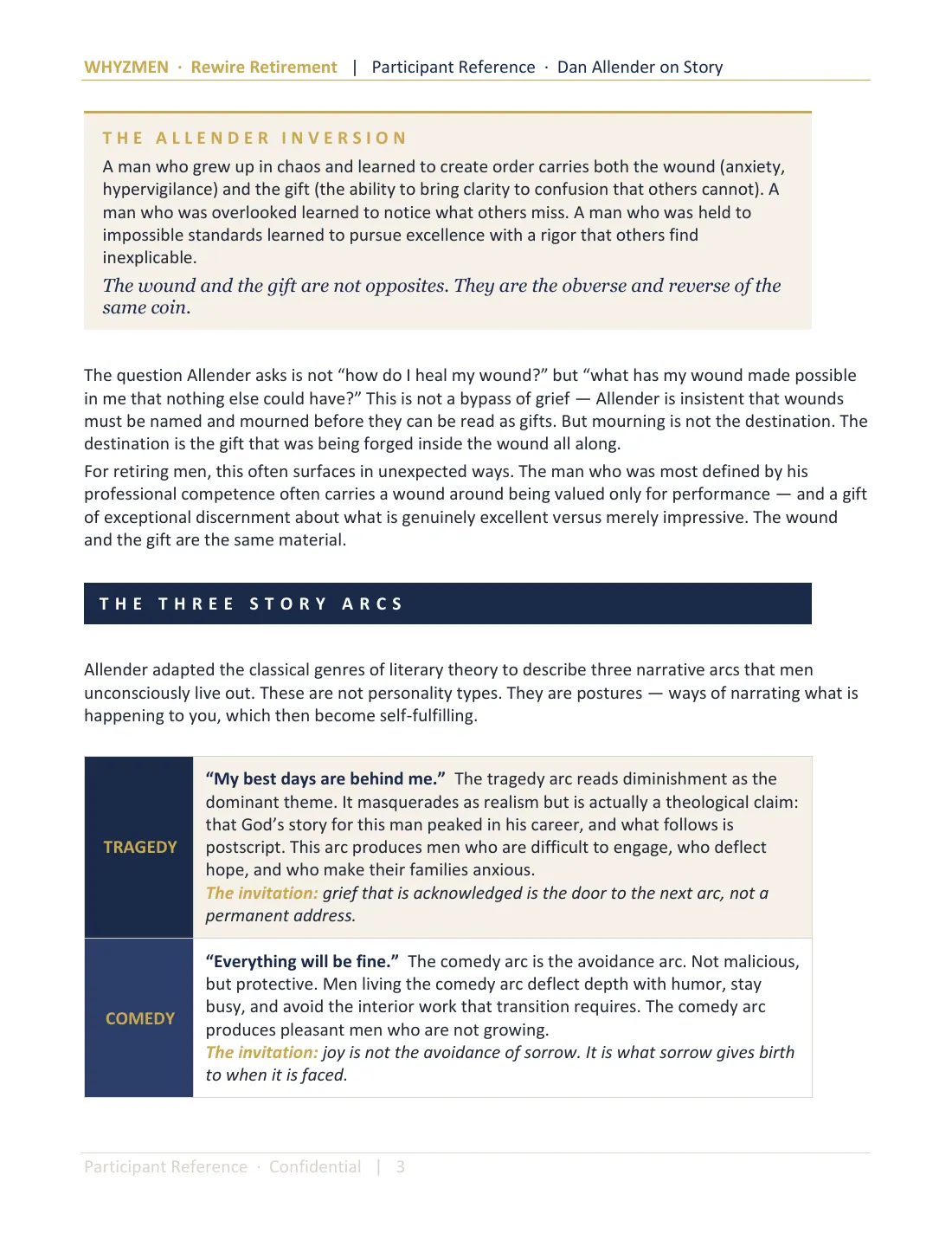
  THE ALLENDER INVERSION
  A man who grew up in chaos and learned to create order carries both the wound (anxiety,
  hypervigilance) and the gift (the ability to bring clarity to confusion that others cannot). A
  man who was overlooked learned to notice what others miss. A man who was held to
  impossible standards learned to pursue excellence with a rigor that others find
  inexplicable.
  The wound and the gift are not opposites. They are the obverse and reverse of the
  same coin.


The question Allender asks is not “how do I heal my wound?” but “what has my wound made possible
in me that nothing else could have?” This is not a bypass of grief — Allender is insistent that wounds
must be named and mourned before they can be read as gifts. But mourning is not the destination. The
destination is the gift that was being forged inside the wound all along.
For retiring men, this often surfaces in unexpected ways. The man who was most defined by his
professional competence often carries a wound around being valued only for performance — and a gift
of exceptional discernment about what is genuinely excellent versus merely impressive. The wound
and the gift are the same material.


  THE THREE STORY ARCS


Allender adapted the classical genres of literary theory to describe three narrative arcs that men
unconsciously live out. These are not personality types. They are postures — ways of narrating what is
happening to you, which then become self-fulfilling.


                “My best days are behind me.” The tragedy arc reads diminishment as the
                dominant theme. It masquerades as realism but is actually a theological claim:
                that God’s story for this man peaked in his career, and what follows is
  TRAGEDY       postscript. This arc produces men who are difficult to engage, who deflect
                hope, and who make their families anxious.
                The invitation: grief that is acknowledged is the door to the next arc, not a
                permanent address.

                “Everything will be fine.” The comedy arc is the avoidance arc. Not malicious,
                but protective. Men living the comedy arc deflect depth with humor, stay
                busy, and avoid the interior work that transition requires. The comedy arc
  COMEDY
                produces pleasant men who are not growing.
                The invitation: joy is not the avoidance of sorrow. It is what sorrow gives birth
                to when it is faced.


Participant Reference · Confidential | 3
WHYZMEN · Rewire Retirement | Participant Reference · Dan Allender on Story

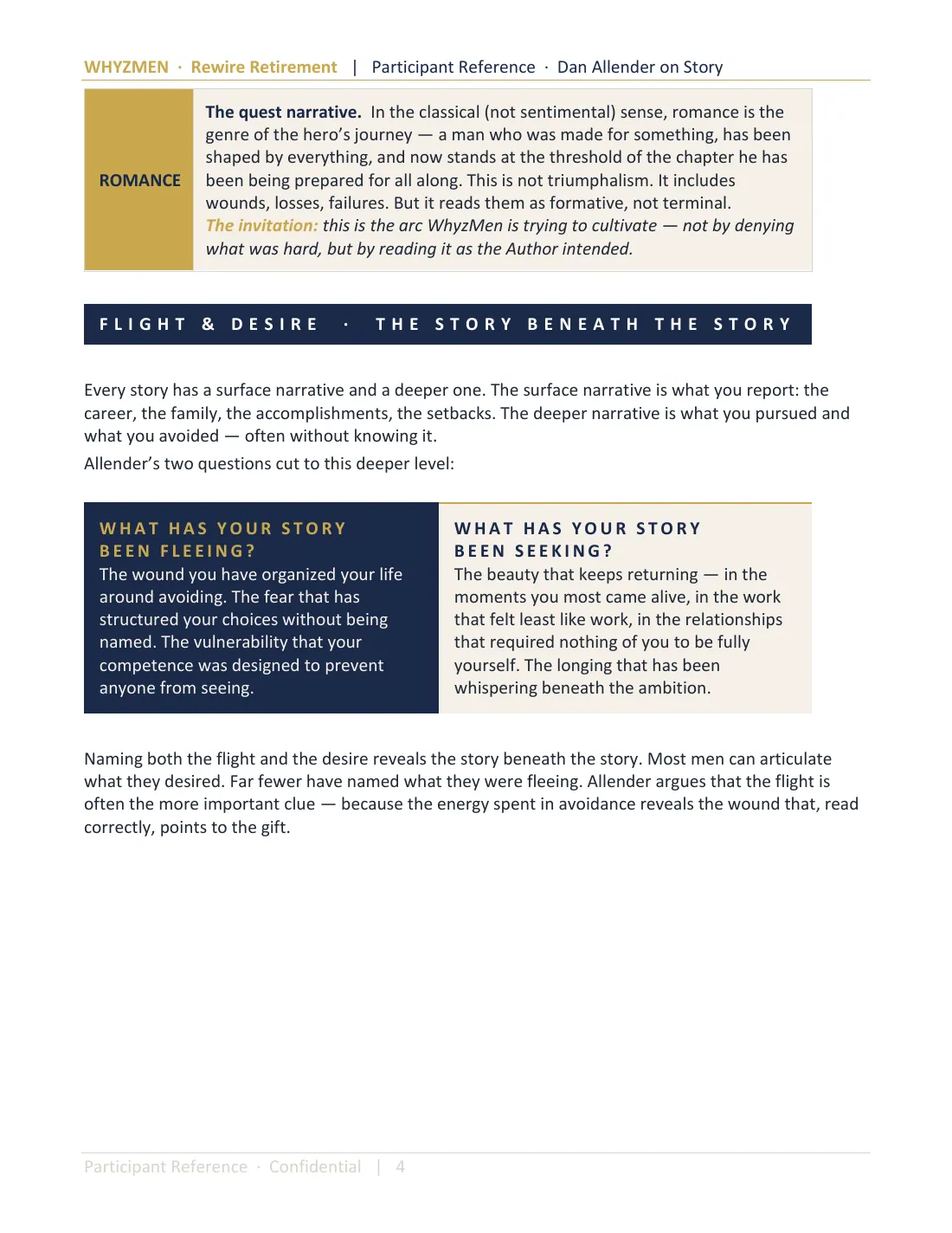
               The quest narrative. In the classical (not sentimental) sense, romance is the
               genre of the hero’s journey — a man who was made for something, has been
               shaped by everything, and now stands at the threshold of the chapter he has
 ROMANCE       been being prepared for all along. This is not triumphalism. It includes
               wounds, losses, failures. But it reads them as formative, not terminal.
               The invitation: this is the arc WhyzMen is trying to cultivate — not by denying
               what was hard, but by reading it as the Author intended.


  FLIGHT & DESIRE                ·   THE STORY BENEATH THE STORY


Every story has a surface narrative and a deeper one. The surface narrative is what you report: the
career, the family, the accomplishments, the setbacks. The deeper narrative is what you pursued and
what you avoided — often without knowing it.
Allender’s two questions cut to this deeper level:


  WHAT HAS YOUR STORY                           WHAT HAS YOUR STORY
  BEEN FLEEING?                                 BEEN SEEKING?
  The wound you have organized your life        The beauty that keeps returning — in the
  around avoiding. The fear that has            moments you most came alive, in the work
  structured your choices without being         that felt least like work, in the relationships
  named. The vulnerability that your            that required nothing of you to be fully
  competence was designed to prevent            yourself. The longing that has been
  anyone from seeing.                           whispering beneath the ambition.


Naming both the flight and the desire reveals the story beneath the story. Most men can articulate
what they desired. Far fewer have named what they were fleeing. Allender argues that the flight is
often the more important clue — because the energy spent in avoidance reveals the wound that, read
correctly, points to the gift.


Participant Reference · Confidential | 4
WHYZMEN · Rewire Retirement | Participant Reference · Dan Allender on Story

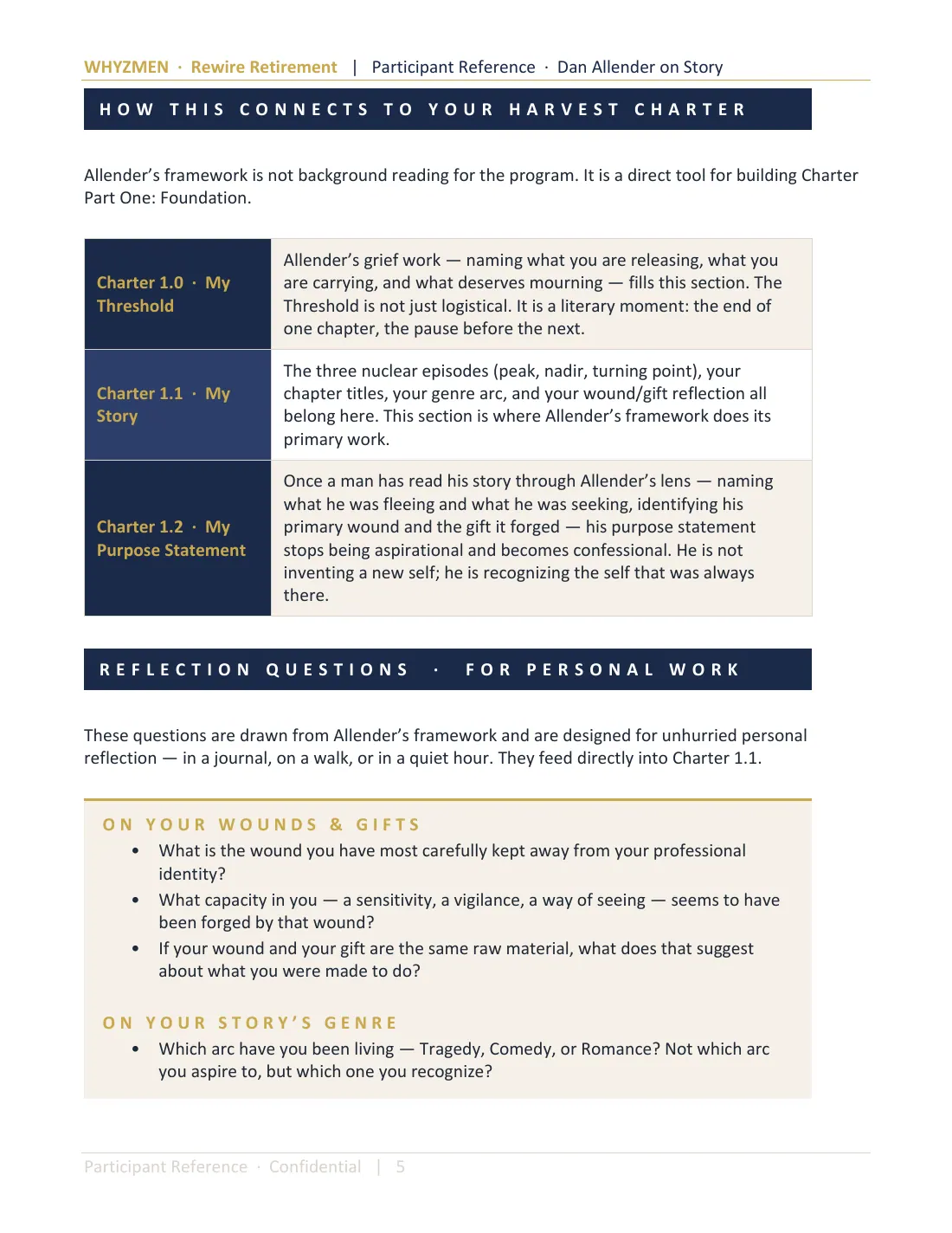
  HOW THIS CONNECTS TO YOUR HARVEST CHARTER


Allender’s framework is not background reading for the program. It is a direct tool for building Charter
Part One: Foundation.


                          Allender’s grief work — naming what you are releasing, what you
 Charter 1.0 · My         are carrying, and what deserves mourning — fills this section. The
 Threshold                Threshold is not just logistical. It is a literary moment: the end of
                          one chapter, the pause before the next.

                          The three nuclear episodes (peak, nadir, turning point), your
 Charter 1.1 · My         chapter titles, your genre arc, and your wound/gift reflection all
 Story                    belong here. This section is where Allender’s framework does its
                          primary work.

                          Once a man has read his story through Allender’s lens — naming
                          what he was fleeing and what he was seeking, identifying his
 Charter 1.2 · My         primary wound and the gift it forged — his purpose statement
 Purpose Statement        stops being aspirational and becomes confessional. He is not
                          inventing a new self; he is recognizing the self that was always
                          there.


  REFLECTION QUESTIONS                        ·    FOR PERSONAL WORK


These questions are drawn from Allender’s framework and are designed for unhurried personal
reflection — in a journal, on a walk, or in a quiet hour. They feed directly into Charter 1.1.


  ON YOUR WOUNDS & GIFTS
    • What is the wound you have most carefully kept away from your professional
      identity?
    • What capacity in you — a sensitivity, a vigilance, a way of seeing — seems to have
      been forged by that wound?
    • If your wound and your gift are the same raw material, what does that suggest
      about what you were made to do?

  ON YOUR STORY’S GENRE
    • Which arc have you been living — Tragedy, Comedy, or Romance? Not which arc
      you aspire to, but which one you recognize?


Participant Reference · Confidential | 5
WHYZMEN · Rewire Retirement | Participant Reference · Dan Allender on Story

     •   What would it mean to read your story as Romance — not triumphantly, but as a
         quest narrative in which everything, including the hard chapters, was preparation?

  ON FLIGHT & DESIRE
    • What has your story been fleeing? Name the fear or the vulnerability, not the
      circumstance.
    • What has your story been seeking? Name the beauty, the longing, the recurring
      draw — not the goal, but the desire beneath the goal.
    • Where do the flight and the desire point to the same place?

  ON GOD AS AUTHOR
    • If God has been writing your story all along, what theme keeps appearing across
      chapters?
    • Where in your nadir moments — the losses, the failures, the unwanted chapters —
      do you see the hand of an Author working with material you didn’t choose toward
      purposes you couldn’t see?
    • What does the arc of your life so far suggest you were being prepared for in this
      next season?


  “We are not the sole authors of our lives. We are co-authors with God — and He is
  a better novelist than we are. The question is whether we are willing to read what
                                    He has written.
                               — Dan Allender, To Be Told
                        Wise Men Still Seek · Knowing Their Why’s


Participant Reference · Confidential | 6