
Session 5 · Recommended Reading
Narrative Identity (Dan McAdams)
Show the text version
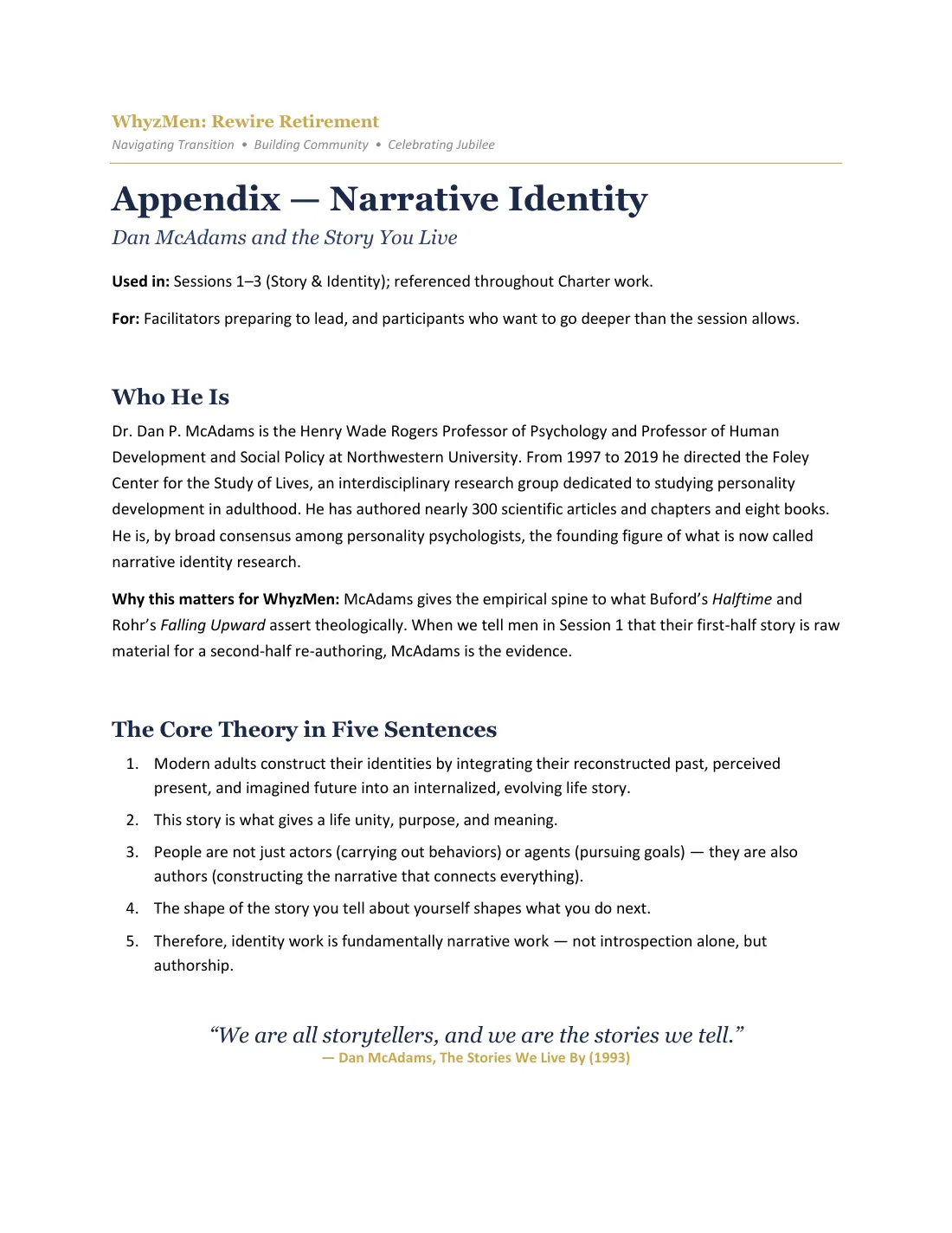
WhyzMen: Rewire Retirement
Navigating Transition • Building Community • Celebrating Jubilee


Appendix — Narrative Identity
Dan McAdams and the Story You Live

Used in: Sessions 1–3 (Story & Identity); referenced throughout Charter work.

For: Facilitators preparing to lead, and participants who want to go deeper than the session allows.


Who He Is
Dr. Dan P. McAdams is the Henry Wade Rogers Professor of Psychology and Professor of Human
Development and Social Policy at Northwestern University. From 1997 to 2019 he directed the Foley
Center for the Study of Lives, an interdisciplinary research group dedicated to studying personality
development in adulthood. He has authored nearly 300 scientific articles and chapters and eight books.
He is, by broad consensus among personality psychologists, the founding figure of what is now called
narrative identity research.

Why this matters for WhyzMen: McAdams gives the empirical spine to what Buford’s Halftime and
Rohr’s Falling Upward assert theologically. When we tell men in Session 1 that their first-half story is raw
material for a second-half re-authoring, McAdams is the evidence.


The Core Theory in Five Sentences
  1. Modern adults construct their identities by integrating their reconstructed past, perceived
     present, and imagined future into an internalized, evolving life story.
  2. This story is what gives a life unity, purpose, and meaning.
  3. People are not just actors (carrying out behaviors) or agents (pursuing goals) — they are also
     authors (constructing the narrative that connects everything).
  4. The shape of the story you tell about yourself shapes what you do next.
  5. Therefore, identity work is fundamentally narrative work — not introspection alone, but
     authorship.


                “We are all storytellers, and we are the stories we tell.”
                                  — Dan McAdams, The Stories We Live By (1993)
Story Is Identity
If a man carries one idea out of Sessions 1–3, it should be this one: the story is not a report on the
identity — the story is the identity. McAdams’ claim is not merely that we tell stories about who we are;
it is that the telling is the constructing. Identity is not an artifact buried in the past waiting to be
excavated. It is authored, and re-authored, every time a man narrates his life to himself or to someone
else.

Which means the telling has consequences. The version a man gives in triad on a Tuesday night is not a
neutral description of a fixed self. It is a draft, and it shapes what he believes is still available to him.
Change the emphasis, the causal links, the ending he assumes is coming, and you have changed more
than a rendition — you have changed the material out of which he will act. It is also why identity keeps
moving. Beliefs shift, assumptions about how life works get revised, and adversity, success, gift, and loss
all become fuel for refinement. Retirement is simply the largest revision most of these men will ever
attempt.

Facilitators should hear this as permission rather than pressure. We are not asking men to invent a
better self. We are asking them to notice that they have been narrating all along, mostly by default, and
to take up the pen deliberately.
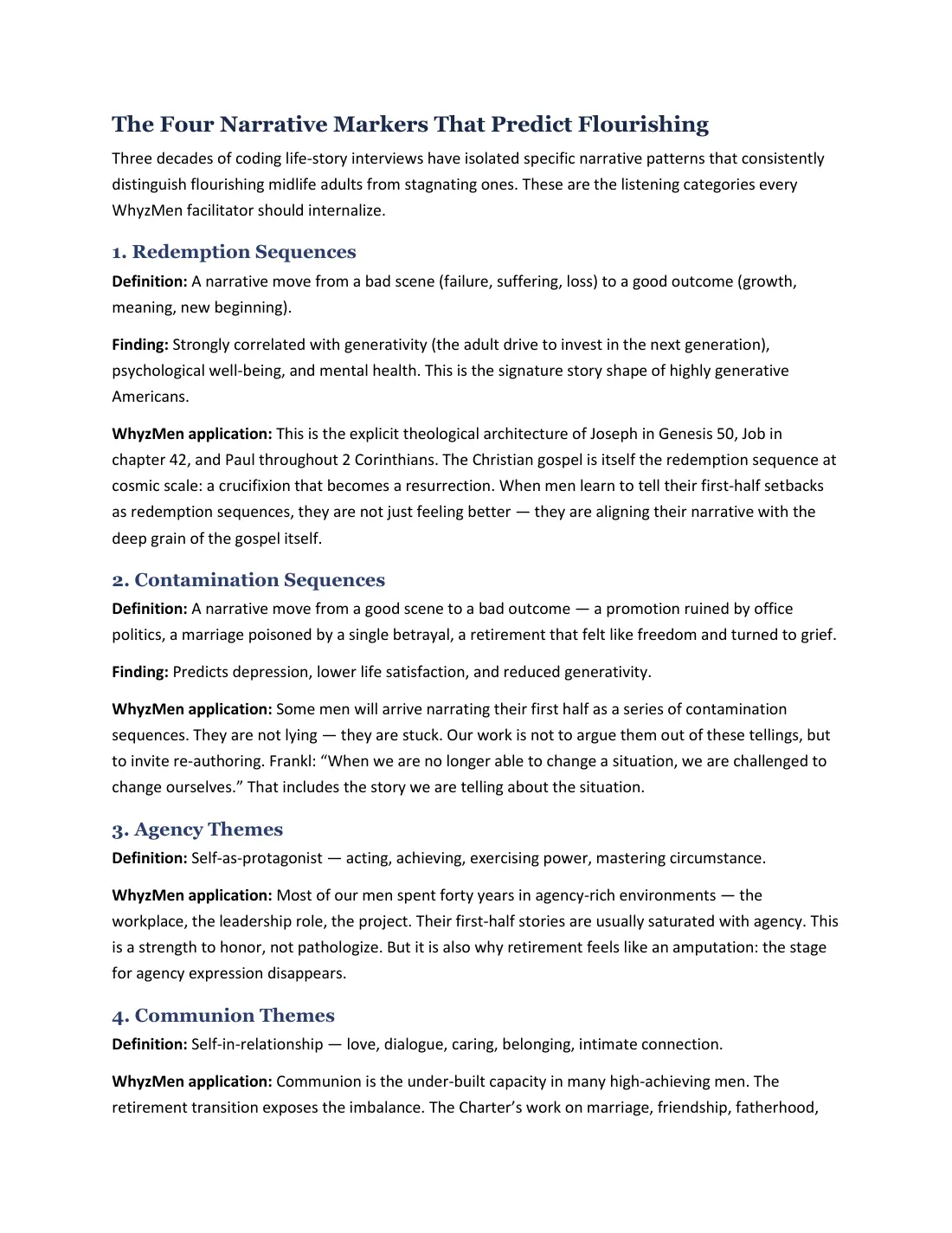
The Four Narrative Markers That Predict Flourishing
Three decades of coding life-story interviews have isolated specific narrative patterns that consistently
distinguish flourishing midlife adults from stagnating ones. These are the listening categories every
WhyzMen facilitator should internalize.

1. Redemption Sequences
Definition: A narrative move from a bad scene (failure, suffering, loss) to a good outcome (growth,
meaning, new beginning).

Finding: Strongly correlated with generativity (the adult drive to invest in the next generation),
psychological well-being, and mental health. This is the signature story shape of highly generative
Americans.

WhyzMen application: This is the explicit theological architecture of Joseph in Genesis 50, Job in
chapter 42, and Paul throughout 2 Corinthians. The Christian gospel is itself the redemption sequence at
cosmic scale: a crucifixion that becomes a resurrection. When men learn to tell their first-half setbacks
as redemption sequences, they are not just feeling better — they are aligning their narrative with the
deep grain of the gospel itself.

2. Contamination Sequences
Definition: A narrative move from a good scene to a bad outcome — a promotion ruined by office
politics, a marriage poisoned by a single betrayal, a retirement that felt like freedom and turned to grief.

Finding: Predicts depression, lower life satisfaction, and reduced generativity.

WhyzMen application: Some men will arrive narrating their first half as a series of contamination
sequences. They are not lying — they are stuck. Our work is not to argue them out of these tellings, but
to invite re-authoring. Frankl: “When we are no longer able to change a situation, we are challenged to
change ourselves.” That includes the story we are telling about the situation.

3. Agency Themes
Definition: Self-as-protagonist — acting, achieving, exercising power, mastering circumstance.

WhyzMen application: Most of our men spent forty years in agency-rich environments — the
workplace, the leadership role, the project. Their first-half stories are usually saturated with agency. This
is a strength to honor, not pathologize. But it is also why retirement feels like an amputation: the stage
for agency expression disappears.

4. Communion Themes
Definition: Self-in-relationship — love, dialogue, caring, belonging, intimate connection.

WhyzMen application: Communion is the under-built capacity in many high-achieving men. The
retirement transition exposes the imbalance. The Charter’s work on marriage, friendship, fatherhood,
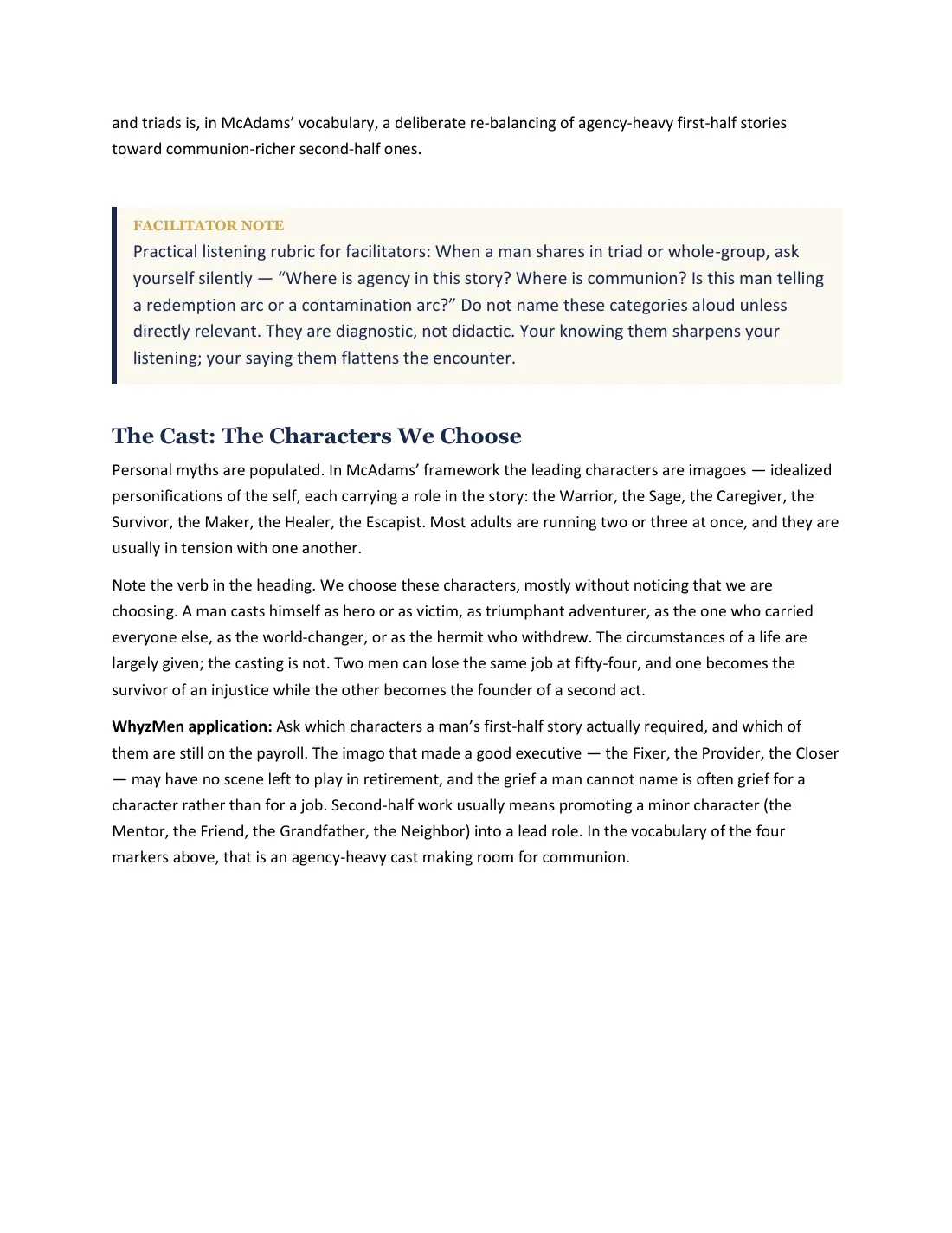
and triads is, in McAdams’ vocabulary, a deliberate re-balancing of agency-heavy first-half stories
toward communion-richer second-half ones.


   FACILITATOR NOTE
   Practical listening rubric for facilitators: When a man shares in triad or whole-group, ask
   yourself silently — “Where is agency in this story? Where is communion? Is this man telling
   a redemption arc or a contamination arc?” Do not name these categories aloud unless
   directly relevant. They are diagnostic, not didactic. Your knowing them sharpens your
   listening; your saying them flattens the encounter.


The Cast: The Characters We Choose
Personal myths are populated. In McAdams’ framework the leading characters are imagoes — idealized
personifications of the self, each carrying a role in the story: the Warrior, the Sage, the Caregiver, the
Survivor, the Maker, the Healer, the Escapist. Most adults are running two or three at once, and they are
usually in tension with one another.

Note the verb in the heading. We choose these characters, mostly without noticing that we are
choosing. A man casts himself as hero or as victim, as triumphant adventurer, as the one who carried
everyone else, as the world-changer, or as the hermit who withdrew. The circumstances of a life are
largely given; the casting is not. Two men can lose the same job at fifty-four, and one becomes the
survivor of an injustice while the other becomes the founder of a second act.

WhyzMen application: Ask which characters a man’s first-half story actually required, and which of
them are still on the payroll. The imago that made a good executive — the Fixer, the Provider, the Closer
— may have no scene left to play in retirement, and the grief a man cannot name is often grief for a
character rather than for a job. Second-half work usually means promoting a minor character (the
Mentor, the Friend, the Grandfather, the Neighbor) into a lead role. In the vocabulary of the four
markers above, that is an agency-heavy cast making room for communion.
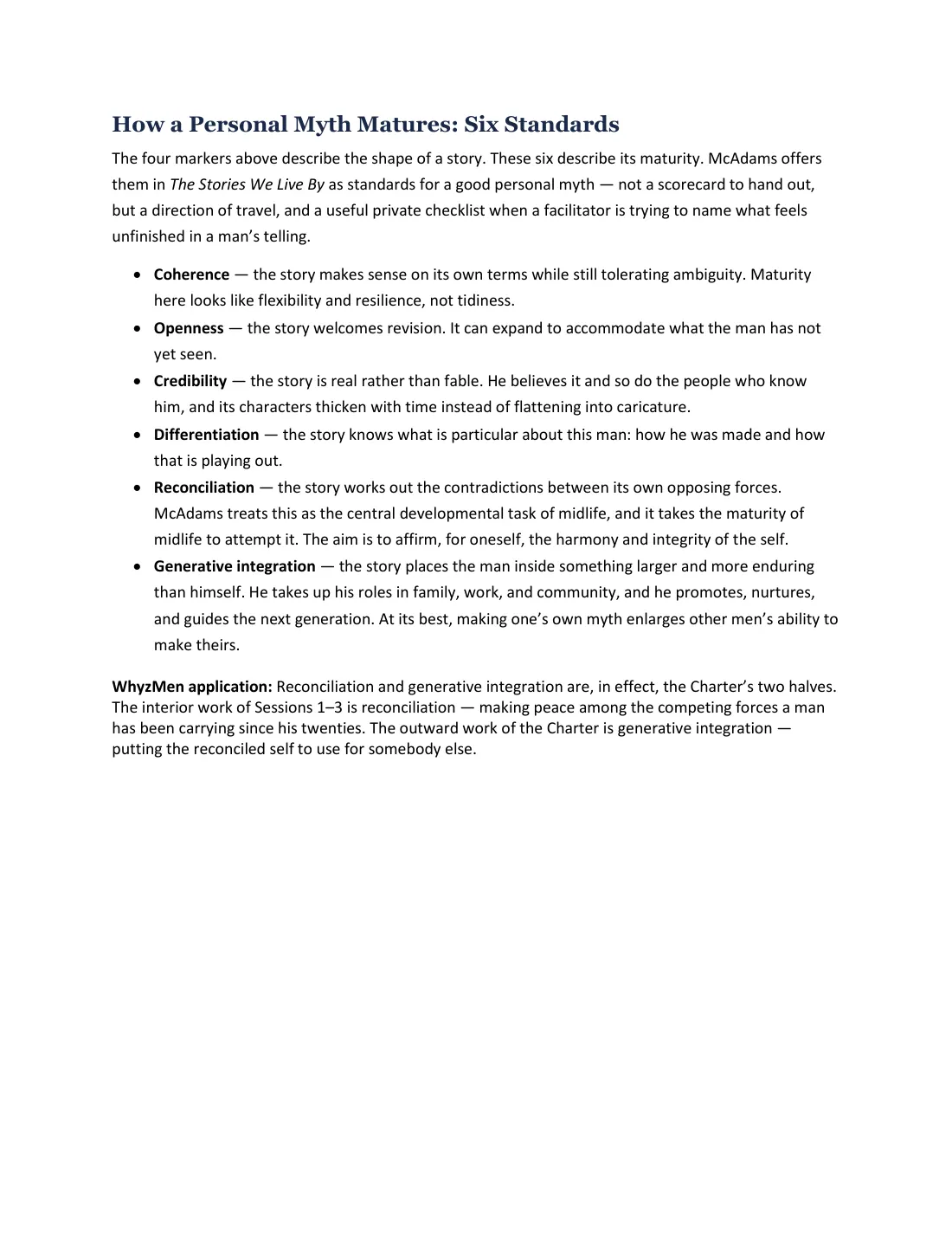
How a Personal Myth Matures: Six Standards
The four markers above describe the shape of a story. These six describe its maturity. McAdams offers
them in The Stories We Live By as standards for a good personal myth — not a scorecard to hand out,
but a direction of travel, and a useful private checklist when a facilitator is trying to name what feels
unfinished in a man’s telling.

   • Coherence — the story makes sense on its own terms while still tolerating ambiguity. Maturity
      here looks like flexibility and resilience, not tidiness.
   • Openness — the story welcomes revision. It can expand to accommodate what the man has not
      yet seen.
   • Credibility — the story is real rather than fable. He believes it and so do the people who know
      him, and its characters thicken with time instead of flattening into caricature.
   • Differentiation — the story knows what is particular about this man: how he was made and how
      that is playing out.
   • Reconciliation — the story works out the contradictions between its own opposing forces.
      McAdams treats this as the central developmental task of midlife, and it takes the maturity of
      midlife to attempt it. The aim is to affirm, for oneself, the harmony and integrity of the self.
   • Generative integration — the story places the man inside something larger and more enduring
      than himself. He takes up his roles in family, work, and community, and he promotes, nurtures,
      and guides the next generation. At its best, making one’s own myth enlarges other men’s ability to
      make theirs.

WhyzMen application: Reconciliation and generative integration are, in effect, the Charter’s two halves.
The interior work of Sessions 1–3 is reconciliation — making peace among the competing forces a man
has been carrying since his twenties. The outward work of the Charter is generative integration —
putting the reconciled self to use for somebody else.
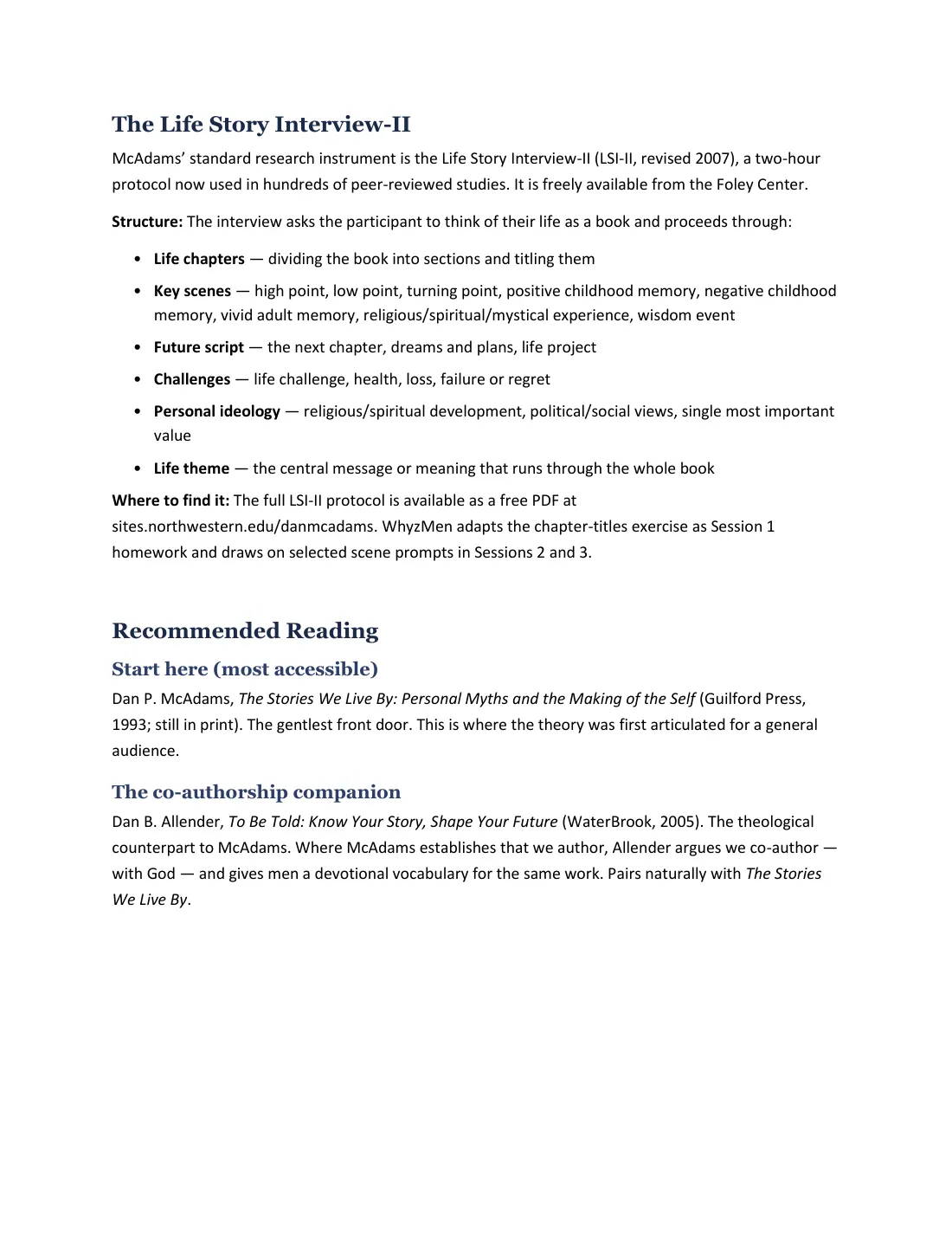
The Life Story Interview-II
McAdams’ standard research instrument is the Life Story Interview-II (LSI-II, revised 2007), a two-hour
protocol now used in hundreds of peer-reviewed studies. It is freely available from the Foley Center.

Structure: The interview asks the participant to think of their life as a book and proceeds through:

   • Life chapters — dividing the book into sections and titling them
   • Key scenes — high point, low point, turning point, positive childhood memory, negative childhood
     memory, vivid adult memory, religious/spiritual/mystical experience, wisdom event
   • Future script — the next chapter, dreams and plans, life project
   • Challenges — life challenge, health, loss, failure or regret
   • Personal ideology — religious/spiritual development, political/social views, single most important
     value
   • Life theme — the central message or meaning that runs through the whole book
Where to find it: The full LSI-II protocol is available as a free PDF at
sites.northwestern.edu/danmcadams. WhyzMen adapts the chapter-titles exercise as Session 1
homework and draws on selected scene prompts in Sessions 2 and 3.


Recommended Reading
Start here (most accessible)
Dan P. McAdams, The Stories We Live By: Personal Myths and the Making of the Self (Guilford Press,
1993; still in print). The gentlest front door. This is where the theory was first articulated for a general
audience.

The co-authorship companion
Dan B. Allender, To Be Told: Know Your Story, Shape Your Future (WaterBrook, 2005). The theological
counterpart to McAdams. Where McAdams establishes that we author, Allender argues we co-author —
with God — and gives men a devotional vocabulary for the same work. Pairs naturally with The Stories
We Live By.
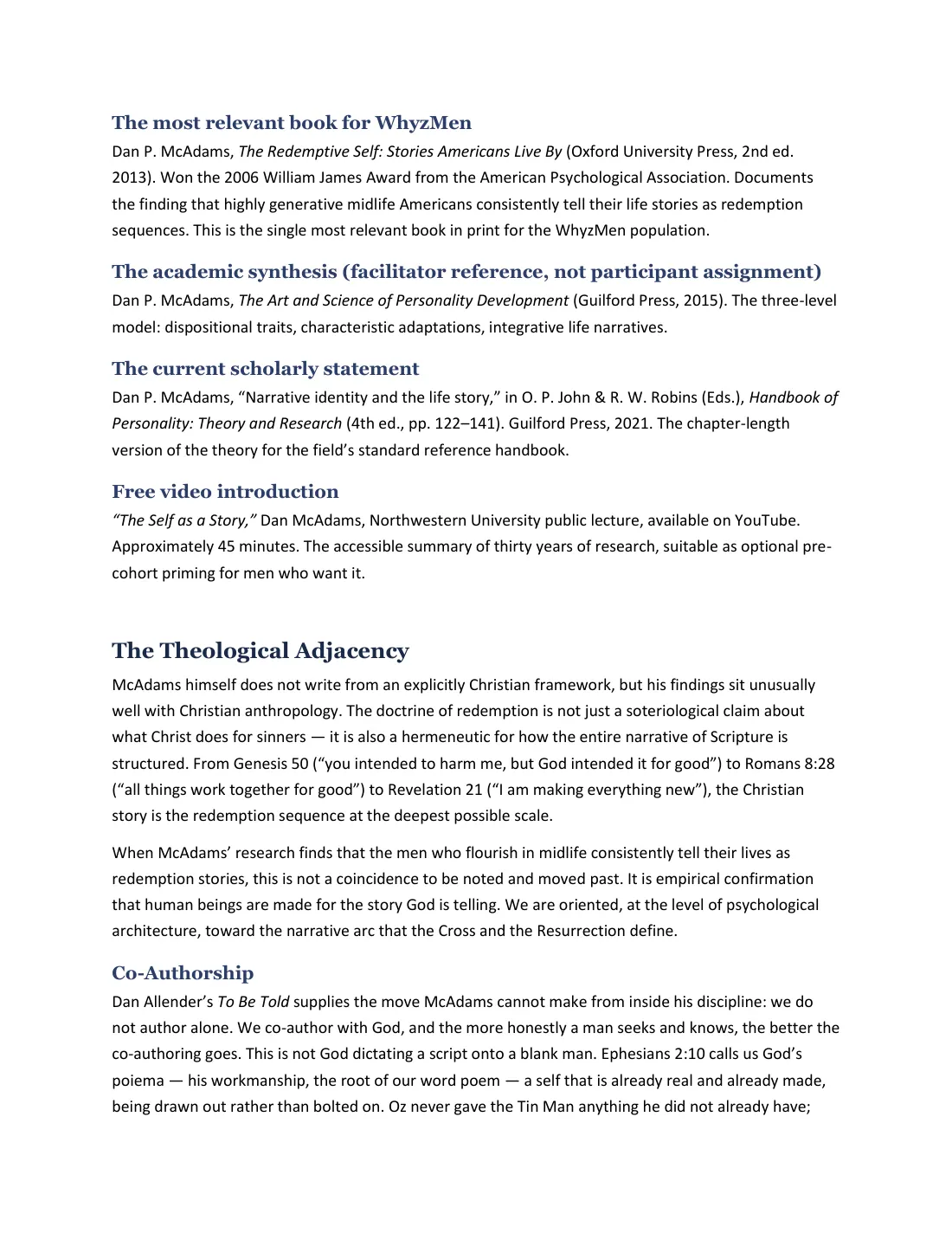
The most relevant book for WhyzMen
Dan P. McAdams, The Redemptive Self: Stories Americans Live By (Oxford University Press, 2nd ed.
2013). Won the 2006 William James Award from the American Psychological Association. Documents
the finding that highly generative midlife Americans consistently tell their life stories as redemption
sequences. This is the single most relevant book in print for the WhyzMen population.

The academic synthesis (facilitator reference, not participant assignment)
Dan P. McAdams, The Art and Science of Personality Development (Guilford Press, 2015). The three-level
model: dispositional traits, characteristic adaptations, integrative life narratives.

The current scholarly statement
Dan P. McAdams, “Narrative identity and the life story,” in O. P. John & R. W. Robins (Eds.), Handbook of
Personality: Theory and Research (4th ed., pp. 122–141). Guilford Press, 2021. The chapter-length
version of the theory for the field’s standard reference handbook.

Free video introduction
“The Self as a Story,” Dan McAdams, Northwestern University public lecture, available on YouTube.
Approximately 45 minutes. The accessible summary of thirty years of research, suitable as optional pre-
cohort priming for men who want it.


The Theological Adjacency
McAdams himself does not write from an explicitly Christian framework, but his findings sit unusually
well with Christian anthropology. The doctrine of redemption is not just a soteriological claim about
what Christ does for sinners — it is also a hermeneutic for how the entire narrative of Scripture is
structured. From Genesis 50 (“you intended to harm me, but God intended it for good”) to Romans 8:28
(“all things work together for good”) to Revelation 21 (“I am making everything new”), the Christian
story is the redemption sequence at the deepest possible scale.

When McAdams’ research finds that the men who flourish in midlife consistently tell their lives as
redemption stories, this is not a coincidence to be noted and moved past. It is empirical confirmation
that human beings are made for the story God is telling. We are oriented, at the level of psychological
architecture, toward the narrative arc that the Cross and the Resurrection define.

Co-Authorship
Dan Allender’s To Be Told supplies the move McAdams cannot make from inside his discipline: we do
not author alone. We co-author with God, and the more honestly a man seeks and knows, the better the
co-authoring goes. This is not God dictating a script onto a blank man. Ephesians 2:10 calls us God’s
poiema — his workmanship, the root of our word poem — a self that is already real and already made,
being drawn out rather than bolted on. Oz never gave the Tin Man anything he did not already have;
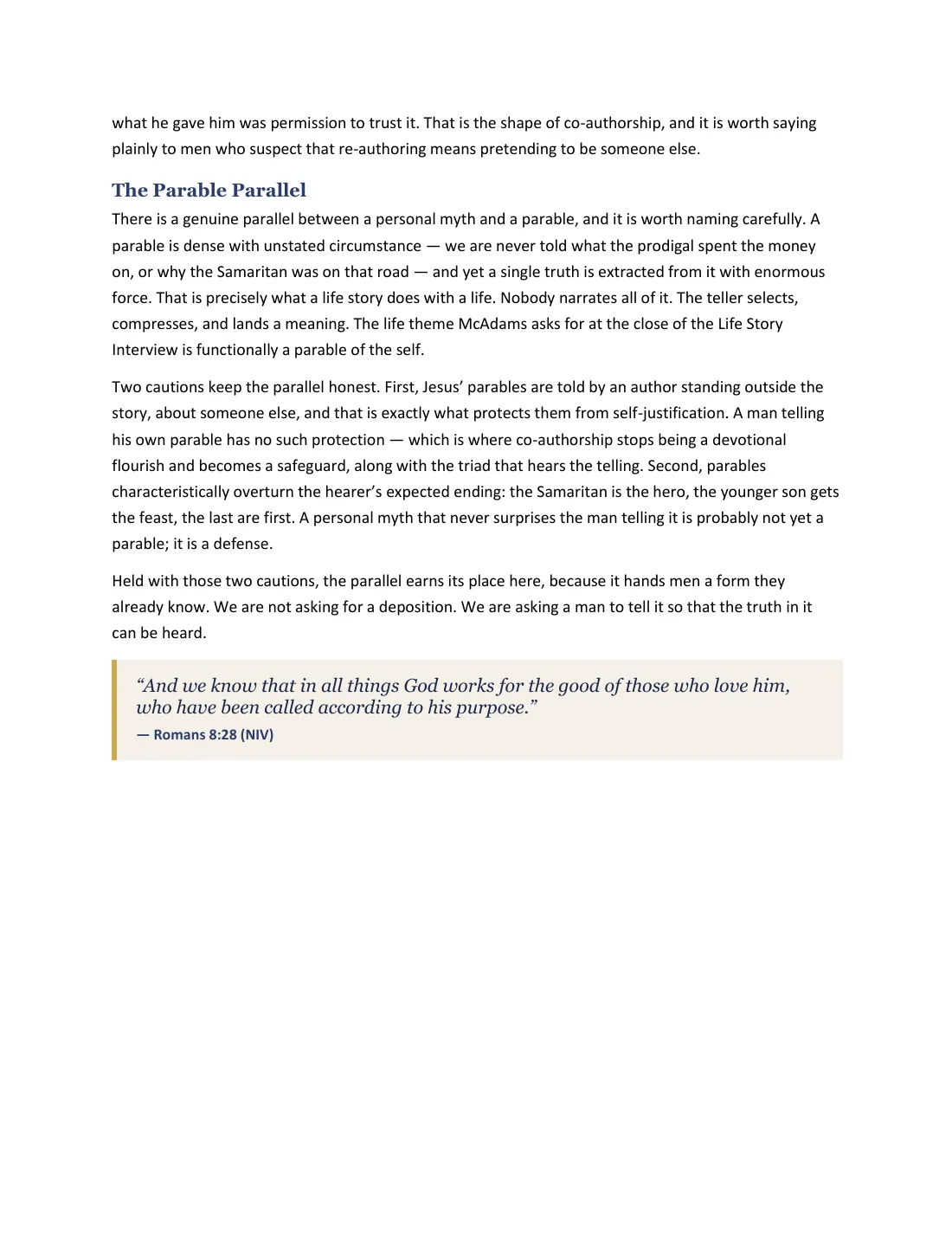
what he gave him was permission to trust it. That is the shape of co-authorship, and it is worth saying
plainly to men who suspect that re-authoring means pretending to be someone else.

The Parable Parallel
There is a genuine parallel between a personal myth and a parable, and it is worth naming carefully. A
parable is dense with unstated circumstance — we are never told what the prodigal spent the money
on, or why the Samaritan was on that road — and yet a single truth is extracted from it with enormous
force. That is precisely what a life story does with a life. Nobody narrates all of it. The teller selects,
compresses, and lands a meaning. The life theme McAdams asks for at the close of the Life Story
Interview is functionally a parable of the self.

Two cautions keep the parallel honest. First, Jesus’ parables are told by an author standing outside the
story, about someone else, and that is exactly what protects them from self-justification. A man telling
his own parable has no such protection — which is where co-authorship stops being a devotional
flourish and becomes a safeguard, along with the triad that hears the telling. Second, parables
characteristically overturn the hearer’s expected ending: the Samaritan is the hero, the younger son gets
the feast, the last are first. A personal myth that never surprises the man telling it is probably not yet a
parable; it is a defense.

Held with those two cautions, the parallel earns its place here, because it hands men a form they
already know. We are not asking for a deposition. We are asking a man to tell it so that the truth in it
can be heard.


   “And we know that in all things God works for the good of those who love him,
   who have been called according to his purpose.”
   — Romans 8:28 (NIV)
   FACILITATOR NOTE
   Do not over-spiritualize this connection in front of the group. The men will see it for
   themselves once they have done the work. Your job is to put the tools in their hands; the
   Spirit will do the integration.


A Closing Note for Facilitators
Buechner: “Listen to your life. See it for the fathomless mystery that it is. In the boredom and pain of it,
no less than in the excitement and gladness: touch, taste, smell your way to the holy and hidden heart
of it, because in the last analysis all moments are key moments, and life itself is grace.”

That is the disposition McAdams gives men permission to take. The Charter is the artifact. The story is
the substrate. Listening is the gift.