
Session 5 · Recommended Reading
Why We Write Our Story
Show the text version
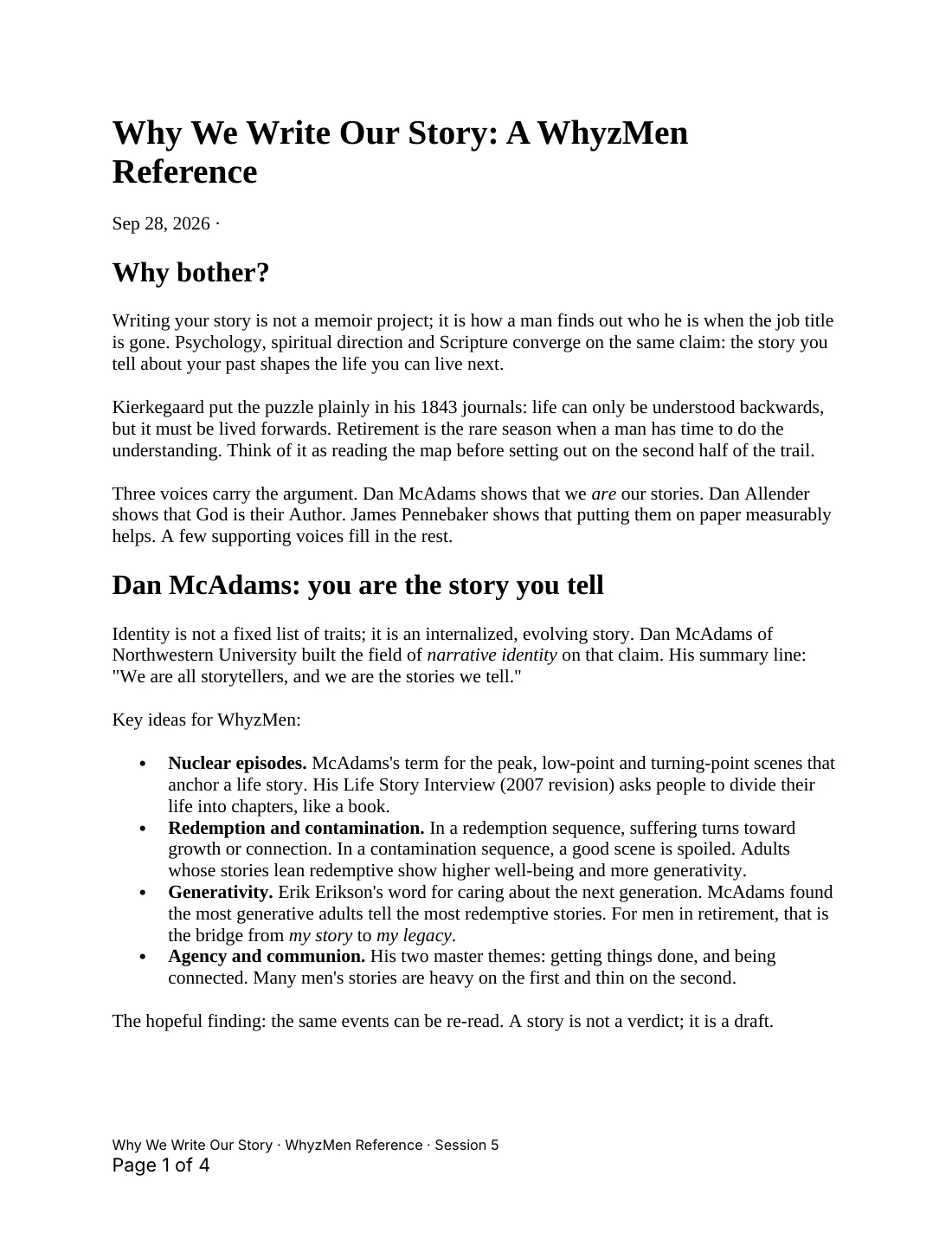
Why We Write Our Story: A WhyzMen
Reference
Sep 28, 2026 ·
Why bother?
Writing your story is not a memoir project; it is how a man finds out who he is when the job title
is gone. Psychology, spiritual direction and Scripture converge on the same claim: the story you
tell about your past shapes the life you can live next.
Kierkegaard put the puzzle plainly in his 1843 journals: life can only be understood backwards,
but it must be lived forwards. Retirement is the rare season when a man has time to do the
understanding. Think of it as reading the map before setting out on the second half of the trail.
Three voices carry the argument. Dan McAdams shows that we are our stories. Dan Allender
shows that God is their Author. James Pennebaker shows that putting them on paper measurably
helps. A few supporting voices fill in the rest.
Dan McAdams: you are the story you tell
Identity is not a fixed list of traits; it is an internalized, evolving story. Dan McAdams of
Northwestern University built the field of narrative identity on that claim. His summary line:
"We are all storytellers, and we are the stories we tell."
Key ideas for WhyzMen:
Nuclear episodes. McAdams's term for the peak, low-point and turning-point scenes that
anchor a life story. His Life Story Interview (2007 revision) asks people to divide their
life into chapters, like a book.
Redemption and contamination. In a redemption sequence, suffering turns toward
growth or connection. In a contamination sequence, a good scene is spoiled. Adults
whose stories lean redemptive show higher well-being and more generativity.
Generativity. Erik Erikson's word for caring about the next generation. McAdams found
the most generative adults tell the most redemptive stories. For men in retirement, that is
the bridge from my story to my legacy.
Agency and communion. His two master themes: getting things done, and being
connected. Many men's stories are heavy on the first and thin on the second.
The hopeful finding: the same events can be re-read. A story is not a verdict; it is a draft.
Why We Write Our Story · WhyzMen Reference · Session 5
Page 1 of 4
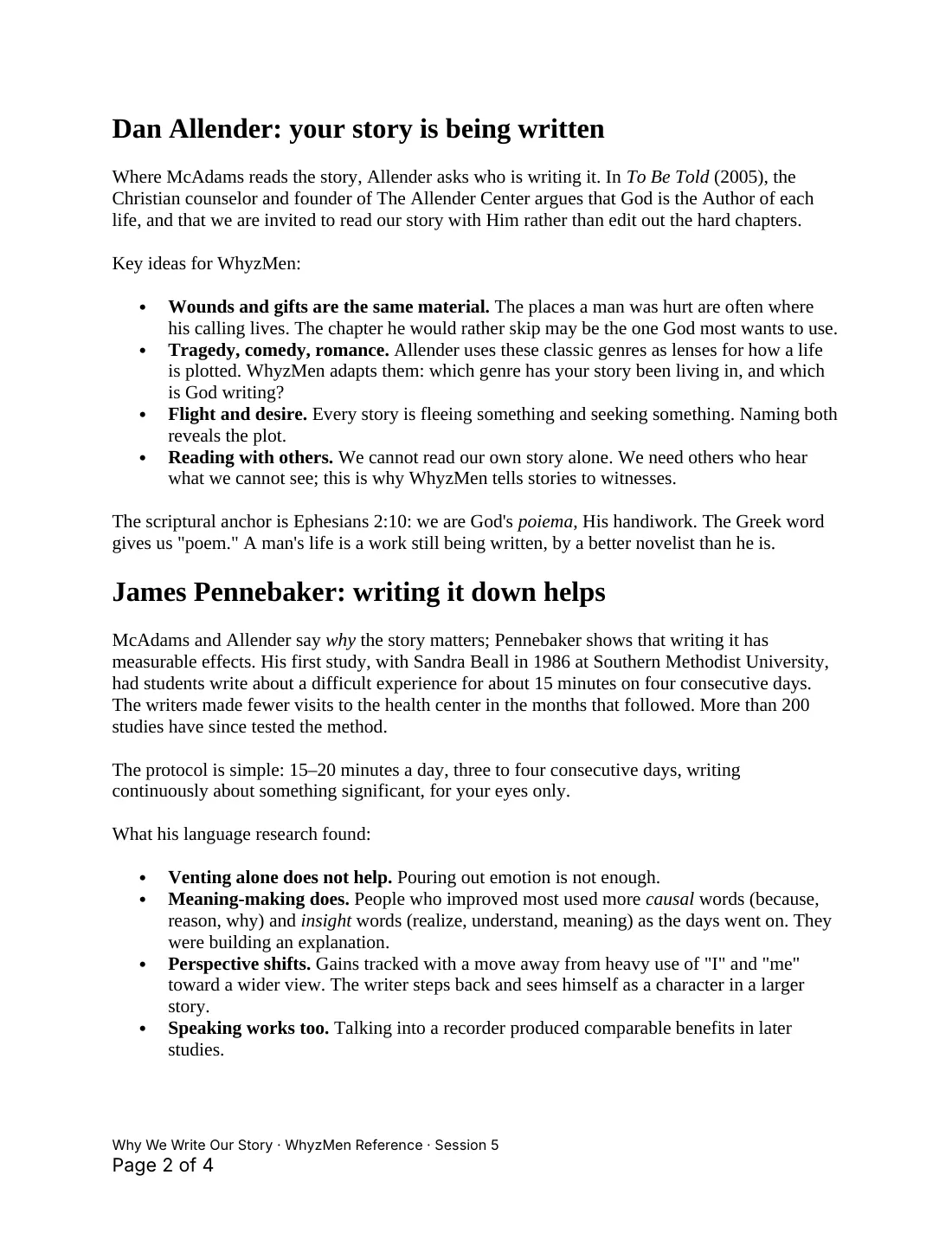
Dan Allender: your story is being written
Where McAdams reads the story, Allender asks who is writing it. In To Be Told (2005), the
Christian counselor and founder of The Allender Center argues that God is the Author of each
life, and that we are invited to read our story with Him rather than edit out the hard chapters.
Key ideas for WhyzMen:
Wounds and gifts are the same material. The places a man was hurt are often where
his calling lives. The chapter he would rather skip may be the one God most wants to use.
Tragedy, comedy, romance. Allender uses these classic genres as lenses for how a life
is plotted. WhyzMen adapts them: which genre has your story been living in, and which
is God writing?
Flight and desire. Every story is fleeing something and seeking something. Naming both
reveals the plot.
Reading with others. We cannot read our own story alone. We need others who hear
what we cannot see; this is why WhyzMen tells stories to witnesses.
The scriptural anchor is Ephesians 2:10: we are God's poiema, His handiwork. The Greek word
gives us "poem." A man's life is a work still being written, by a better novelist than he is.
James Pennebaker: writing it down helps
McAdams and Allender say why the story matters; Pennebaker shows that writing it has
measurable effects. His first study, with Sandra Beall in 1986 at Southern Methodist University,
had students write about a difficult experience for about 15 minutes on four consecutive days.
The writers made fewer visits to the health center in the months that followed. More than 200
studies have since tested the method.
The protocol is simple: 15–20 minutes a day, three to four consecutive days, writing
continuously about something significant, for your eyes only.
What his language research found:
Venting alone does not help. Pouring out emotion is not enough.
Meaning-making does. People who improved most used more causal words (because,
reason, why) and insight words (realize, understand, meaning) as the days went on. They
were building an explanation.
Perspective shifts. Gains tracked with a move away from heavy use of "I" and "me"
toward a wider view. The writer steps back and sees himself as a character in a larger
story.
Speaking works too. Talking into a recorder produced comparable benefits in later
studies.
Why We Write Our Story · WhyzMen Reference · Session 5
Page 2 of 4
One honest note: most study participants were college students of both sexes. The findings apply
to people, not specifically to retired men. WhyzMen's four-day life-story prompts are an
adaptation of his method, not his own.
Supporting voices
Jonathan Adler (Olin College, a McAdams student). His research found that three
qualities of a story track with well-being: coherence (it hangs together), complexity (it
holds mixed feelings), and positive resolution (the struggle has come to some peace). The
arc a person gives an experience predicts outcomes more than the experience itself. In
WhyzMen, resolution can include an honestly open ending, left for God to finish.
Bruce Feiler, Life Is in the Transitions (2020). After collecting 225 life stories, Feiler
found adults face a disruptor roughly every 12–18 months and three to five major
"lifequakes" in a lifetime. Retirement is one. Writing the story is how a man turns a
lifequake into a new chapter.
Frederick Buechner. The novelist and minister urged readers to listen to their lives,
paying attention to what makes them laugh and what makes them cry. His memoirs,
beginning with The Sacred Journey (1982), model a man reading his own life for traces
of God.
Scripture's own habit. Israel was told to remember and retell: Deuteronomy 6:20–25,
Psalm 78:4, and Joshua's twelve memorial stones (Joshua 4). Joseph reads his whole
story in Genesis 50:20: what others meant for evil, God meant for good. The same
Hebrew verb is used of both intentions.
How the threads weave together
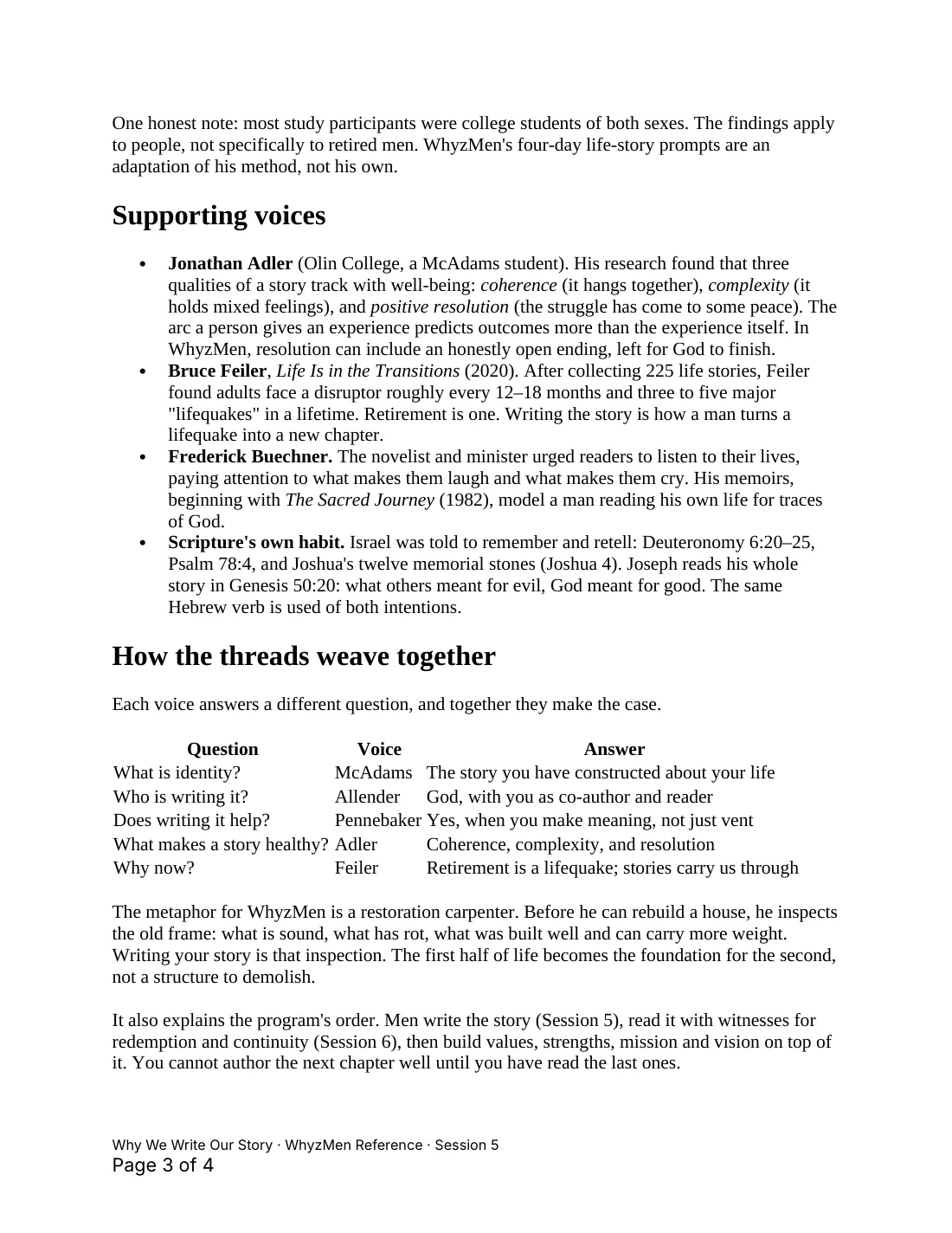
Each voice answers a different question, and together they make the case.
Question Voice Answer
What is identity? McAdams The story you have constructed about your life
Who is writing it? Allender God, with you as co-author and reader
Does writing it help? Pennebaker Yes, when you make meaning, not just vent
What makes a story healthy? Adler Coherence, complexity, and resolution
Why now? Feiler Retirement is a lifequake; stories carry us through
The metaphor for WhyzMen is a restoration carpenter. Before he can rebuild a house, he inspects
the old frame: what is sound, what has rot, what was built well and can carry more weight.
Writing your story is that inspection. The first half of life becomes the foundation for the second,
not a structure to demolish.
It also explains the program's order. Men write the story (Session 5), read it with witnesses for
redemption and continuity (Session 6), then build values, strengths, mission and vision on top of
it. You cannot author the next chapter well until you have read the last ones.
Why We Write Our Story · WhyzMen Reference · Session 5
Page 3 of 4
How to write it well
1. Write privately first. Use Pennebaker's frame: 15–20 minutes, several days in a row, no
editing, nobody reads it. Candor comes when there is no audience.
2. Then distill what you share. From the raw pages, draw out the short version you are
willing to read aloud. You share only what you choose.
3. Think in chapters and scenes. Name your life's chapters like a book (McAdams). Then
pick the peak, the valley, and the turning point.
4. Ask why, not just what. Push past the events to their meaning. Use "because," "I now
realize," "what it made of me."
5. Write small. One name, one room, one conversation. The particular carries the universal.
6. Look for the thread. What has stayed true about you across every chapter? That
continuity is the answer to retirement's quiet fear: without my role, am I still me?
7. Read it with others. Let witnesses hear what you cannot. They may see the redemption
you missed.
8. Leave room for the Author. Some chapters do not resolve yet. That is honest, not
failure.
Sources and further reading
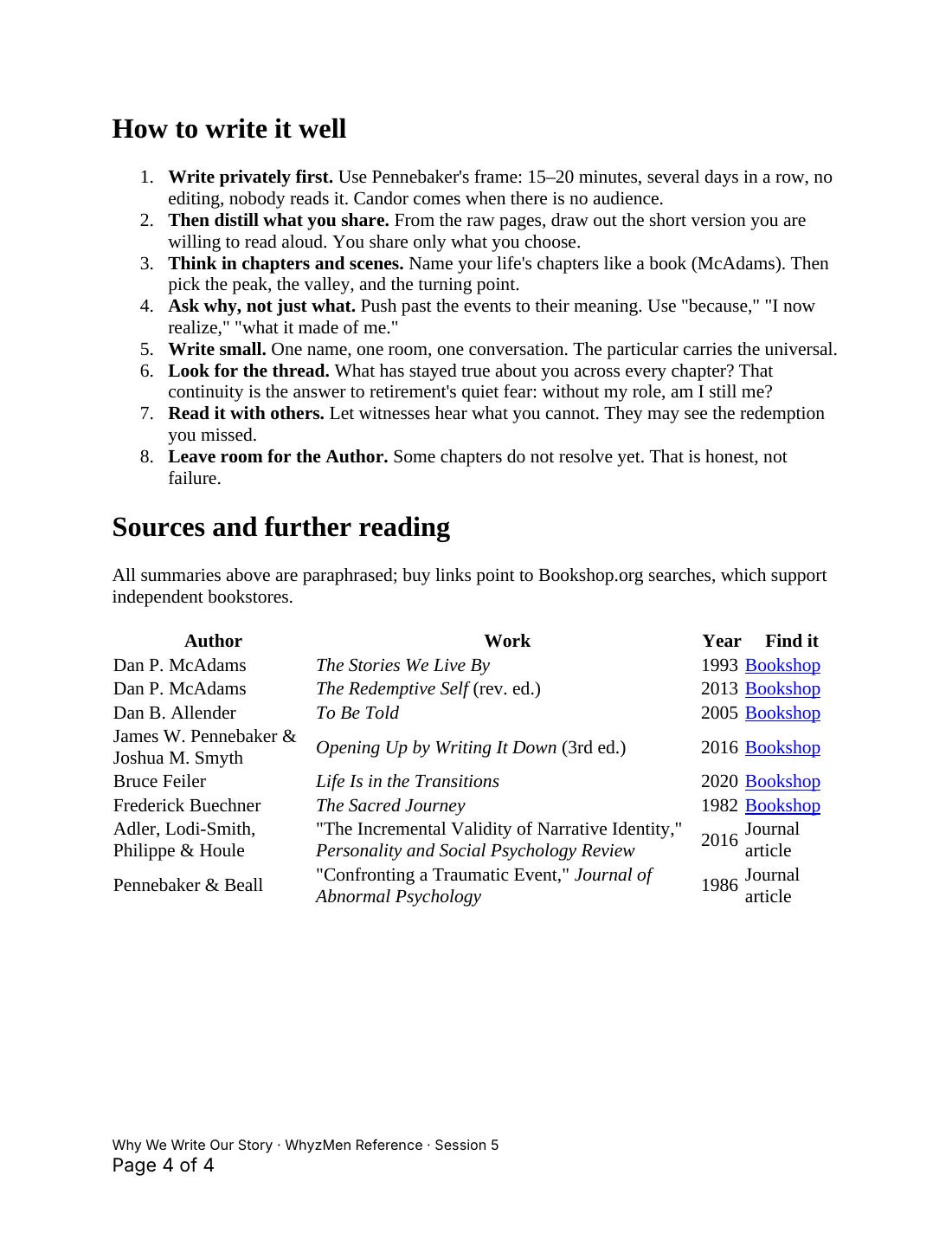
All summaries above are paraphrased; buy links point to Bookshop.org searches, which support
independent bookstores.
Author Work Year Find it
Dan P. McAdams The Stories We Live By 1993 Bookshop
Dan P. McAdams The Redemptive Self (rev. ed.) 2013 Bookshop
Dan B. Allender To Be Told 2005 Bookshop
James W. Pennebaker &
Opening Up by Writing It Down (3rd ed.) 2016 Bookshop
Joshua M. Smyth
Bruce Feiler Life Is in the Transitions 2020 Bookshop
Frederick Buechner The Sacred Journey 1982 Bookshop
Adler, Lodi-Smith, "The Incremental Validity of Narrative Identity," Journal
2016
Philippe & Houle Personality and Social Psychology Review article
"Confronting a Traumatic Event," Journal of Journal
Pennebaker & Beall 1986
Abnormal Psychology article
Why We Write Our Story · WhyzMen Reference · Session 5
Page 4 of 4