
Session 10 · Recommended Reading
Who Are Your Five? (Robin Dunbar)
Show the text version
   WHYZMEN · GO DEEPER 06 · BROTHERHOOD & CIRCLE · SESSION 10

   Who Are Your Five?
   Robin Dunbar's circles of friendship, and why the inner ring is where retired men run short

The question is not "do you have friends?" The question is "who are your five?" For most retired men the honest answer is two, and
one of them is his wife. That is where the crisis lives. Your 150 is fine. Your five is where we are working.

The circles: your social world has rings
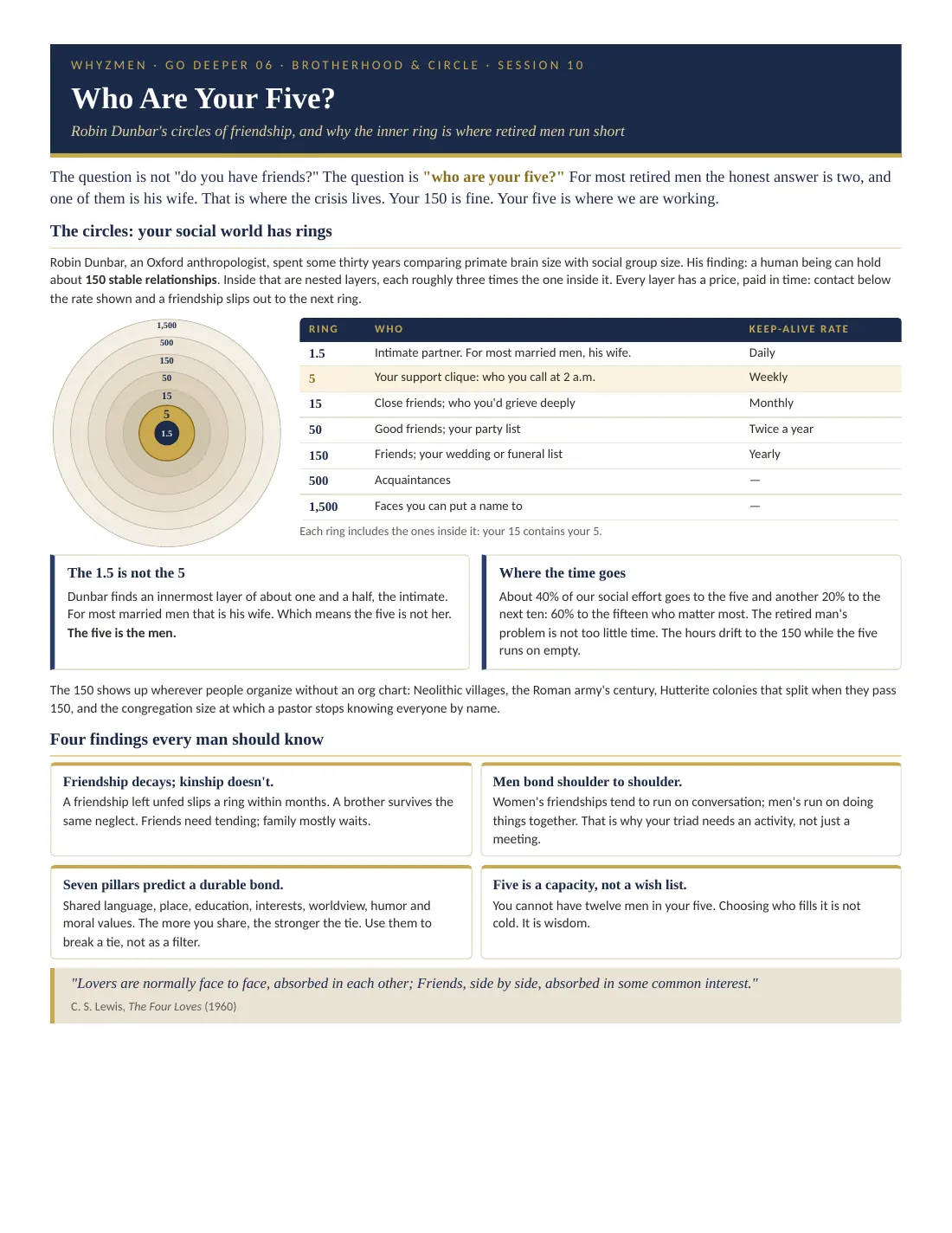
Robin Dunbar, an Oxford anthropologist, spent some thirty years comparing primate brain size with social group size. His finding: a human being can hold
about 150 stable relationships. Inside that are nested layers, each roughly three times the one inside it. Every layer has a price, paid in time: contact below
the rate shown and a friendship slips out to the next ring.
                    1,500                       RING          WHO                                                                      K E E P - A L I V E R AT E
                     500
                                                1.5           Intimate partner. For most married men, his wife.                        Daily
                     150
                     50                         5             Your support clique: who you call at 2 a.m.                              Weekly
                     15
                                                15            Close friends; who you'd grieve deeply                                   Monthly
                      5
                     1.5                        50            Good friends; your party list                                            Twice a year

                                                150           Friends; your wedding or funeral list                                    Yearly

                                                500           Acquaintances                                                            —

                                                1,500         Faces you can put a name to                                              —
                                               Each ring includes the ones inside it: your 15 contains your 5.


   The 1.5 is not the 5                                                                 Where the time goes
   Dunbar finds an innermost layer of about one and a half, the intimate.               About 40% of our social effort goes to the five and another 20% to the
   For most married men that is his wife. Which means the five is not her.              next ten: 60% to the fifteen who matter most. The retired man's
   The five is the men.                                                                 problem is not too little time. The hours drift to the 150 while the five
                                                                                        runs on empty.

The 150 shows up wherever people organize without an org chart: Neolithic villages, the Roman army's century, Hutterite colonies that split when they pass
150, and the congregation size at which a pastor stops knowing everyone by name.

Four findings every man should know

  Friendship decays; kinship doesn't.                                                  Men bond shoulder to shoulder.
  A friendship left unfed slips a ring within months. A brother survives the           Women's friendships tend to run on conversation; men's run on doing
  same neglect. Friends need tending; family mostly waits.                             things together. That is why your triad needs an activity, not just a
                                                                                       meeting.


  Seven pillars predict a durable bond.                                                Five is a capacity, not a wish list.
  Shared language, place, education, interests, worldview, humor and                   You cannot have twelve men in your five. Choosing who fills it is not
  moral values. The more you share, the stronger the tie. Use them to                  cold. It is wisdom.
  break a tie, not as a filter.


   "Lovers are normally face to face, absorbed in each other; Friends, side by side, absorbed in some common interest."
   C. S. Lewis, The Four Loves (1960)
The cold math
For some men friendship takes care of itself: the golf group, the cigar night, the friends who never moved away. For most men it does not. These numbers
are for them.

   M E N A N D F R I E N D S H I P, B Y T H E N U M B E R S

   15%                                                              40% → 15%                                                        1 in 5
   of American men report no close friends, up from                 men with ten or more close friends, 1990 to 2021.                men got emotional support from a friend in the
   3% in 1990.                                                                                                                       past week.

   200 hours                                                        15 cigarettes                                                    +50%
   together, roughly, to turn an acquaintance into a                a day: the health risk of loneliness, by one widely              better odds of survival for people with strong
   close friend.                                                    cited comparison.                                                social ties (148 studies).

   The Harvard Study of Adult Development, now past 85 years: the men most satisfied in their relationships at 50 were the healthiest at 80. Most of
   you are between those ages.


Do the arithmetic. A triad that meets ninety minutes a month and does one ordinary thing together in between reaches 200 hours in under two years. The
structure is the whole difference. This is a design problem, not a character problem. The structures that used to produce friendship (the job, the kids' teams,
the neighborhood) disappeared, and nobody handed you new blueprints.

The Recipe: a maintenance schedule for your five
A monthly triad meeting, by itself, keeps a man in your fifteen. What makes him a five is what happens between meetings.
  Every week                                 One personal touch for each man in your five: a text, a call, a porch visit (not a group text). Plus one shoulder-to-shoulder
                                             hour with at least one of them.
  Every month                                Your triad meets. One invitation goes out to a man in your fifteen.
  Every quarter                              Host one thing: six to twelve men, wives if it fits. This is how a fifteen becomes a fifty, and a fifty yields your next five.
  Every year                                 Reread your five. Redraw your circle. Go one rung deeper with one man.
Hours are the currency. Weekly keeps a five. The calendar, not the feeling, decides. Too much? You take a pill every morning for a heart you cannot see. This is ten minutes
a week for the men you can.

What turns three friends into a "we"
Three friendships are not yet a group. Dunbar's research finds that a few shared acts release the endorphins that bond a group: eat together, laugh
together, pray or sing together, tell the same stories, and keep a ritual. The meal and the closing prayer are the mechanism, not decoration. Break bread at
every meeting.


    Your turn: who are your five?
    Current reality, not wishful thinking. Few names is normal; the ring is what we are filling.
    NAME                                                                                                             W H AT ' S M I S S I N G ?

    1.
    2.
    3.
    4.
    5.
    Three names from the cohort, two from beyond the room (a drifted friend, a neighbor, someone who was once a fifteen). For each, name the missing practice:
    proximity, activity, initiative, vulnerability, or a container.


                      "Though one may be overpowered, two can defend themselves. A cord of three strands is not quickly broken."
                                                                                         Ecclesiastes 4:12

Sources. Robin Dunbar, Friends: Understanding the Power of Our Most Important Relationships (2021); Sam Roberts & Robin Dunbar, "Communication in social networks: Effects of kinship, network
size, and emotional closeness," Personal Relationships (2011); Dunbar, "Breaking Bread: the Functions of Social Eating," Adaptive Human Behavior and Physiology (2017); Daniel Cox, The State of
American Friendship, American Perspectives Survey, Survey Center on American Life (2021); Jeffrey Hall, "How many hours does it take to make a friend?" Journal of Social and Personal Relationships
(2019); Julianne Holt-Lunstad, Timothy Smith & J. Bradley Layton, "Social Relationships and Mortality Risk," PLoS Medicine (2010); U.S. Surgeon General, Our Epidemic of Loneliness and Isolation
(2023); Robert Waldinger & Marc Schulz, The Good Life (2023); C. S. Lewis, The Four Loves (1960).

Wise men still seek, knowing their why's.                                                                                                             WHYZMEN · GO DEEPER 06 · ©2026