
Session 11 · Going Deeper
Cultivating Purpose (Burrow)
Show the text version
                                                            WhyzMen · Read Deeper · Cultivating Purpose


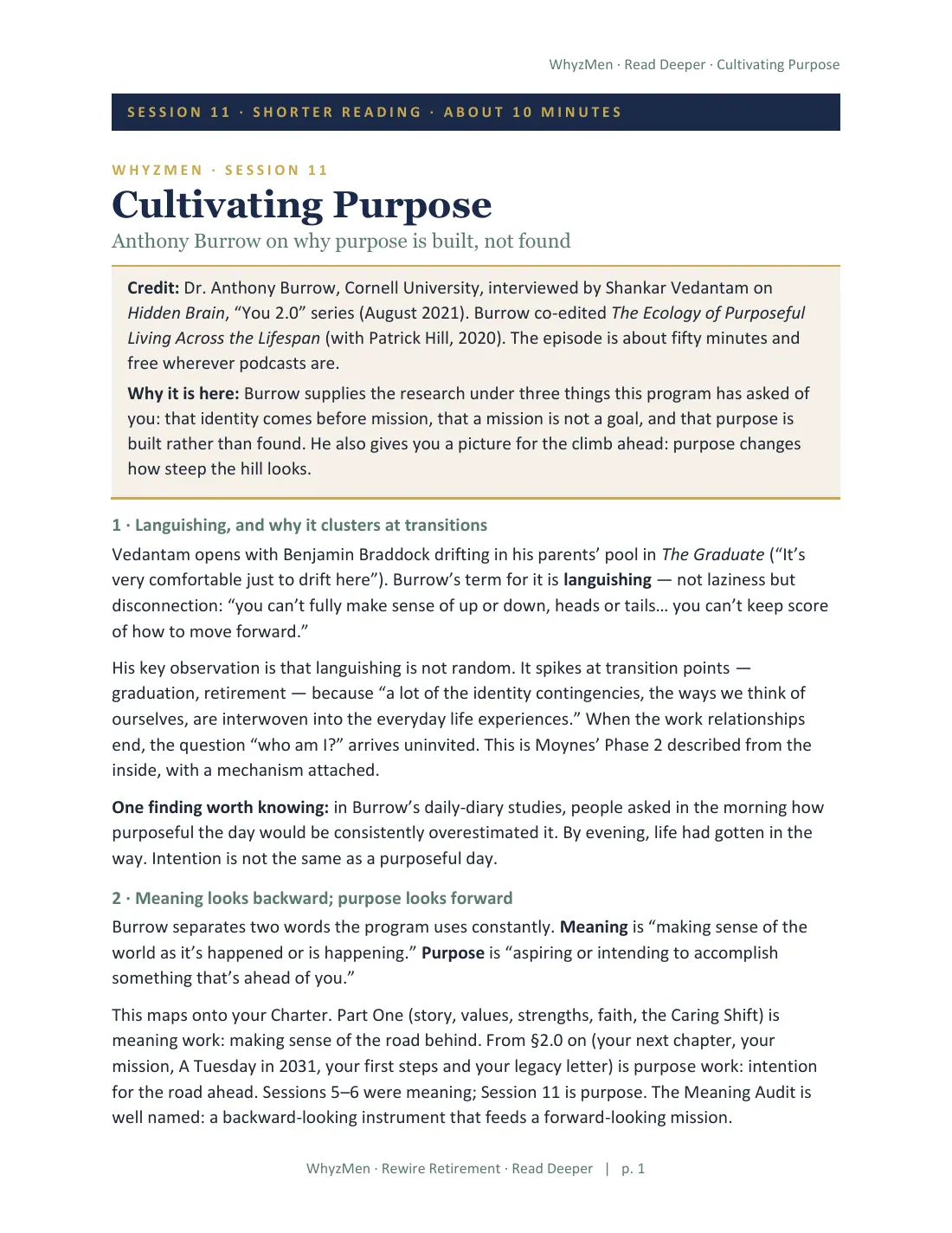
  SESSION 11 · SHORTER READING · ABOUT 10 MINUTES


WHYZMEN · SESSION 11

Cultivating Purpose
Anthony Burrow on why purpose is built, not found

  Credit: Dr. Anthony Burrow, Cornell University, interviewed by Shankar Vedantam on
  Hidden Brain, “You 2.0” series (August 2021). Burrow co-edited The Ecology of Purposeful
  Living Across the Lifespan (with Patrick Hill, 2020). The episode is about fifty minutes and
  free wherever podcasts are.
  Why it is here: Burrow supplies the research under three things this program has asked of
  you: that identity comes before mission, that a mission is not a goal, and that purpose is
  built rather than found. He also gives you a picture for the climb ahead: purpose changes
  how steep the hill looks.


1 · Languishing, and why it clusters at transitions
Vedantam opens with Benjamin Braddock drifting in his parents’ pool in The Graduate (“It’s
very comfortable just to drift here”). Burrow’s term for it is languishing — not laziness but
disconnection: “you can’t fully make sense of up or down, heads or tails… you can’t keep score
of how to move forward.”
His key observation is that languishing is not random. It spikes at transition points —
graduation, retirement — because “a lot of the identity contingencies, the ways we think of
ourselves, are interwoven into the everyday life experiences.” When the work relationships
end, the question “who am I?” arrives uninvited. This is Moynes’ Phase 2 described from the
inside, with a mechanism attached.
One finding worth knowing: in Burrow’s daily-diary studies, people asked in the morning how
purposeful the day would be consistently overestimated it. By evening, life had gotten in the
way. Intention is not the same as a purposeful day.

2 · Meaning looks backward; purpose looks forward
Burrow separates two words the program uses constantly. Meaning is “making sense of the
world as it’s happened or is happening.” Purpose is “aspiring or intending to accomplish
something that’s ahead of you.”
This maps onto your Charter. Part One (story, values, strengths, faith, the Caring Shift) is
meaning work: making sense of the road behind. From §2.0 on (your next chapter, your
mission, A Tuesday in 2031, your first steps and your legacy letter) is purpose work: intention
for the road ahead. Sessions 5–6 were meaning; Session 11 is purpose. The Meaning Audit is
well named: a backward-looking instrument that feeds a forward-looking mission.

                          WhyzMen · Rewire Retirement · Read Deeper | p. 1
                                                            WhyzMen · Read Deeper · Cultivating Purpose

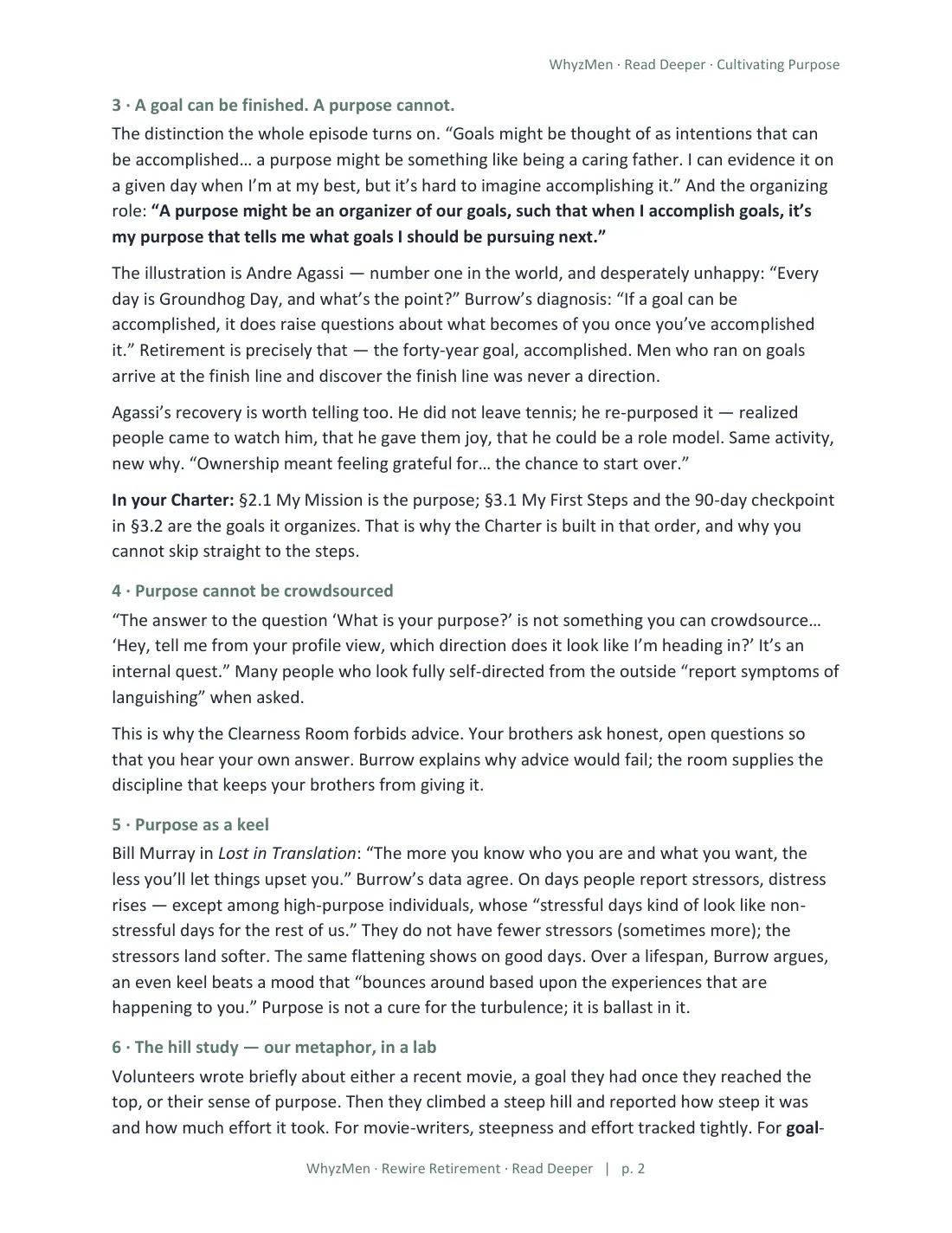
3 · A goal can be finished. A purpose cannot.
The distinction the whole episode turns on. “Goals might be thought of as intentions that can
be accomplished… a purpose might be something like being a caring father. I can evidence it on
a given day when I’m at my best, but it’s hard to imagine accomplishing it.” And the organizing
role: “A purpose might be an organizer of our goals, such that when I accomplish goals, it’s
my purpose that tells me what goals I should be pursuing next.”
The illustration is Andre Agassi — number one in the world, and desperately unhappy: “Every
day is Groundhog Day, and what’s the point?” Burrow’s diagnosis: “If a goal can be
accomplished, it does raise questions about what becomes of you once you’ve accomplished
it.” Retirement is precisely that — the forty-year goal, accomplished. Men who ran on goals
arrive at the finish line and discover the finish line was never a direction.
Agassi’s recovery is worth telling too. He did not leave tennis; he re-purposed it — realized
people came to watch him, that he gave them joy, that he could be a role model. Same activity,
new why. “Ownership meant feeling grateful for… the chance to start over.”
In your Charter: §2.1 My Mission is the purpose; §3.1 My First Steps and the 90-day checkpoint
in §3.2 are the goals it organizes. That is why the Charter is built in that order, and why you
cannot skip straight to the steps.

4 · Purpose cannot be crowdsourced
“The answer to the question ‘What is your purpose?’ is not something you can crowdsource…
‘Hey, tell me from your profile view, which direction does it look like I’m heading in?’ It’s an
internal quest.” Many people who look fully self-directed from the outside “report symptoms of
languishing” when asked.
This is why the Clearness Room forbids advice. Your brothers ask honest, open questions so
that you hear your own answer. Burrow explains why advice would fail; the room supplies the
discipline that keeps your brothers from giving it.

5 · Purpose as a keel
Bill Murray in Lost in Translation: “The more you know who you are and what you want, the
less you’ll let things upset you.” Burrow’s data agree. On days people report stressors, distress
rises — except among high-purpose individuals, whose “stressful days kind of look like non-
stressful days for the rest of us.” They do not have fewer stressors (sometimes more); the
stressors land softer. The same flattening shows on good days. Over a lifespan, Burrow argues,
an even keel beats a mood that “bounces around based upon the experiences that are
happening to you.” Purpose is not a cure for the turbulence; it is ballast in it.

6 · The hill study — our metaphor, in a lab
Volunteers wrote briefly about either a recent movie, a goal they had once they reached the
top, or their sense of purpose. Then they climbed a steep hill and reported how steep it was
and how much effort it took. For movie-writers, steepness and effort tracked tightly. For goal-

                          WhyzMen · Rewire Retirement · Read Deeper | p. 2
                                                            WhyzMen · Read Deeper · Cultivating Purpose

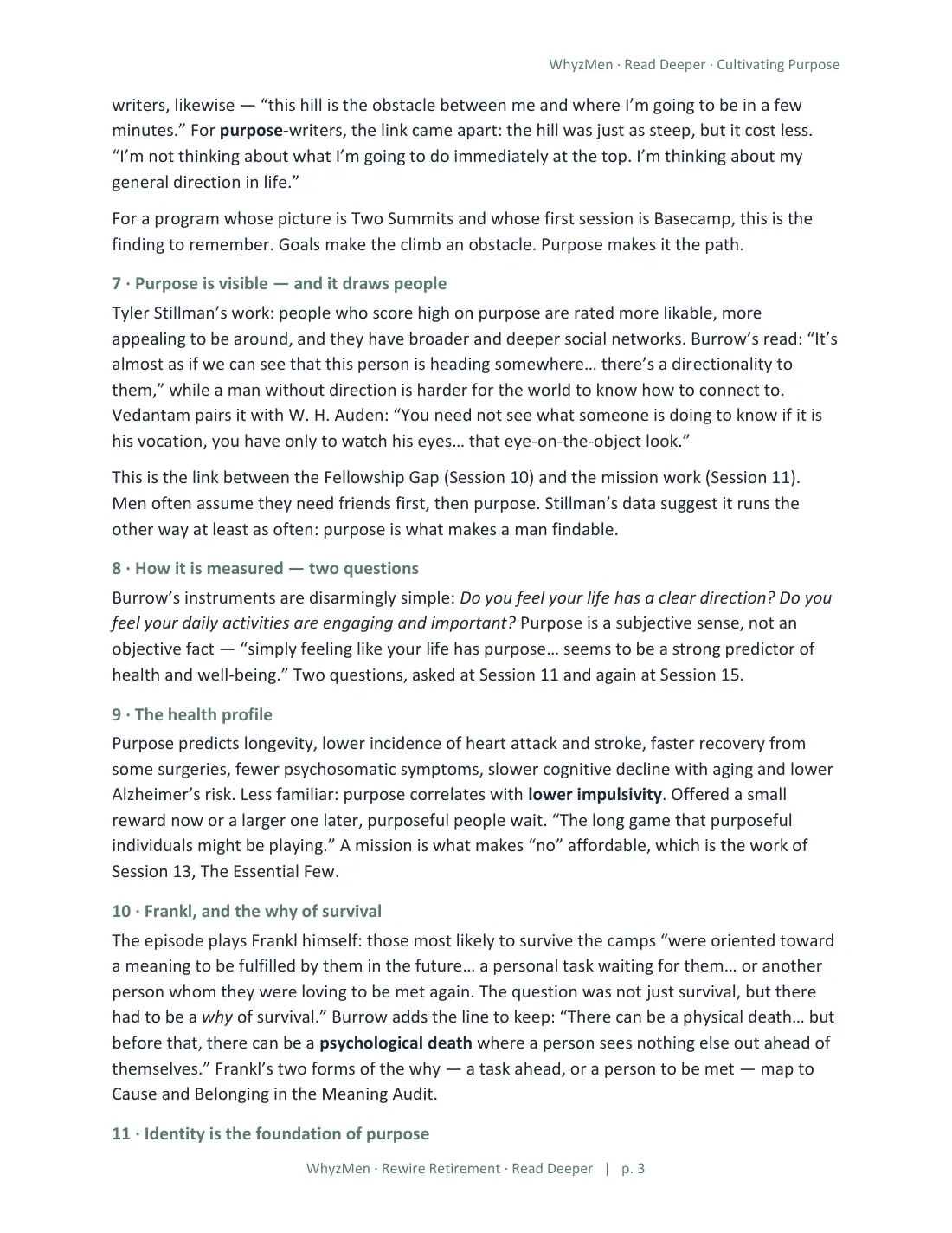
writers, likewise — “this hill is the obstacle between me and where I’m going to be in a few
minutes.” For purpose-writers, the link came apart: the hill was just as steep, but it cost less.
“I’m not thinking about what I’m going to do immediately at the top. I’m thinking about my
general direction in life.”
For a program whose picture is Two Summits and whose first session is Basecamp, this is the
finding to remember. Goals make the climb an obstacle. Purpose makes it the path.

7 · Purpose is visible — and it draws people
Tyler Stillman’s work: people who score high on purpose are rated more likable, more
appealing to be around, and they have broader and deeper social networks. Burrow’s read: “It’s
almost as if we can see that this person is heading somewhere… there’s a directionality to
them,” while a man without direction is harder for the world to know how to connect to.
Vedantam pairs it with W. H. Auden: “You need not see what someone is doing to know if it is
his vocation, you have only to watch his eyes… that eye-on-the-object look.”
This is the link between the Fellowship Gap (Session 10) and the mission work (Session 11).
Men often assume they need friends first, then purpose. Stillman’s data suggest it runs the
other way at least as often: purpose is what makes a man findable.

8 · How it is measured — two questions
Burrow’s instruments are disarmingly simple: Do you feel your life has a clear direction? Do you
feel your daily activities are engaging and important? Purpose is a subjective sense, not an
objective fact — “simply feeling like your life has purpose… seems to be a strong predictor of
health and well-being.” Two questions, asked at Session 11 and again at Session 15.

9 · The health profile
Purpose predicts longevity, lower incidence of heart attack and stroke, faster recovery from
some surgeries, fewer psychosomatic symptoms, slower cognitive decline with aging and lower
Alzheimer’s risk. Less familiar: purpose correlates with lower impulsivity. Offered a small
reward now or a larger one later, purposeful people wait. “The long game that purposeful
individuals might be playing.” A mission is what makes “no” affordable, which is the work of
Session 13, The Essential Few.

10 · Frankl, and the why of survival
The episode plays Frankl himself: those most likely to survive the camps “were oriented toward
a meaning to be fulfilled by them in the future… a personal task waiting for them… or another
person whom they were loving to be met again. The question was not just survival, but there
had to be a why of survival.” Burrow adds the line to keep: “There can be a physical death… but
before that, there can be a psychological death where a person sees nothing else out ahead of
themselves.” Frankl’s two forms of the why — a task ahead, or a person to be met — map to
Cause and Belonging in the Meaning Audit.

11 · Identity is the foundation of purpose
                          WhyzMen · Rewire Retirement · Read Deeper | p. 3
                                                             WhyzMen · Read Deeper · Cultivating Purpose

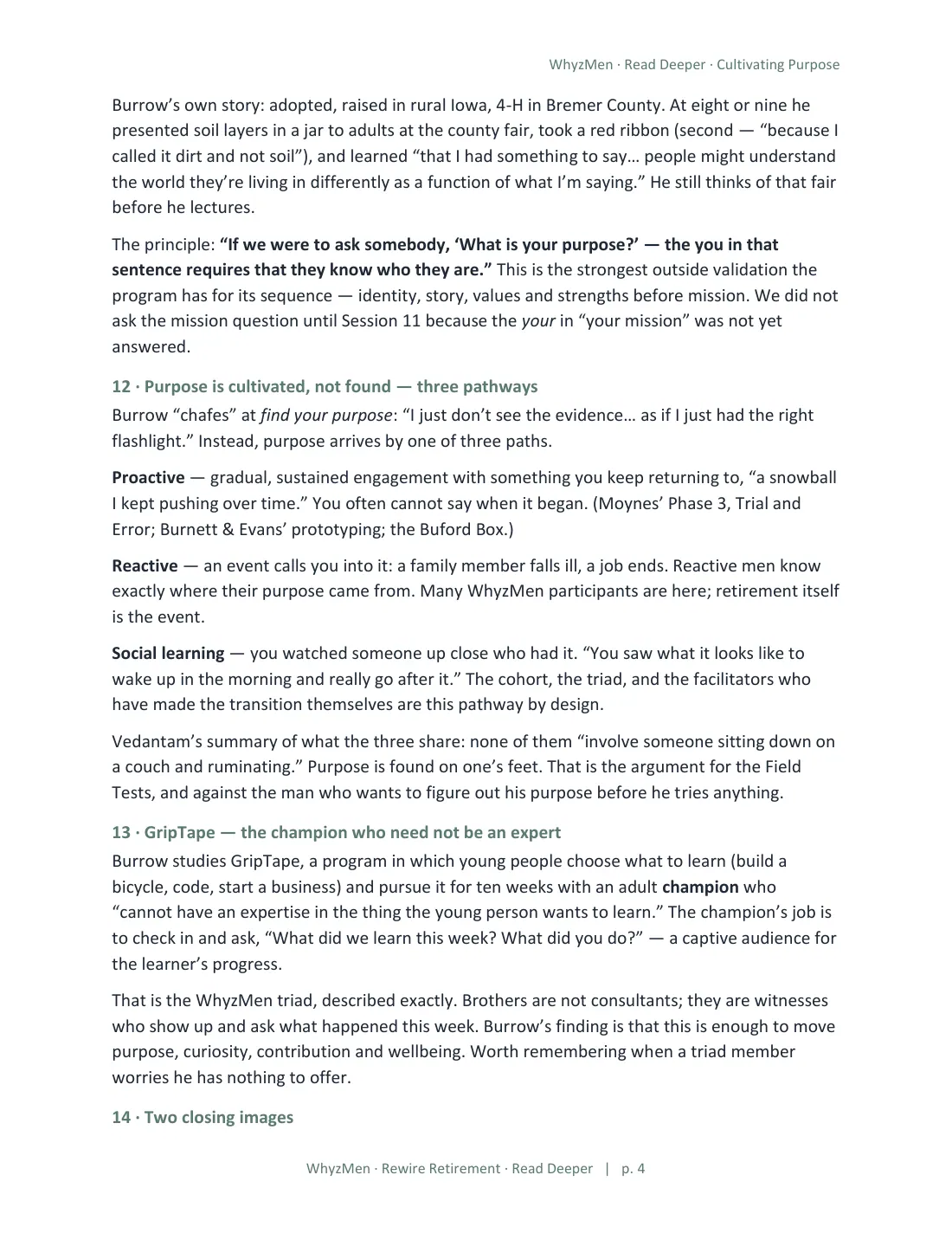
Burrow’s own story: adopted, raised in rural Iowa, 4-H in Bremer County. At eight or nine he
presented soil layers in a jar to adults at the county fair, took a red ribbon (second — “because I
called it dirt and not soil”), and learned “that I had something to say… people might understand
the world they’re living in differently as a function of what I’m saying.” He still thinks of that fair
before he lectures.
The principle: “If we were to ask somebody, ‘What is your purpose?’ — the you in that
sentence requires that they know who they are.” This is the strongest outside validation the
program has for its sequence — identity, story, values and strengths before mission. We did not
ask the mission question until Session 11 because the your in “your mission” was not yet
answered.

12 · Purpose is cultivated, not found — three pathways
Burrow “chafes” at find your purpose: “I just don’t see the evidence… as if I just had the right
flashlight.” Instead, purpose arrives by one of three paths.
Proactive — gradual, sustained engagement with something you keep returning to, “a snowball
I kept pushing over time.” You often cannot say when it began. (Moynes’ Phase 3, Trial and
Error; Burnett & Evans’ prototyping; the Buford Box.)
Reactive — an event calls you into it: a family member falls ill, a job ends. Reactive men know
exactly where their purpose came from. Many WhyzMen participants are here; retirement itself
is the event.
Social learning — you watched someone up close who had it. “You saw what it looks like to
wake up in the morning and really go after it.” The cohort, the triad, and the facilitators who
have made the transition themselves are this pathway by design.
Vedantam’s summary of what the three share: none of them “involve someone sitting down on
a couch and ruminating.” Purpose is found on one’s feet. That is the argument for the Field
Tests, and against the man who wants to figure out his purpose before he tries anything.

13 · GripTape — the champion who need not be an expert
Burrow studies GripTape, a program in which young people choose what to learn (build a
bicycle, code, start a business) and pursue it for ten weeks with an adult champion who
“cannot have an expertise in the thing the young person wants to learn.” The champion’s job is
to check in and ask, “What did we learn this week? What did you do?” — a captive audience for
the learner’s progress.
That is the WhyzMen triad, described exactly. Brothers are not consultants; they are witnesses
who show up and ask what happened this week. Burrow’s finding is that this is enough to move
purpose, curiosity, contribution and wellbeing. Worth remembering when a triad member
worries he has nothing to offer.

14 · Two closing images

                           WhyzMen · Rewire Retirement · Read Deeper | p. 4
                                                                   WhyzMen · Read Deeper · Cultivating Purpose

Kendrick Lamar, “Good Kid” — Burrow’s reminder that some people’s “menu of possible selves”
is constrained by their environment, and that “we all play a role in other people’s purpose
development.” A church cohort is, among other things, one man widening another man’s
menu.
Mae Jemison — her stated purpose is travel to the nearest star, which no current propulsion
can reach. Burrow calls it “a trick”: naming a destination far beyond the horizon organizes
everything we must build in the here and now. A Second Summit no man will fully climb is not a
flaw in the metaphor. It is the point of it.

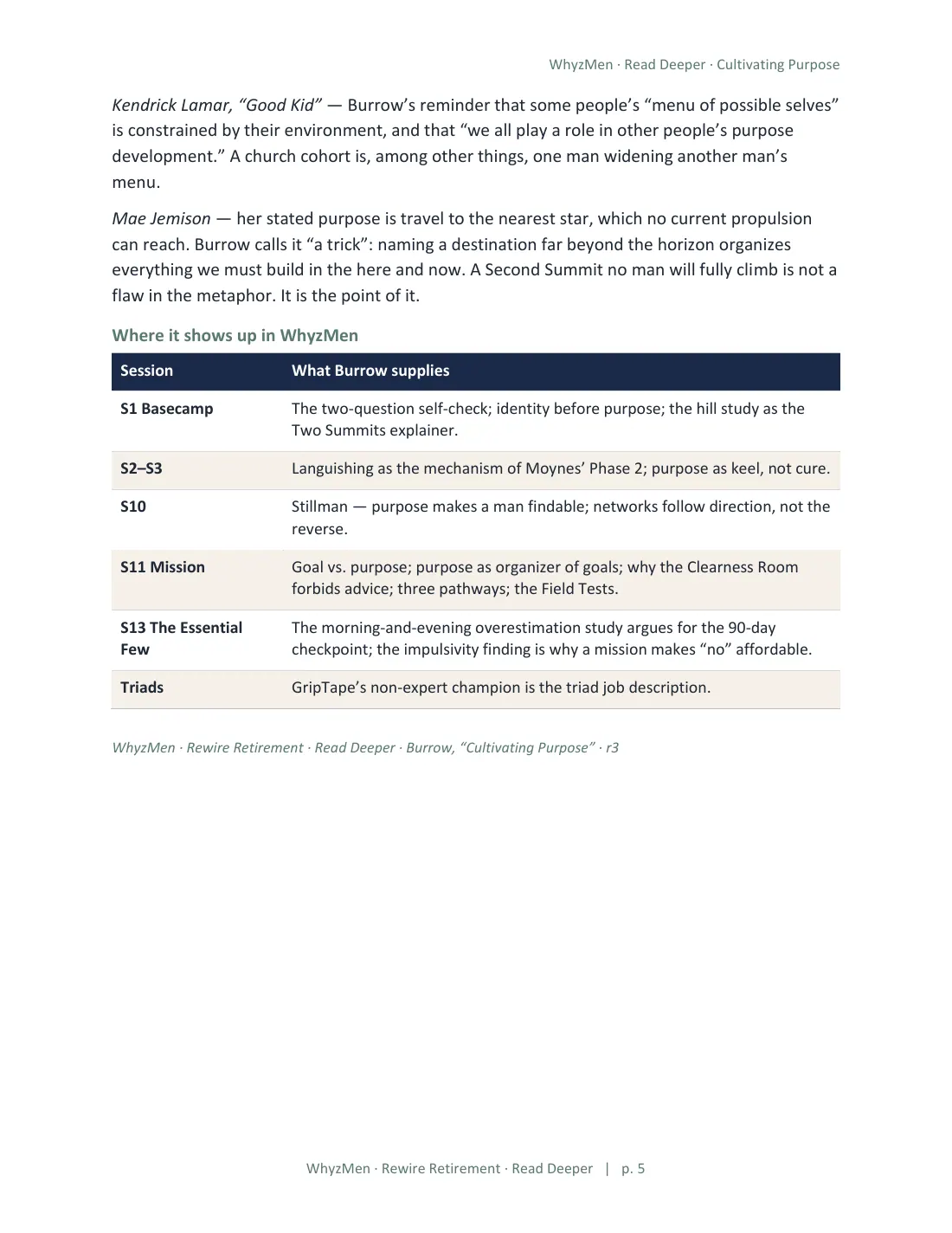
Where it shows up in WhyzMen
 Session                   What Burrow supplies

 S1 Basecamp               The two-question self-check; identity before purpose; the hill study as the
                           Two Summits explainer.

 S2–S3                     Languishing as the mechanism of Moynes’ Phase 2; purpose as keel, not cure.

 S10                       Stillman — purpose makes a man findable; networks follow direction, not the
                           reverse.

 S11 Mission               Goal vs. purpose; purpose as organizer of goals; why the Clearness Room
                           forbids advice; three pathways; the Field Tests.

 S13 The Essential         The morning-and-evening overestimation study argues for the 90-day
 Few                       checkpoint; the impulsivity finding is why a mission makes “no” affordable.

 Triads                    GripTape’s non-expert champion is the triad job description.


WhyzMen · Rewire Retirement · Read Deeper · Burrow, “Cultivating Purpose” · r3


                             WhyzMen · Rewire Retirement · Read Deeper | p. 5