
Session 11 · Recommended Reading
The Meaning Audit
Show the text version
WHYZMEN · Rewire Retirement | The Meaning Audit · A Reference

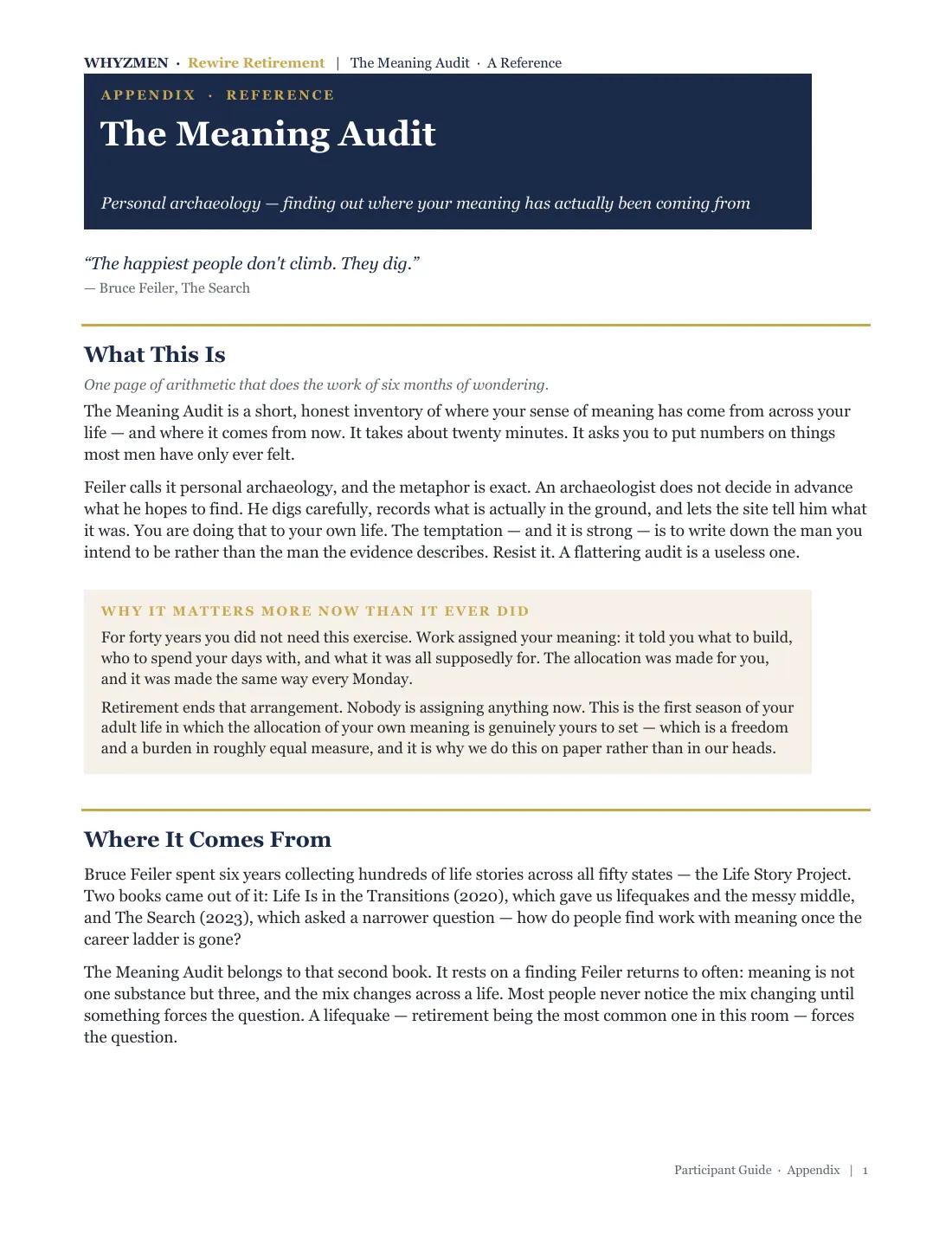
  APPENDIX         ·   REFERENCE


  The Meaning Audit
  Personal archaeology — finding out where your meaning has actually been coming from


“The happiest people don't climb. They dig.”
— Bruce Feiler, The Search


What This Is
One page of arithmetic that does the work of six months of wondering.
The Meaning Audit is a short, honest inventory of where your sense of meaning has come from across your
life — and where it comes from now. It takes about twenty minutes. It asks you to put numbers on things
most men have only ever felt.
Feiler calls it personal archaeology, and the metaphor is exact. An archaeologist does not decide in advance
what he hopes to find. He digs carefully, records what is actually in the ground, and lets the site tell him what
it was. You are doing that to your own life. The temptation — and it is strong — is to write down the man you
intend to be rather than the man the evidence describes. Resist it. A flattering audit is a useless one.


  WHY IT MATTERS MORE NOW THAN IT EVER DID

  For forty years you did not need this exercise. Work assigned your meaning: it told you what to build,
  who to spend your days with, and what it was all supposedly for. The allocation was made for you,
  and it was made the same way every Monday.
  Retirement ends that arrangement. Nobody is assigning anything now. This is the first season of your
  adult life in which the allocation of your own meaning is genuinely yours to set — which is a freedom
  and a burden in roughly equal measure, and it is why we do this on paper rather than in our heads.


Where It Comes From
Bruce Feiler spent six years collecting hundreds of life stories across all fifty states — the Life Story Project.
Two books came out of it: Life Is in the Transitions (2020), which gave us lifequakes and the messy middle,
and The Search (2023), which asked a narrower question — how do people find work with meaning once the
career ladder is gone?
The Meaning Audit belongs to that second book. It rests on a finding Feiler returns to often: meaning is not
one substance but three, and the mix changes across a life. Most people never notice the mix changing until
something forces the question. A lifequake — retirement being the most common one in this room — forces
the question.


                                                                                      Participant Guide · Appendix | 1
WHYZMEN · Rewire Retirement | The Meaning Audit · A Reference


The Audit
Two steps. Twenty minutes. Do them in order.

  STEP ONE · NAME THE POSTPONED DREAM

  Before the arithmetic, one question — and Feiler considers it the more important of the two.

  What dream have I postponed for most of my life?


  If I do not pursue it in this third act, will it still be available to me later?


  Feiler's blunt observation is that most people answer the second question honestly and immediately, and
  that the honest answer is usually no. That is not meant to frighten you. It is meant to move the dream
  from the someday column into a column with a date on it.


Step Two · The Hundred Points
Twice. Once for the man you were, once for the man you are.
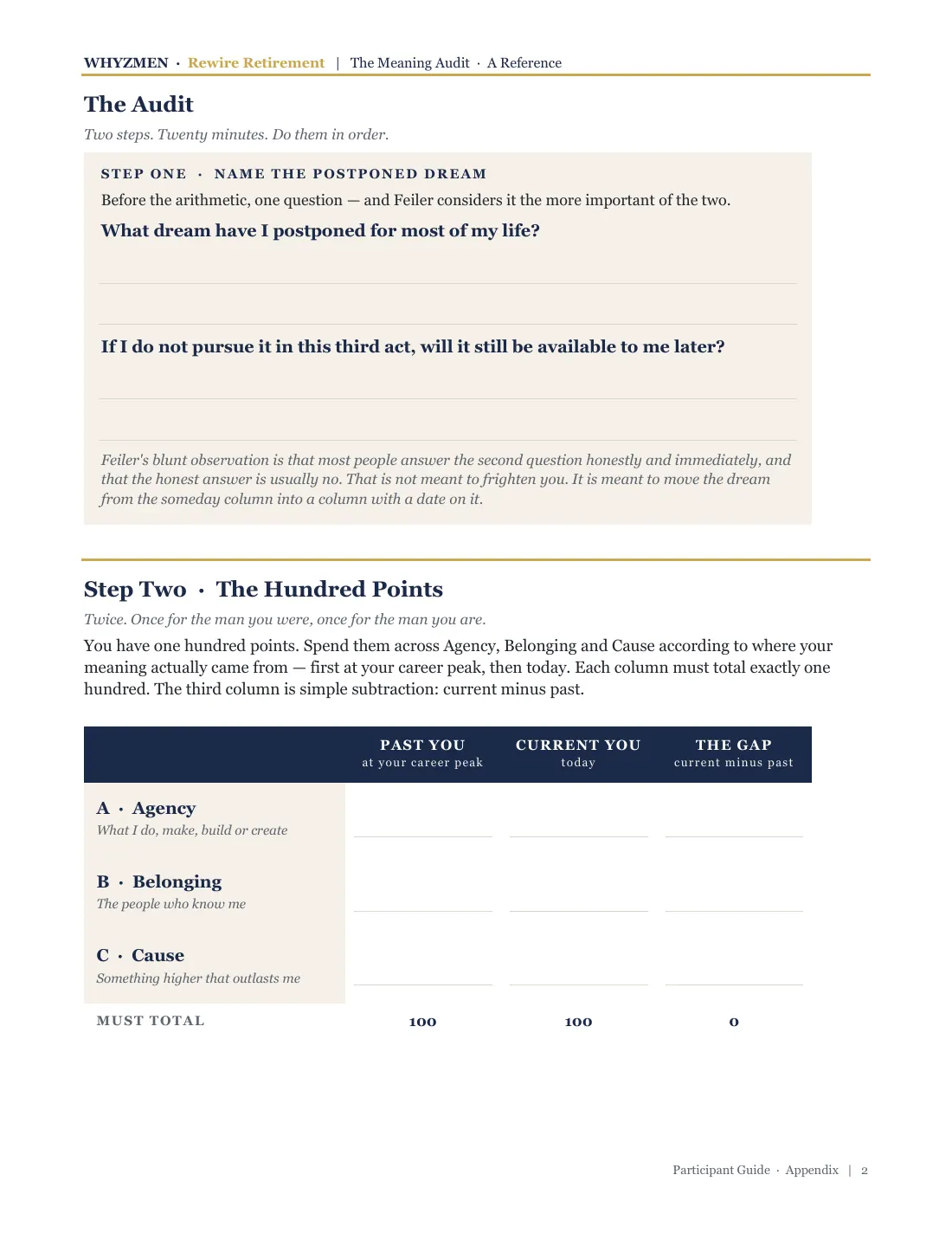
You have one hundred points. Spend them across Agency, Belonging and Cause according to where your
meaning actually came from — first at your career peak, then today. Each column must total exactly one
hundred. The third column is simple subtraction: current minus past.


                                           PAST YOU                CURRENT YOU             THE GAP
                                        at yo ur c ar e er p eak       t oda y         c urr e nt m i n us p ast


 A · Agency
 What I do, make, build or create


 B · Belonging
 The people who know me


 C · Cause
 Something higher that outlasts me


 MUST TOTAL                                      100                   100                        0


                                                                                       Participant Guide · Appendix | 2
WHYZMEN · Rewire Retirement | The Meaning Audit · A Reference


Four Rules for an Honest Audit
The exercise is only as good as the flinching you refuse to do.
 • Numbers before narrative. Write all six figures down before you let yourself explain any of them. The
    explaining is where the flattery gets in.
 • Past You means the peak, not the average. Pick a specific stretch — a title, a project, a year you remember
    clearly — and score that man, not a blur of four decades.
 • The points are zero-sum on purpose. You cannot give everything eighty. The constraint is the instrument;
    forcing a trade-off is what makes the reading useful.
 • Nobody sees this. Not your triad, not your facilitator, not your wife unless you choose. A number you would be
    embarrassed to defend is usually the most informative number on the page.


Reading Your Gap
The gap is a compass bearing, not a grade.
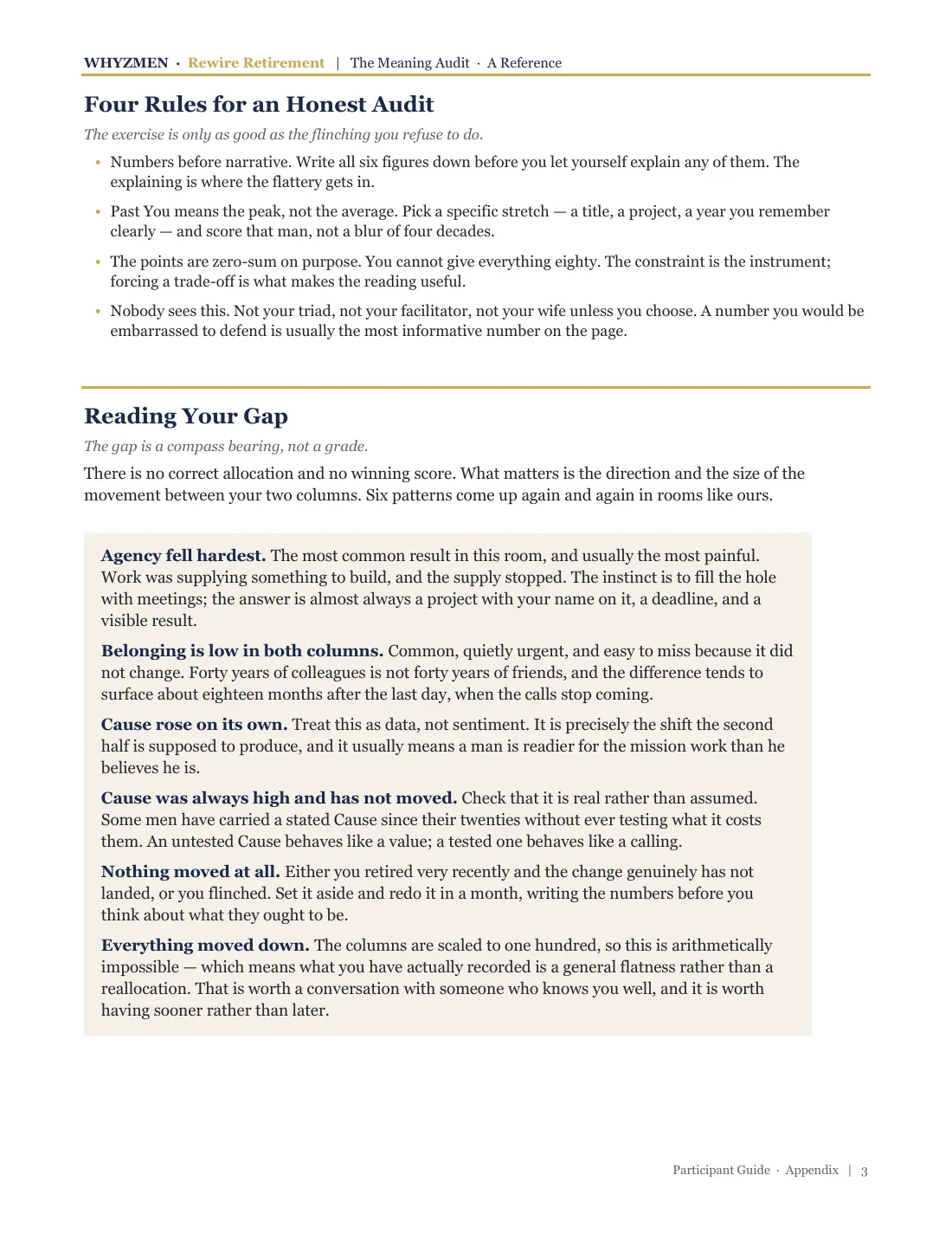
There is no correct allocation and no winning score. What matters is the direction and the size of the
movement between your two columns. Six patterns come up again and again in rooms like ours.


  Agency fell hardest. The most common result in this room, and usually the most painful.
  Work was supplying something to build, and the supply stopped. The instinct is to fill the hole
  with meetings; the answer is almost always a project with your name on it, a deadline, and a
  visible result.
  Belonging is low in both columns. Common, quietly urgent, and easy to miss because it did
  not change. Forty years of colleagues is not forty years of friends, and the difference tends to
  surface about eighteen months after the last day, when the calls stop coming.
  Cause rose on its own. Treat this as data, not sentiment. It is precisely the shift the second
  half is supposed to produce, and it usually means a man is readier for the mission work than he
  believes he is.
  Cause was always high and has not moved. Check that it is real rather than assumed.
  Some men have carried a stated Cause since their twenties without ever testing what it costs
  them. An untested Cause behaves like a value; a tested one behaves like a calling.
  Nothing moved at all. Either you retired very recently and the change genuinely has not
  landed, or you flinched. Set it aside and redo it in a month, writing the numbers before you
  think about what they ought to be.
  Everything moved down. The columns are scaled to one hundred, so this is arithmetically
  impossible — which means what you have actually recorded is a general flatness rather than a
  reallocation. That is worth a conversation with someone who knows you well, and it is worth
  having sooner rather than later.


                                                                                      Participant Guide · Appendix | 3
WHYZMEN · Rewire Retirement | The Meaning Audit · A Reference


Using the Audit to Choose Your Domains
This is what the arithmetic is for.
Charter Section 2.2 asks you to write a vision for each life domain. Section 3.1 then asks you to pick your
three highest-priority domains and build real goals for them — with indicators, habits, and a ninety-day
checkpoint.
Choosing three out of seven is the hardest instruction in the Charter, and most men make it on mood. The
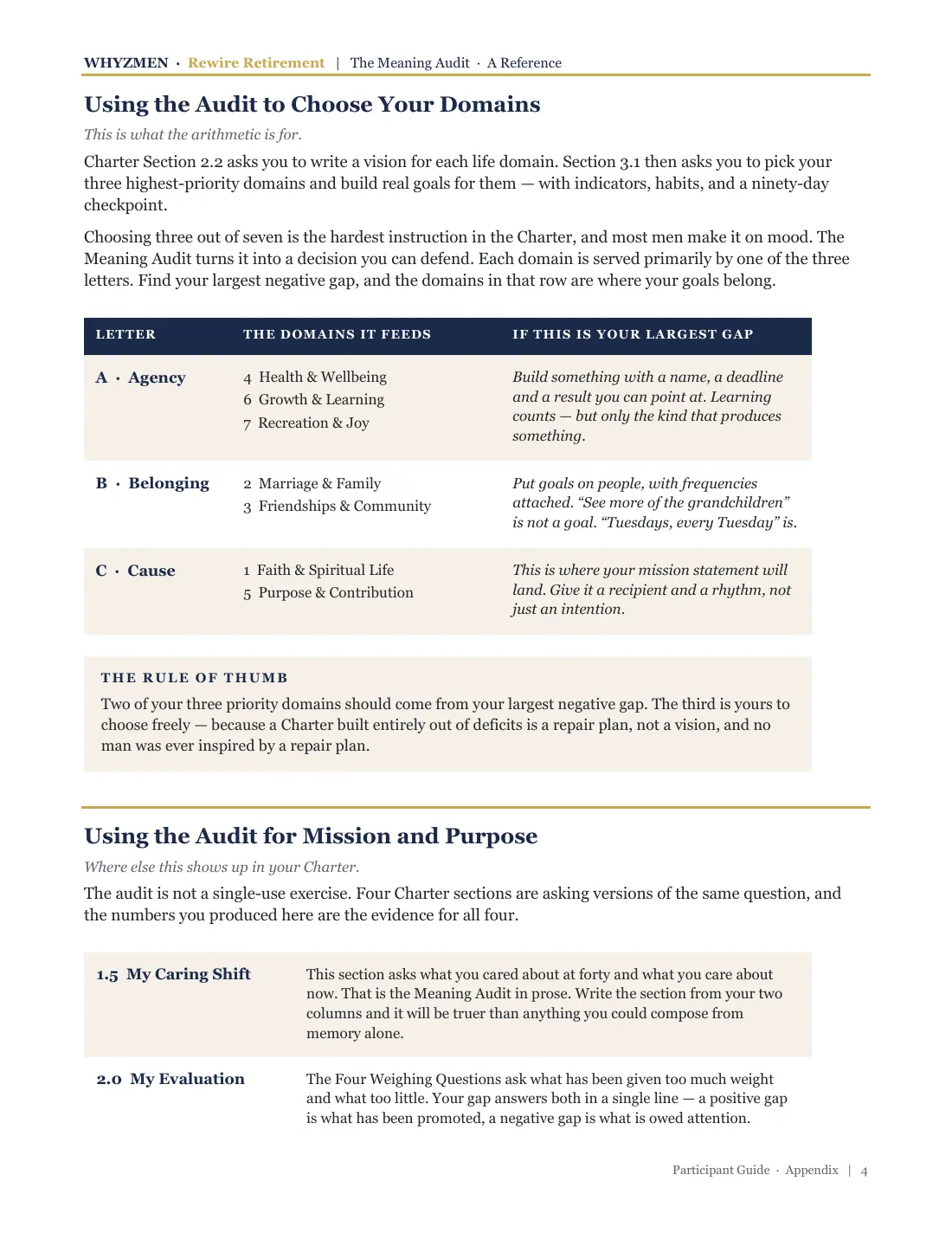
Meaning Audit turns it into a decision you can defend. Each domain is served primarily by one of the three
letters. Find your largest negative gap, and the domains in that row are where your goals belong.


 L ET TER                T H E D OMAI NS IT F EEDS                    I F TH IS IS YOU R LA RG EST G AP


 A · Agency              4 Health & Wellbeing                         Build something with a name, a deadline
                         6 Growth & Learning                          and a result you can point at. Learning
                         7 Recreation & Joy                           counts — but only the kind that produces
                                                                      something.


 B · Belonging           2 Marriage & Family                          Put goals on people, with frequencies
                         3 Friendships & Community                    attached. “See more of the grandchildren”
                                                                      is not a goal. “Tuesdays, every Tuesday” is.


 C · Cause               1 Faith & Spiritual Life                     This is where your mission statement will
                         5 Purpose & Contribution                     land. Give it a recipient and a rhythm, not
                                                                      just an intention.


  THE RULE OF THUMB

  Two of your three priority domains should come from your largest negative gap. The third is yours to
  choose freely — because a Charter built entirely out of deficits is a repair plan, not a vision, and no
  man was ever inspired by a repair plan.


Using the Audit for Mission and Purpose
Where else this shows up in your Charter.
The audit is not a single-use exercise. Four Charter sections are asking versions of the same question, and
the numbers you produced here are the evidence for all four.


  1.5 My Caring Shift                 This section asks what you cared about at forty and what you care about
                                      now. That is the Meaning Audit in prose. Write the section from your two
                                      columns and it will be truer than anything you could compose from
                                      memory alone.


  2.0 My Evaluation                   The Four Weighing Questions ask what has been given too much weight
                                      and what too little. Your gap answers both in a single line — a positive gap
                                      is what has been promoted, a negative gap is what is owed attention.


                                                                                               Participant Guide · Appendix | 4
WHYZMEN · Rewire Retirement | The Meaning Audit · A Reference

 2.1 Personal Mission             A mission built on your highest current letter will be honest but may simply
 Statement                        describe the life you already have. A mission built on your largest gap will
                                  stretch you. Most good mission statements sit between the two: they lead
                                  with the gap and are carried by the strength.


 2.1b Essentialism                The trade-off you are willing to make is almost always a trade of points
 Filter                           from a letter that is over-weighted into one that is starved. Name that trade
                                  explicitly and the three things you will decline become obvious rather than
                                  agonizing.


What the Audit Is Not
Three misreadings worth heading off.
 • It is not a personality test. Your allocation is a description of a season, not of a self. Feiler's own example is
   that he scores high on Agency — he does not treat that as an identity, and neither should you.
 • It is not a ranking. Cause is not the highest letter and Agency is not the shallow one. A man who rebuilds his
   own agency so that he has something left to give is not being selfish; he is being sequential. Order, not rank.
 • It is not permanent. The audit describes today. Do it again at the end of the program, and once a year after
   that — Tier 3 of your Charter treats exactly this kind of re-reading as a lifelong practice rather than a
   milestone.


  BEFORE YOU CLOSE THIS PAGE

  Write one sentence. My largest gap is in ________________, which suggests my next
  season should be weighted toward ________________.

  Bring that sentence with you when you write your mission statement. It is the shortest bridge in this
  program between what you discovered and what you decide.


Sources
 • Bruce Feiler, The Search: Finding Meaningful Work in a Post-Career World (2023) — the meaning audit, personal
   archaeology, and twenty-one questions for finding work you love.
 • Bruce Feiler, Life Is in the Transitions: Mastering Change at Any Age (2020) — the ABCs of meaning, lifequakes,
   and the three phases of transition.
 • Greg McKeown, Essentialism — the trade-off discipline behind Charter 2.1b.


                   “Stop chasing someone else's dream. Start chasing your own.”
                                              BRUCE FEILER

                                   Wise men still seek, knowing their why's.


                                                                                           Participant Guide · Appendix | 5