
Session 14 · Guide and forms
Appendix K: The Ethical Will
Show the text version
                                                                       WhyzMen · My Harvest Charter · Appendix K


                          WHYZMEN · REWIRE RETIREMENT
                        Wise Men Seek, Knowing Their Why’s


                        APPENDIX K
                           The Ethical Will
                   An Expanded Addendum to My Harvest Charter

“When Jacob had finished giving instructions to his sons … he was gathered to his
people.” — Genesis 49:33

                 Navigating Transition · Building Brotherhood · Igniting Jubilee


                                      The Ethical Will — Page 1
                                                                           WhyzMen · My Harvest Charter · Appendix K


An Ancient Practice You Are Stepping Into
You are about to do something men have done for more than three thousand years. The ethical will is
not a modern self-help exercise. It has a name — in Hebrew, the tzava’ah — and a lineage that runs
straight through Scripture. When Jacob gathered his twelve sons around his bed to bless each one and
name what he saw in them, he was writing an ethical will. So was Moses in his final song over the tribes,
and David charging Solomon, and Paul writing to Timothy from a Roman cell, and Jesus himself in the
upper room on the last night.

     “I have fought the good fight, I have finished the race, I have kept the faith.” — 2
     Timothy 4:7

A legal will distributes what you owned. An ethical will distributes what you learned. One settles your
estate; the other settles your story. Both matter — but only one of them tells your grandchildren who
you were, what you believed, and what you hoped they would carry forward when you are no longer in
the room.

The Power to Bless
At the heart of this tradition is the blessing — the berakhah a father speaks over the next generation.
Isaac blessed Jacob; Jacob crossed his hands over his grandsons Ephraim and Manasseh and blessed
them too. Gary Smalley and John Trent, in their book The Blessing, describe what a true blessing
contains: meaningful presence, a spoken message, attaching high value to the person, picturing a special
future for them, and an active commitment to help it come to pass.

Many men were never blessed this way by their own fathers. The ethical will is your chance to break
that silence — to give what you may never have received. That is holy work, and it is the most important
thing in this document.


A Word of Permission
Most men carry quiet scripts into a task like this: don’t be too emotional, only talk about the wins, get it
perfect or don’t bother. Set those down. An ethical will asks for something different:

   • Honesty over polish. This is not a press release. It is a series of letters from your deepest, wisest
     self to the people you love.
   • Stories over theories. “Let me tell you about a time…” will always land deeper than abstract
     advice.
   • Humility over perfection. Your regrets and mistakes belong here. They are often the most useful
     thing you can give.
   • Blessing over control. You are not telling them how to live. You are offering what you have
     learned and what you hope for them.


                                            The Ethical Will — Page 2
                                                                         WhyzMen · My Harvest Charter · Appendix K


   “All you have to do is write one true sentence. Write the truest sentence that you
   know.” — Ernest Hemingway
Let that be your floor and your permission. One true sentence under each heading is already a complete
ethical will. Everything beyond that is a gift, not a requirement.


How to Write Yours
 1. Choose your format. Write it — a Word file, a notebook, printed letters. Or record short spoken
    pieces by topic. Most men do best with a written core plus a few recorded stories in their own
    voice.

 2. Start small and modular. Don’t attempt one perfect document. Work one Movement at a time,
    one page or one story per sitting. Think in chapters and letters, not a book.

 3. Harvest what you have already mined. You do not start from a blank page. Pull your values
    forward from your Values Compass, your redemptive story from Read My Story, your strengths
    from your Strengths Portrait. The ethical will is where you pour the blade you have already forged
    across this program.

 4. Write to one person. Even when the words are for everyone, picture one specific grandchild as
    you write. It softens the tone and sharpens the truth.

 5. Keep it living. Date your entries. Revisit them every year or two. Add new stories; revise what no
    longer feels true. Tell your family plainly: this is my best attempt to share what I have seen so far
    — not the last word.

 6. Decide who it is for, and when. Write a primary version for your children and grandchildren,
    knowing others may one day read it. Then decide: many men find the greatest gift is to share parts
    of it now, while they can watch it be received, rather than leaving it sealed until they are gone.


                                           The Ethical Will — Page 3
                                                                      WhyzMen · My Harvest Charter · Appendix K


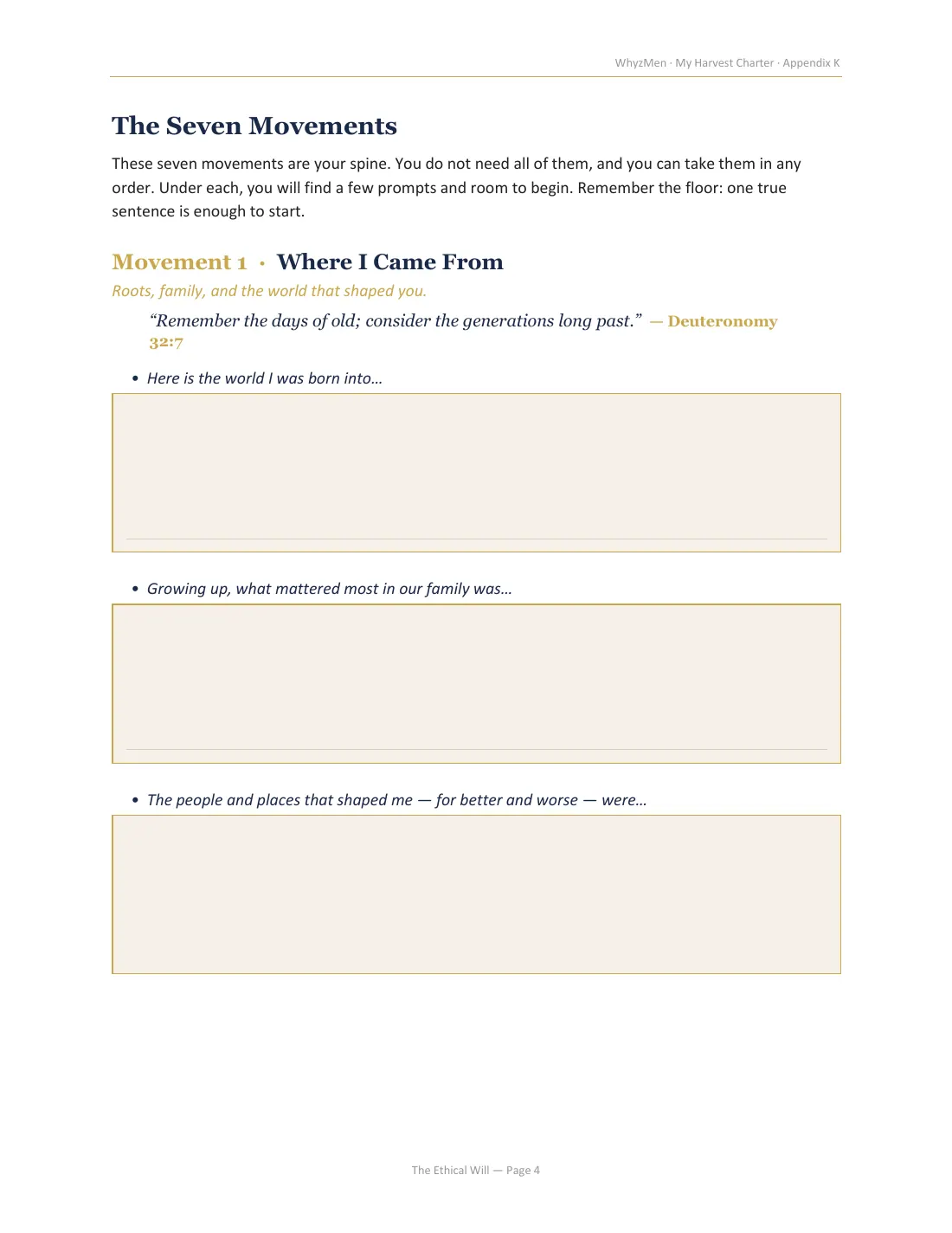
The Seven Movements
These seven movements are your spine. You do not need all of them, and you can take them in any
order. Under each, you will find a few prompts and room to begin. Remember the floor: one true
sentence is enough to start.


Movement 1 · Where I Came From
Roots, family, and the world that shaped you.
     “Remember the days of old; consider the generations long past.” — Deuteronomy
     32:7

  • Here is the world I was born into…


  • Growing up, what mattered most in our family was…


  • The people and places that shaped me — for better and worse — were…


                                          The Ethical Will — Page 4
                                                                         WhyzMen · My Harvest Charter · Appendix K


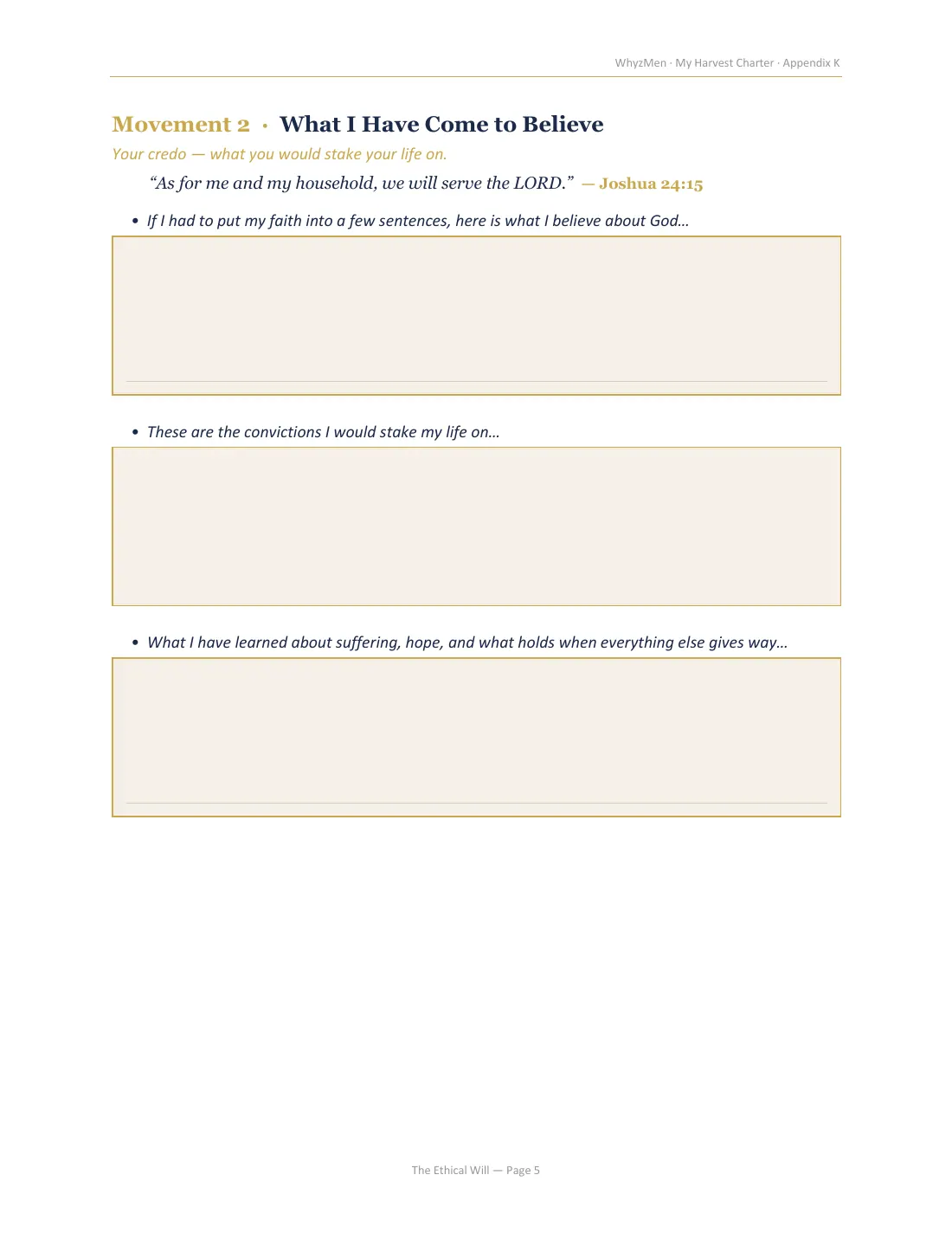
Movement 2 · What I Have Come to Believe
Your credo — what you would stake your life on.
     “As for me and my household, we will serve the LORD.” — Joshua 24:15

  • If I had to put my faith into a few sentences, here is what I believe about God…


  • These are the convictions I would stake my life on…


  • What I have learned about suffering, hope, and what holds when everything else gives way…


                                           The Ethical Will — Page 5
                                                                      WhyzMen · My Harvest Charter · Appendix K


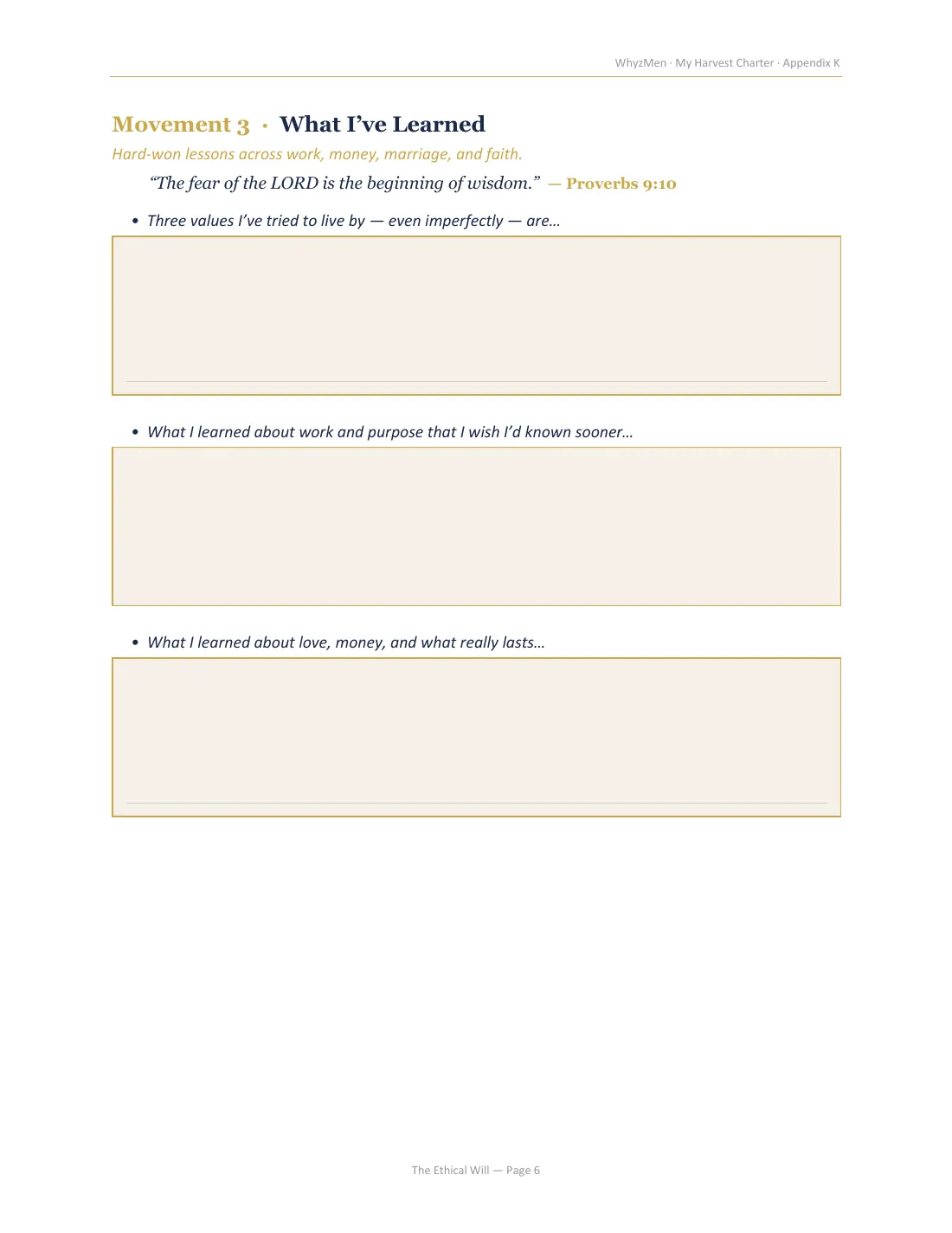
Movement 3 · What I’ve Learned
Hard-won lessons across work, money, marriage, and faith.
     “The fear of the LORD is the beginning of wisdom.” — Proverbs 9:10

  • Three values I’ve tried to live by — even imperfectly — are…


  • What I learned about work and purpose that I wish I’d known sooner…


  • What I learned about love, money, and what really lasts…


                                          The Ethical Will — Page 6
                                                                        WhyzMen · My Harvest Charter · Appendix K


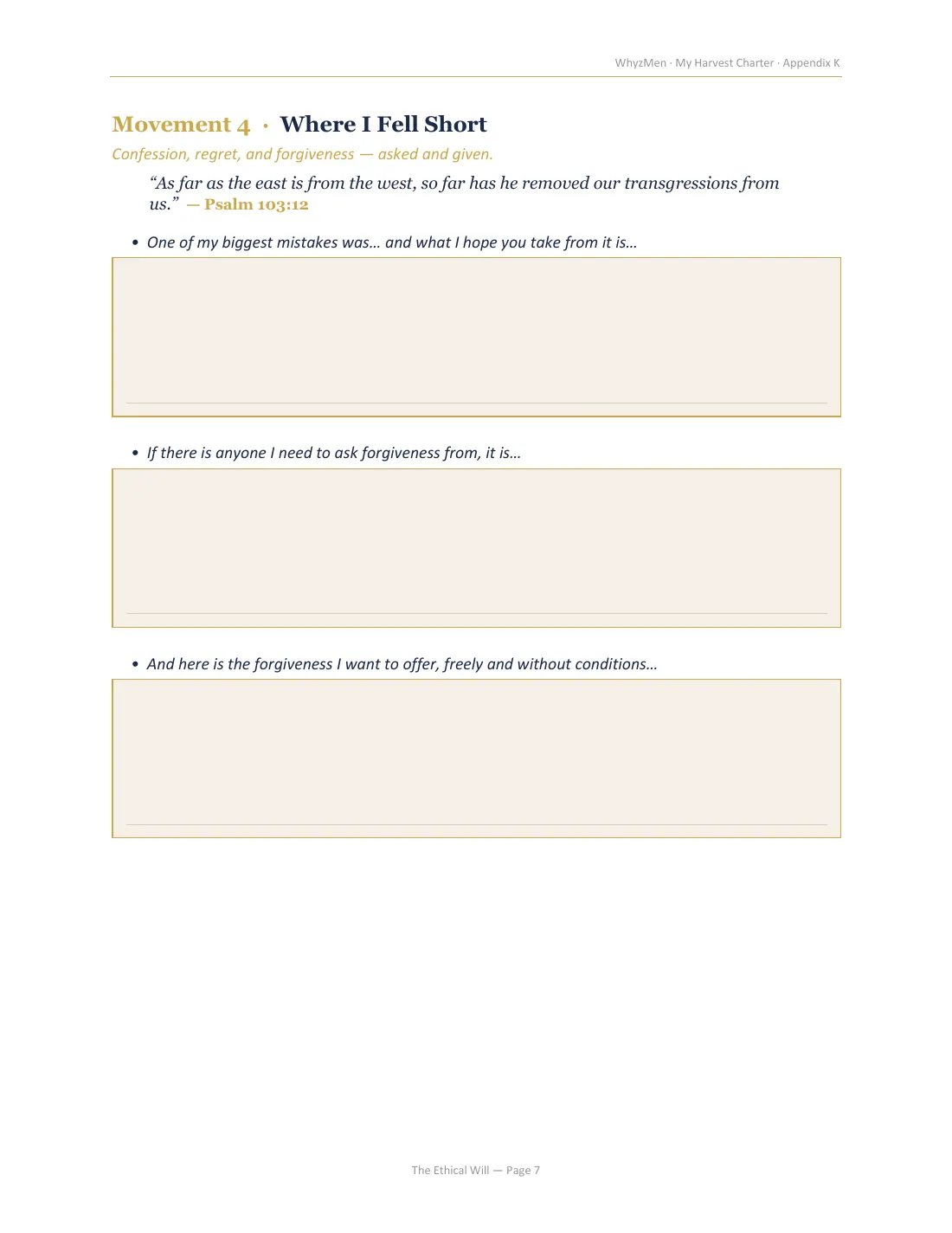
Movement 4 · Where I Fell Short
Confession, regret, and forgiveness — asked and given.
     “As far as the east is from the west, so far has he removed our transgressions from
     us.” — Psalm 103:12

  • One of my biggest mistakes was… and what I hope you take from it is…


  • If there is anyone I need to ask forgiveness from, it is…


  • And here is the forgiveness I want to offer, freely and without conditions…


                                            The Ethical Will — Page 7
                                                                      WhyzMen · My Harvest Charter · Appendix K


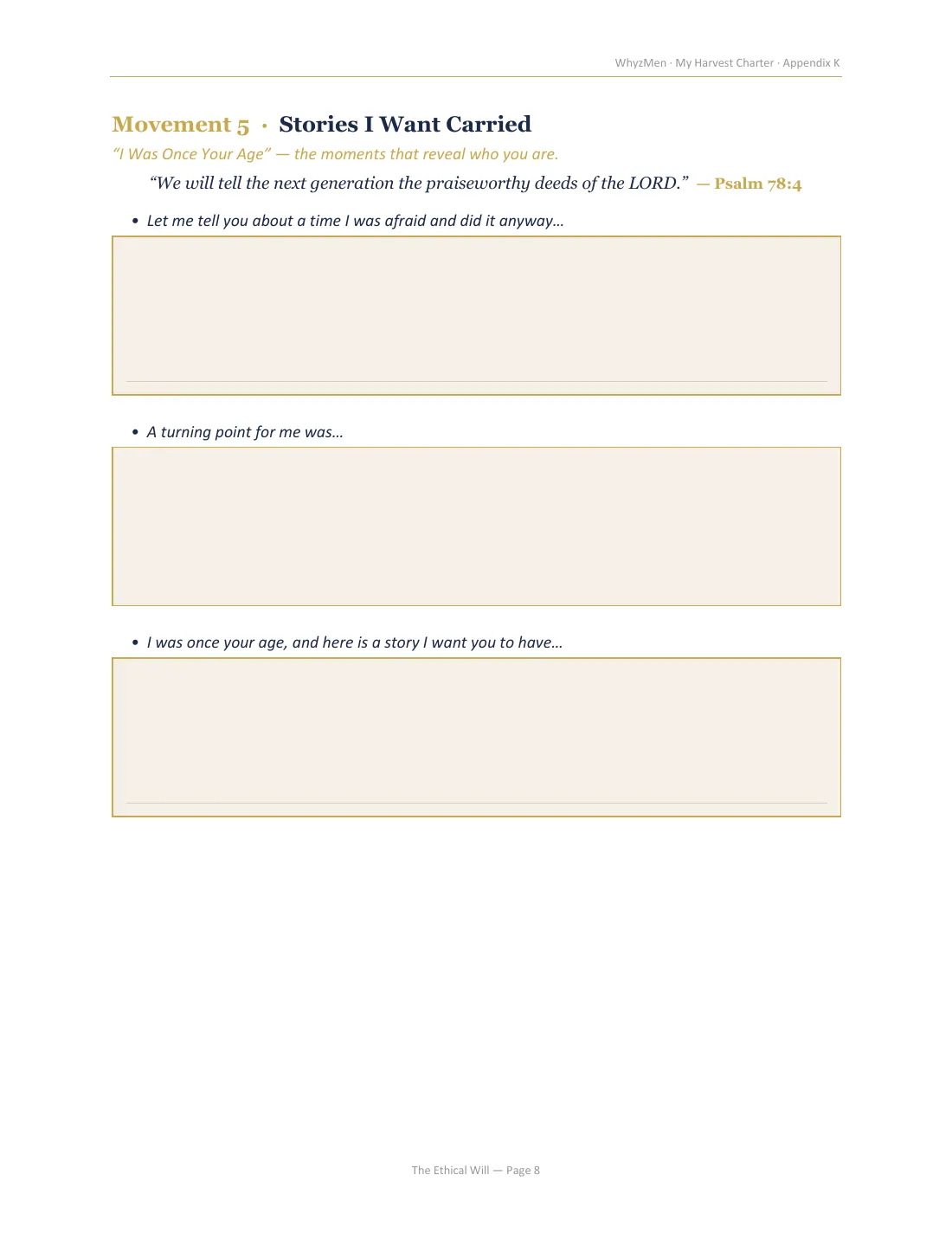
Movement 5 · Stories I Want Carried
“I Was Once Your Age” — the moments that reveal who you are.
     “We will tell the next generation the praiseworthy deeds of the LORD.” — Psalm 78:4

  • Let me tell you about a time I was afraid and did it anyway…


  • A turning point for me was…


  • I was once your age, and here is a story I want you to have…


                                          The Ethical Will — Page 8
                                                                      WhyzMen · My Harvest Charter · Appendix K


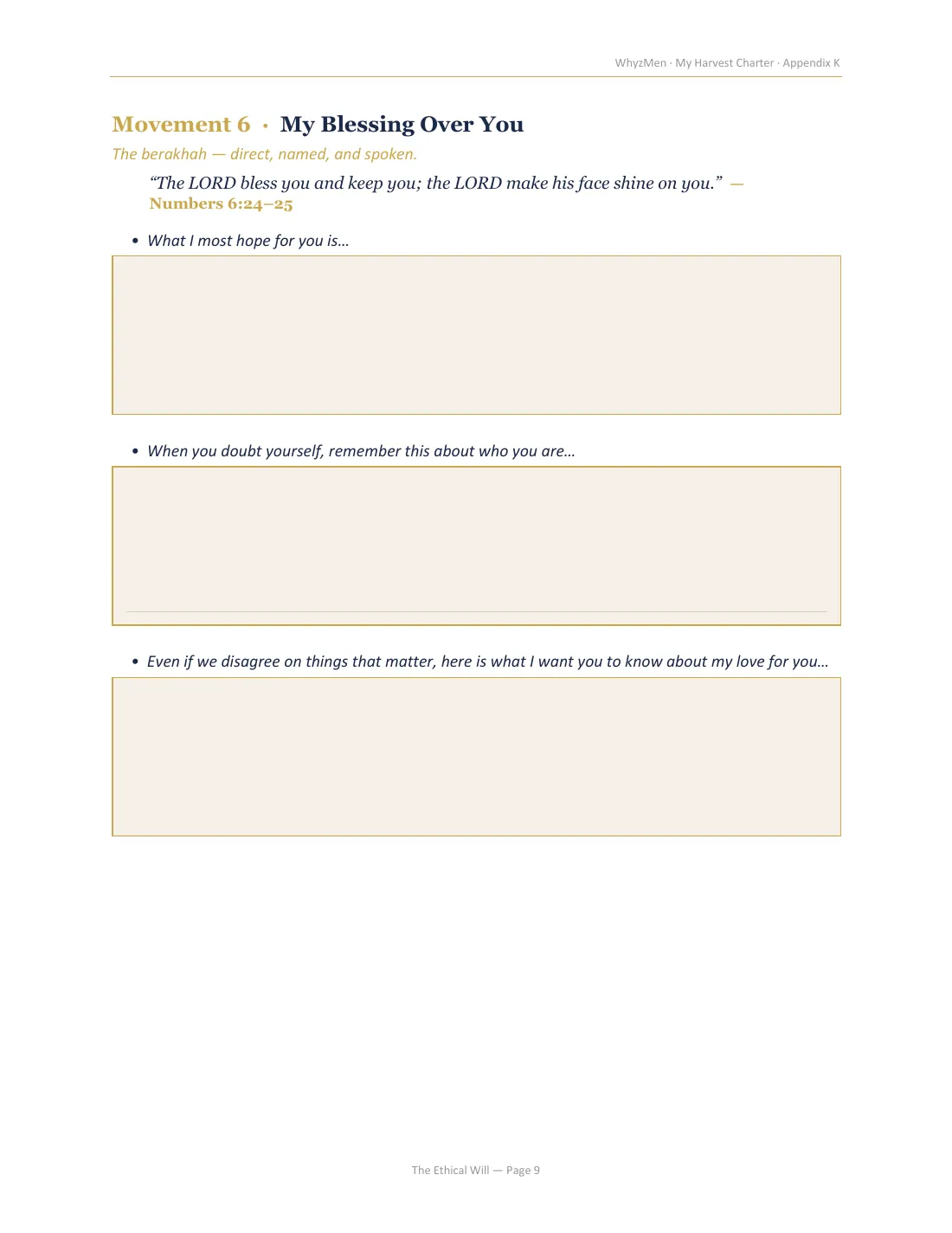
Movement 6 · My Blessing Over You
The berakhah — direct, named, and spoken.
     “The LORD bless you and keep you; the LORD make his face shine on you.” —
     Numbers 6:24–25

  • What I most hope for you is…


  • When you doubt yourself, remember this about who you are…


  • Even if we disagree on things that matter, here is what I want you to know about my love for you…


                                         The Ethical Will — Page 9
                                                                       WhyzMen · My Harvest Charter · Appendix K


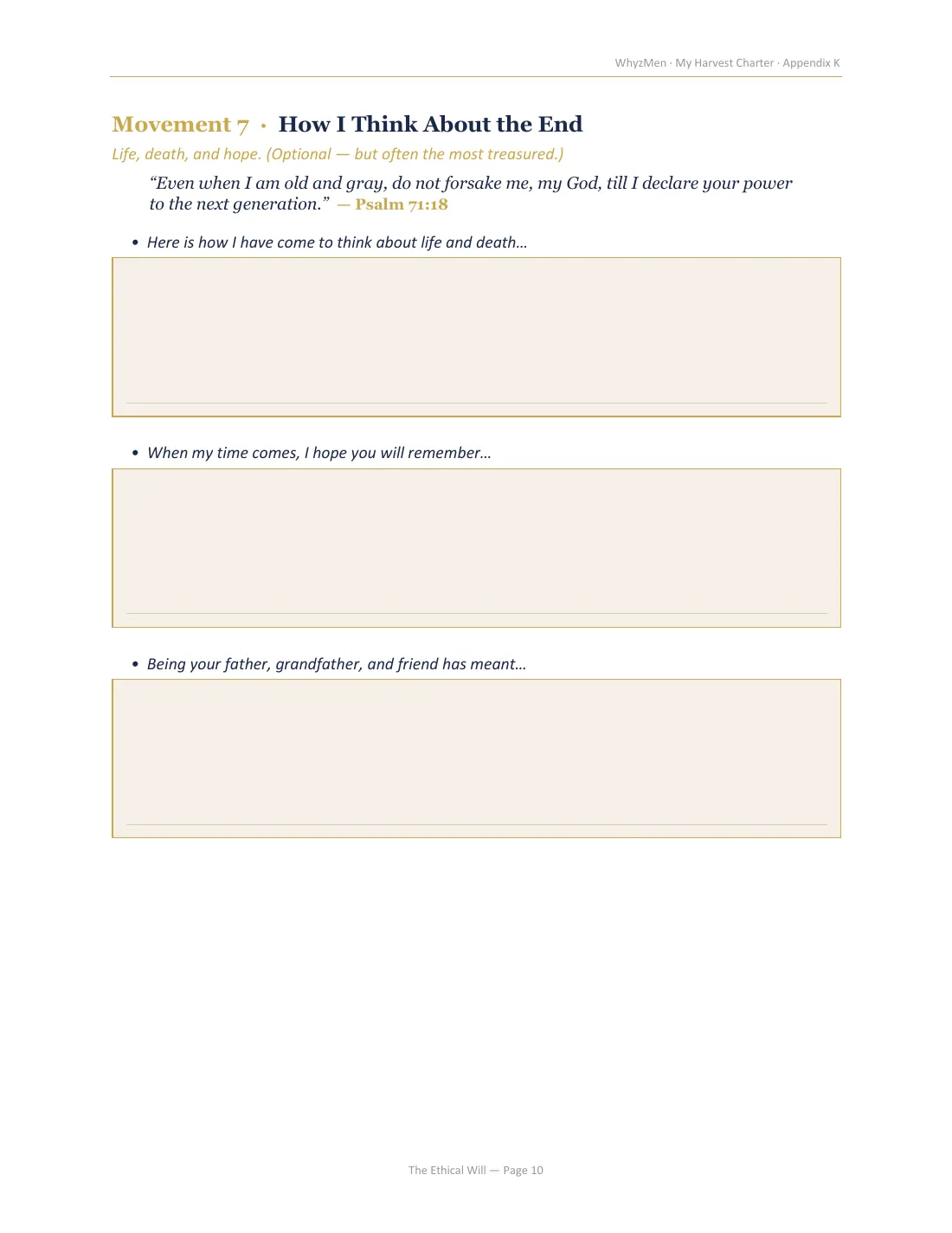
Movement 7 · How I Think About the End
Life, death, and hope. (Optional — but often the most treasured.)
     “Even when I am old and gray, do not forsake me, my God, till I declare your power
     to the next generation.” — Psalm 71:18

  • Here is how I have come to think about life and death…


  • When my time comes, I hope you will remember…


  • Being your father, grandfather, and friend has meant…


                                          The Ethical Will — Page 10
                                                                        WhyzMen · My Harvest Charter · Appendix K


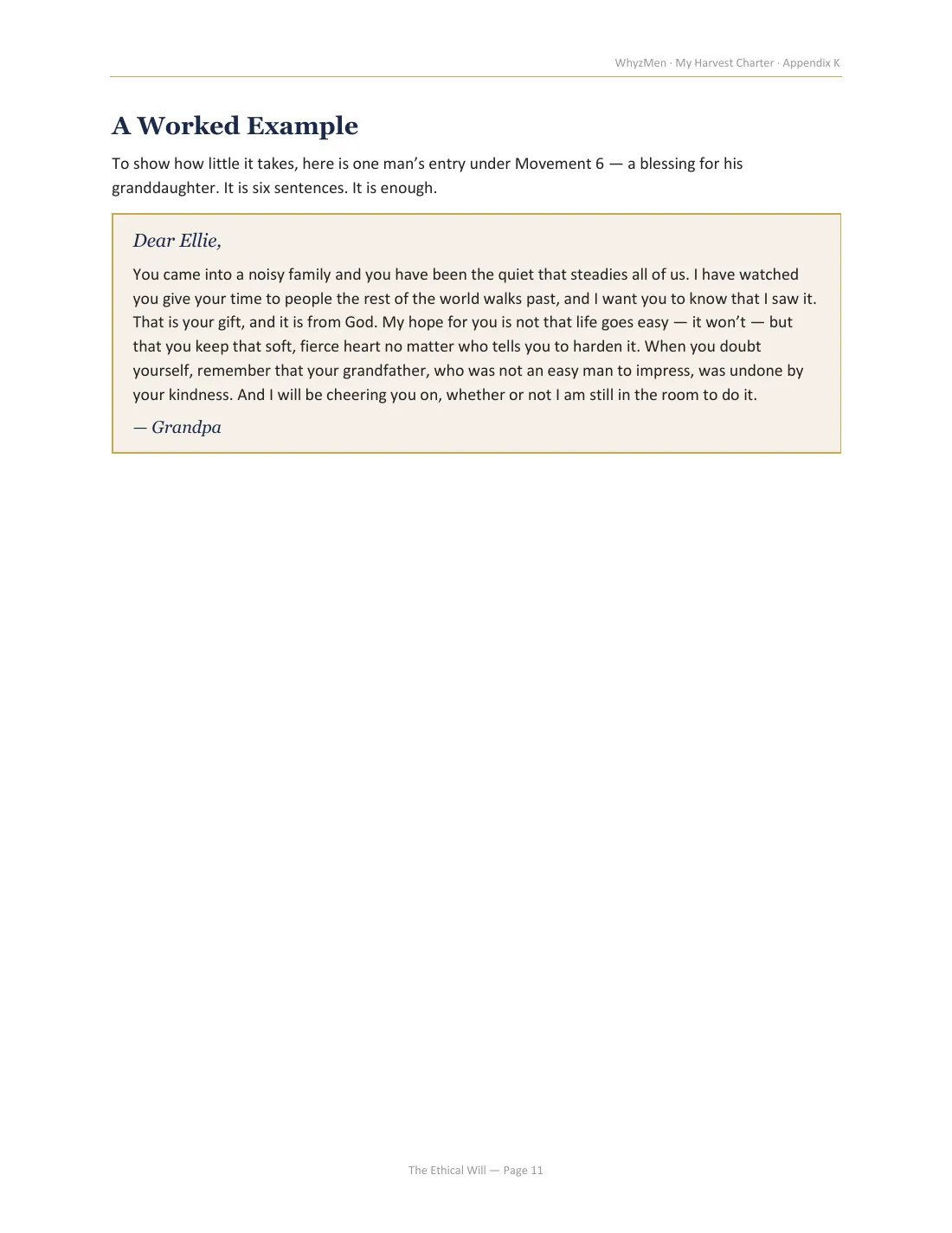
A Worked Example
To show how little it takes, here is one man’s entry under Movement 6 — a blessing for his
granddaughter. It is six sentences. It is enough.


  Dear Ellie,
  You came into a noisy family and you have been the quiet that steadies all of us. I have watched
  you give your time to people the rest of the world walks past, and I want you to know that I saw it.
  That is your gift, and it is from God. My hope for you is not that life goes easy — it won’t — but
  that you keep that soft, fierce heart no matter who tells you to harden it. When you doubt
  yourself, remember that your grandfather, who was not an easy man to impress, was undone by
  your kindness. And I will be cheering you on, whether or not I am still in the room to do it.
  — Grandpa


                                          The Ethical Will — Page 11
                                                                                      WhyzMen · My Harvest Charter · Appendix K


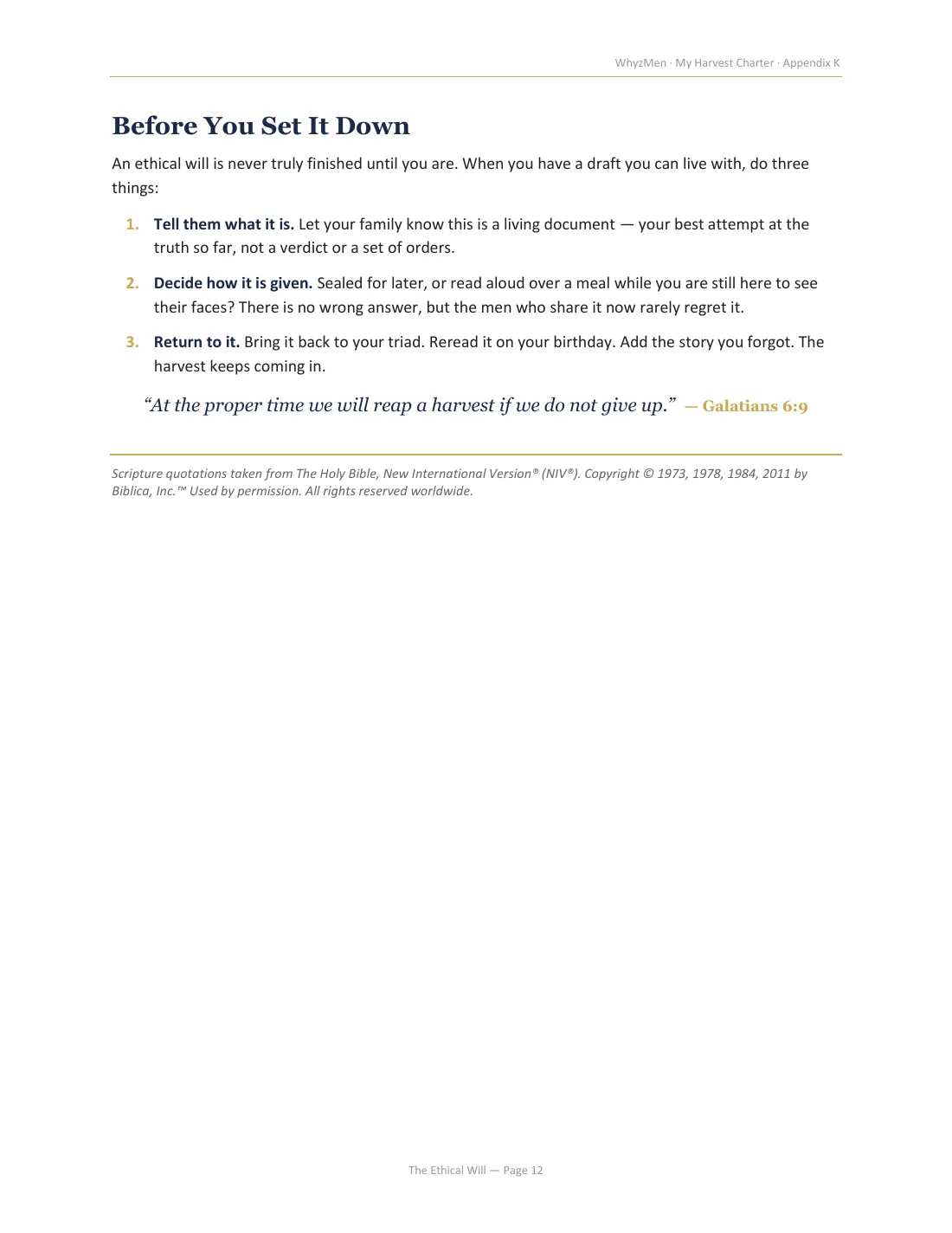
Before You Set It Down
An ethical will is never truly finished until you are. When you have a draft you can live with, do three
things:

  1. Tell them what it is. Let your family know this is a living document — your best attempt at the
     truth so far, not a verdict or a set of orders.

  2. Decide how it is given. Sealed for later, or read aloud over a meal while you are still here to see
     their faces? There is no wrong answer, but the men who share it now rarely regret it.

  3. Return to it. Bring it back to your triad. Reread it on your birthday. Add the story you forgot. The
     harvest keeps coming in.

     “At the proper time we will reap a harvest if we do not give up.” — Galatians 6:9


Scripture quotations taken from The Holy Bible, New International Version® (NIV®). Copyright © 1973, 1978, 1984, 2011 by
Biblica, Inc.™ Used by permission. All rights reserved worldwide.


                                                   The Ethical Will — Page 12