
Session 14 · Recommended Reading
Writing an Ethical Will and Letters
Show the text version
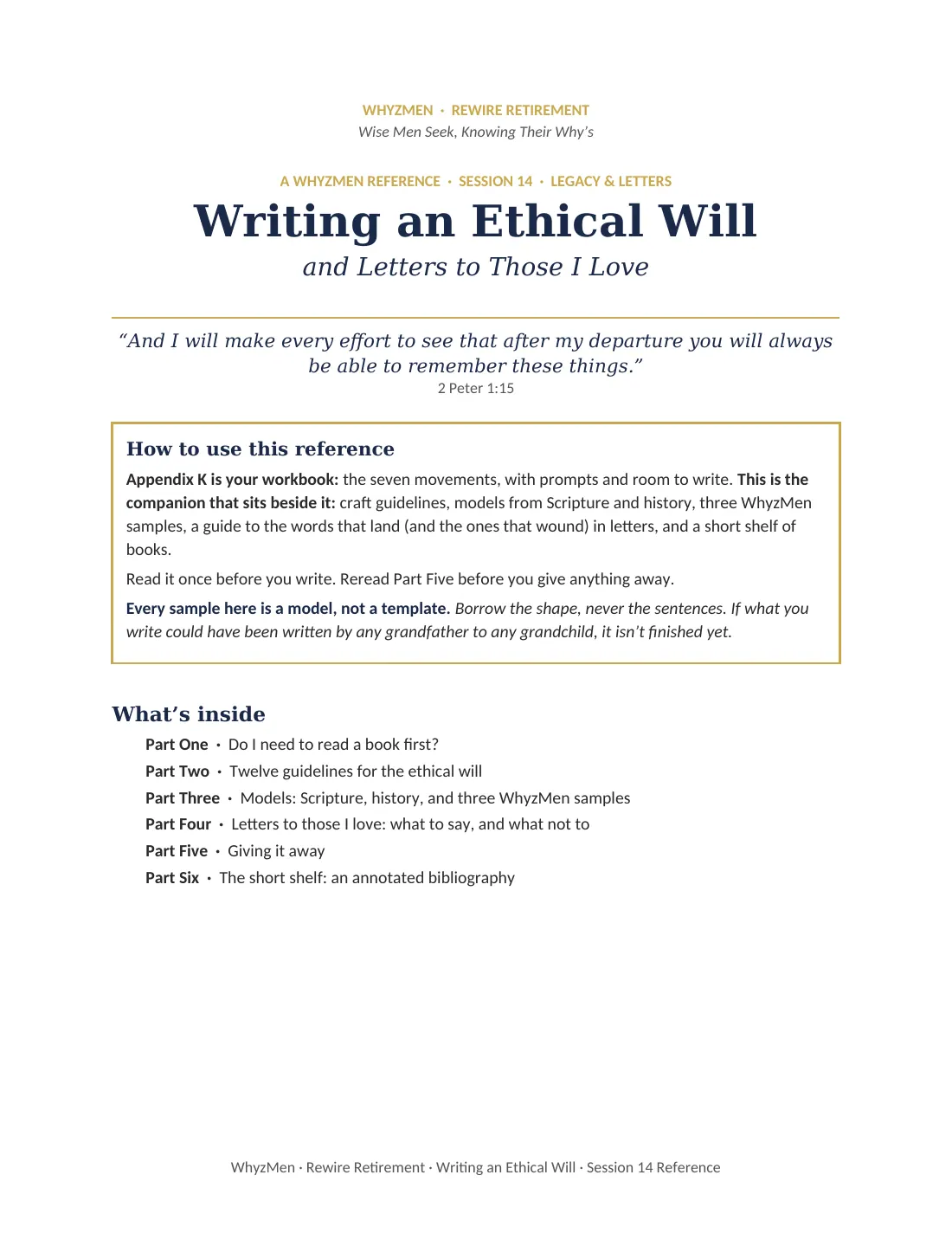
WHYZMEN · REWIRE RETIREMENT
Wise Men Seek, Knowing Their Why’s
A WHYZMEN REFERENCE · SESSION 14 · LEGACY & LETTERS
Writing an Ethical Will
and Letters to Those I Love
“And I will make every effort to see that after my departure you will always
be able to remember these things.”
2 Peter 1:15
How to use this reference
Appendix K is your workbook: the seven movements, with prompts and room to write. This is the
companion that sits beside it: craft guidelines, models from Scripture and history, three WhyzMen
samples, a guide to the words that land (and the ones that wound) in letters, and a short shelf of
books.
Read it once before you write. Reread Part Five before you give anything away.
Every sample here is a model, not a template. Borrow the shape, never the sentences. If what you
write could have been written by any grandfather to any grandchild, it isn’t finished yet.
What’s inside
Part One · Do I need to read a book first?
Part Two · Twelve guidelines for the ethical will
Part Three · Models: Scripture, history, and three WhyzMen samples
Part Four · Letters to those I love: what to say, and what not to
Part Five · Giving it away
Part Six · The short shelf: an annotated bibliography
WhyzMen · Rewire Retirement · Writing an Ethical Will · Session 14 Reference
PART ONE
Do I need to read a book first?
No. You don’t need a book on fatherhood before you hold your grandson, and you don’t need one
before you write to him. The men who never write an ethical will rarely fail for lack of information. They
fail because they wait until they feel ready, and the feeling never comes.
If you want one book, read one. Barry Baines’s Ethical Wills will show you how; Riemer and Stampfer’s
So That Your Values Live On will let you hear how others have done it across eight centuries. Everything
else on the shelf (Part Six) is for later, or for the man who finds he wants more.
Then write one true sentence. Hemingway’s advice in Appendix K is the whole method in miniature:
“Write the truest sentence that you know.” Then write the next one.
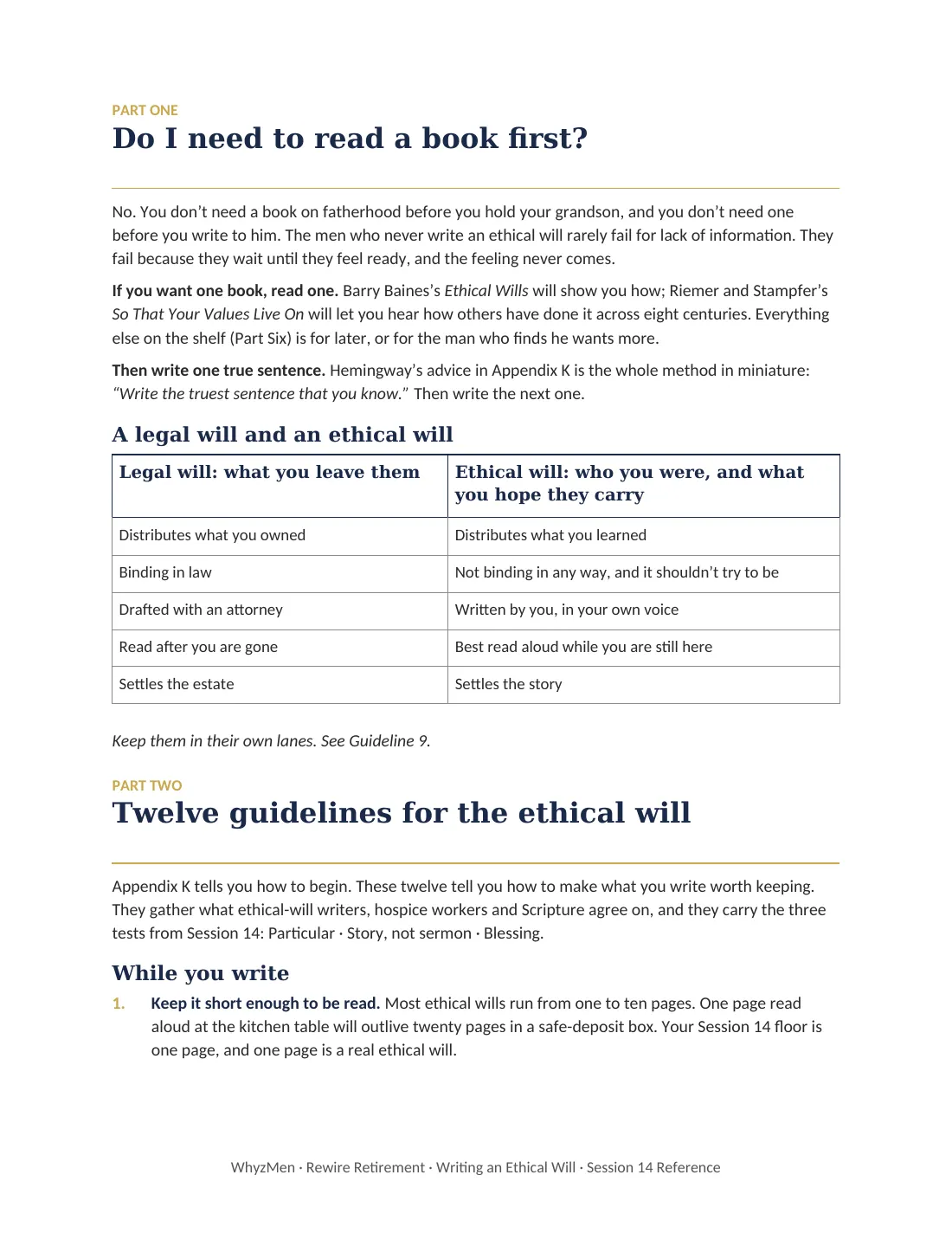
A legal will and an ethical will
Legal will: what you leave them Ethical will: who you were, and what
you hope they carry
Distributes what you owned Distributes what you learned
Binding in law Not binding in any way, and it shouldn’t try to be
Drafted with an attorney Written by you, in your own voice
Read after you are gone Best read aloud while you are still here
Settles the estate Settles the story
Keep them in their own lanes. See Guideline 9.
PART TWO
Twelve guidelines for the ethical will
Appendix K tells you how to begin. These twelve tell you how to make what you write worth keeping.
They gather what ethical-will writers, hospice workers and Scripture agree on, and they carry the three
tests from Session 14: Particular · Story, not sermon · Blessing.
While you write
1. Keep it short enough to be read. Most ethical wills run from one to ten pages. One page read
aloud at the kitchen table will outlive twenty pages in a safe-deposit box. Your Session 14 floor is
one page, and one page is a real ethical will.
WhyzMen · Rewire Retirement · Writing an Ethical Will · Session 14 Reference
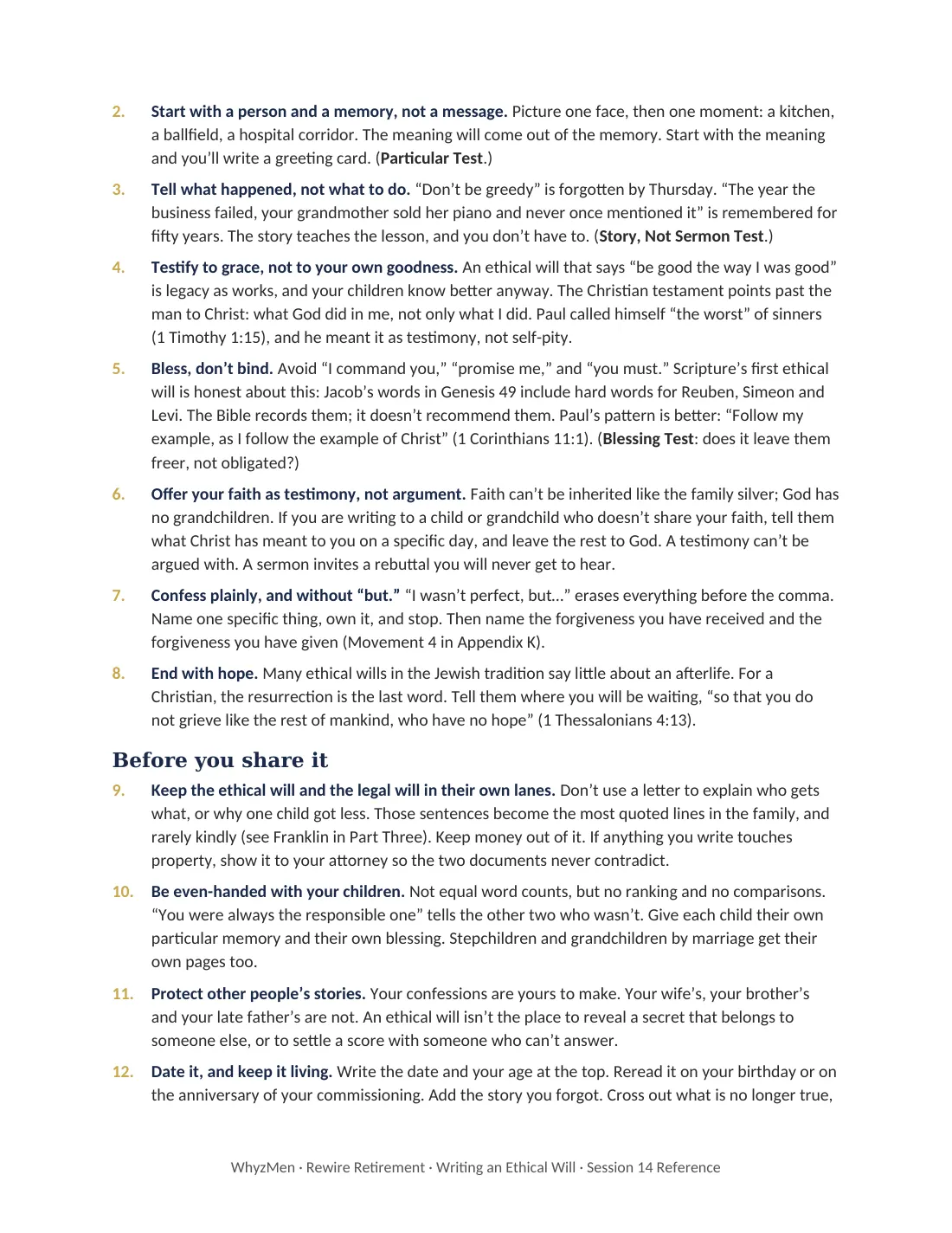
2. Start with a person and a memory, not a message. Picture one face, then one moment: a kitchen,
a ballfield, a hospital corridor. The meaning will come out of the memory. Start with the meaning
and you’ll write a greeting card. (Particular Test.)
3. Tell what happened, not what to do. “Don’t be greedy” is forgotten by Thursday. “The year the
business failed, your grandmother sold her piano and never once mentioned it” is remembered for
fifty years. The story teaches the lesson, and you don’t have to. (Story, Not Sermon Test.)
4. Testify to grace, not to your own goodness. An ethical will that says “be good the way I was good”
is legacy as works, and your children know better anyway. The Christian testament points past the
man to Christ: what God did in me, not only what I did. Paul called himself “the worst” of sinners
(1 Timothy 1:15), and he meant it as testimony, not self-pity.
5. Bless, don’t bind. Avoid “I command you,” “promise me,” and “you must.” Scripture’s first ethical
will is honest about this: Jacob’s words in Genesis 49 include hard words for Reuben, Simeon and
Levi. The Bible records them; it doesn’t recommend them. Paul’s pattern is better: “Follow my
example, as I follow the example of Christ” (1 Corinthians 11:1). (Blessing Test: does it leave them
freer, not obligated?)
6. Offer your faith as testimony, not argument. Faith can’t be inherited like the family silver; God has
no grandchildren. If you are writing to a child or grandchild who doesn’t share your faith, tell them
what Christ has meant to you on a specific day, and leave the rest to God. A testimony can’t be
argued with. A sermon invites a rebuttal you will never get to hear.
7. Confess plainly, and without “but.” “I wasn’t perfect, but…” erases everything before the comma.
Name one specific thing, own it, and stop. Then name the forgiveness you have received and the
forgiveness you have given (Movement 4 in Appendix K).
8. End with hope. Many ethical wills in the Jewish tradition say little about an afterlife. For a
Christian, the resurrection is the last word. Tell them where you will be waiting, “so that you do
not grieve like the rest of mankind, who have no hope” (1 Thessalonians 4:13).
Before you share it
9. Keep the ethical will and the legal will in their own lanes. Don’t use a letter to explain who gets
what, or why one child got less. Those sentences become the most quoted lines in the family, and
rarely kindly (see Franklin in Part Three). Keep money out of it. If anything you write touches
property, show it to your attorney so the two documents never contradict.
10. Be even-handed with your children. Not equal word counts, but no ranking and no comparisons.
“You were always the responsible one” tells the other two who wasn’t. Give each child their own
particular memory and their own blessing. Stepchildren and grandchildren by marriage get their
own pages too.
11. Protect other people’s stories. Your confessions are yours to make. Your wife’s, your brother’s
and your late father’s are not. An ethical will isn’t the place to reveal a secret that belongs to
someone else, or to settle a score with someone who can’t answer.
12. Date it, and keep it living. Write the date and your age at the top. Reread it on your birthday or on
the anniversary of your commissioning. Add the story you forgot. Cross out what is no longer true,
WhyzMen · Rewire Retirement · Writing an Ethical Will · Session 14 Reference
initial and date the change, and leave the old line visible; the amendments become part of the
legacy.
PART THREE
Models: Scripture, history, and three
WhyzMen samples
You are not inventing this form. You are stepping into one of the oldest kinds of writing in Scripture. In
Hebrew it is the tzava’ah (“command” or “testament”), and the church inherited it. “You do not support
the root, but the root supports you” (Romans 11:18).
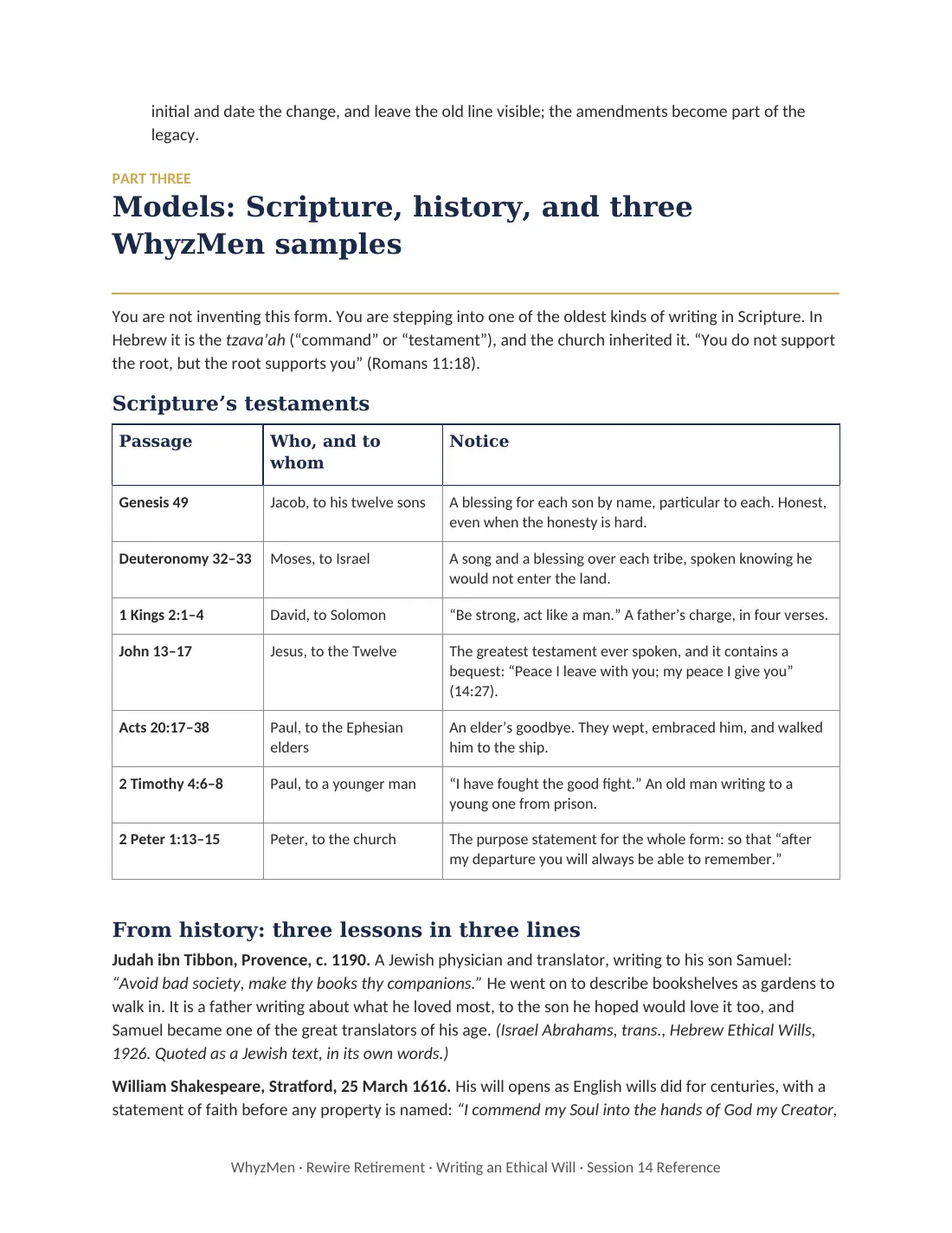
Scripture’s testaments
Passage Who, and to Notice
whom
Genesis 49 Jacob, to his twelve sons A blessing for each son by name, particular to each. Honest,
even when the honesty is hard.
Deuteronomy 32–33 Moses, to Israel A song and a blessing over each tribe, spoken knowing he
would not enter the land.
1 Kings 2:1–4 David, to Solomon “Be strong, act like a man.” A father’s charge, in four verses.
John 13–17 Jesus, to the Twelve The greatest testament ever spoken, and it contains a
bequest: “Peace I leave with you; my peace I give you”
(14:27).
Acts 20:17–38 Paul, to the Ephesian An elder’s goodbye. They wept, embraced him, and walked
elders him to the ship.
2 Timothy 4:6–8 Paul, to a younger man “I have fought the good fight.” An old man writing to a
young one from prison.
2 Peter 1:13–15 Peter, to the church The purpose statement for the whole form: so that “after
my departure you will always be able to remember.”
From history: three lessons in three lines
Judah ibn Tibbon, Provence, c. 1190. A Jewish physician and translator, writing to his son Samuel:
“Avoid bad society, make thy books thy companions.” He went on to describe bookshelves as gardens to
walk in. It is a father writing about what he loved most, to the son he hoped would love it too, and
Samuel became one of the great translators of his age. (Israel Abrahams, trans., Hebrew Ethical Wills,
1926. Quoted as a Jewish text, in its own words.)
William Shakespeare, Stratford, 25 March 1616. His will opens as English wills did for centuries, with a
statement of faith before any property is named: “I commend my Soul into the hands of God my Creator,
WhyzMen · Rewire Retirement · Writing an Ethical Will · Session 14 Reference
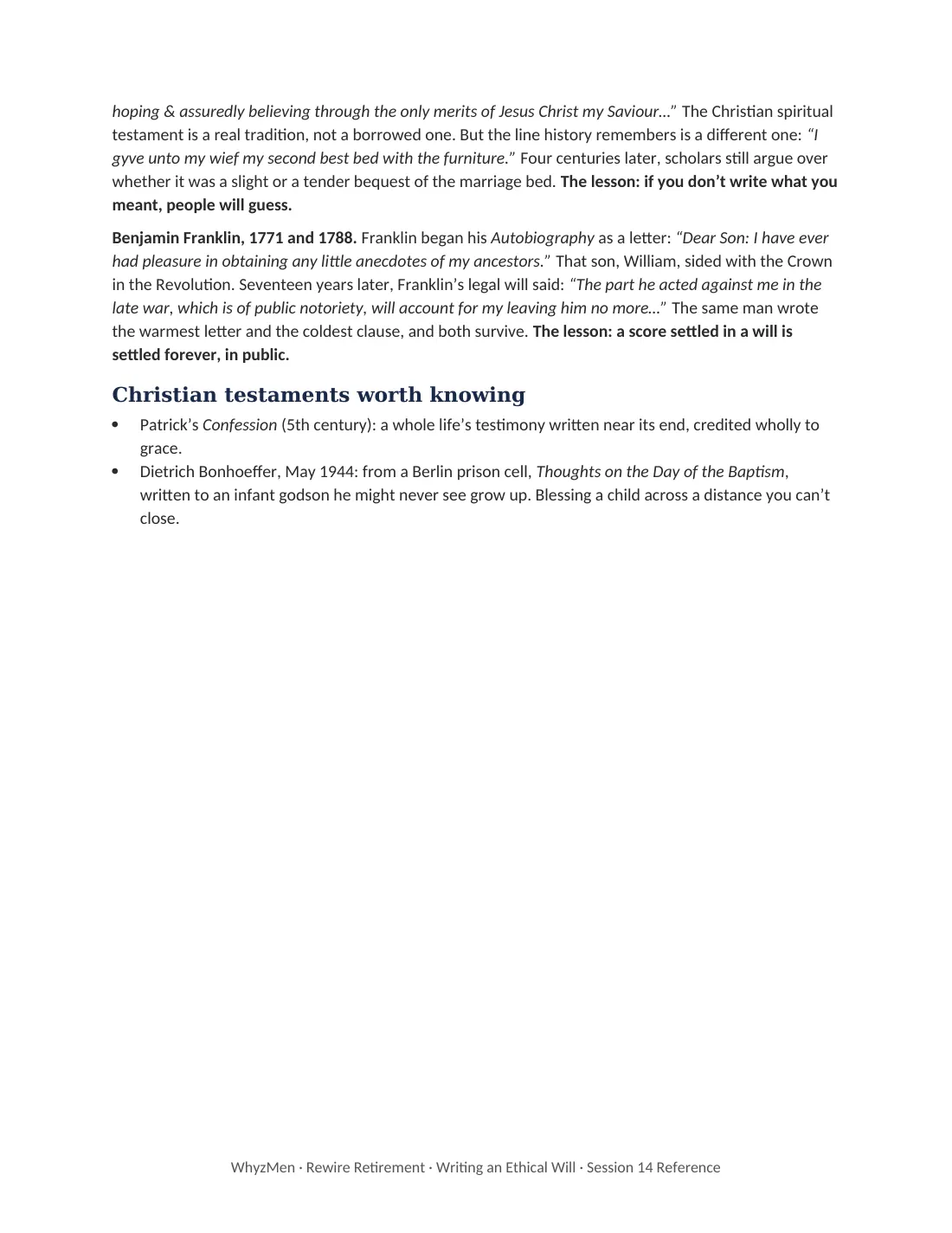
hoping & assuredly believing through the only merits of Jesus Christ my Saviour…” The Christian spiritual
testament is a real tradition, not a borrowed one. But the line history remembers is a different one: “I
gyve unto my wief my second best bed with the furniture.” Four centuries later, scholars still argue over
whether it was a slight or a tender bequest of the marriage bed. The lesson: if you don’t write what you
meant, people will guess.
Benjamin Franklin, 1771 and 1788. Franklin began his Autobiography as a letter: “Dear Son: I have ever
had pleasure in obtaining any little anecdotes of my ancestors.” That son, William, sided with the Crown
in the Revolution. Seventeen years later, Franklin’s legal will said: “The part he acted against me in the
late war, which is of public notoriety, will account for my leaving him no more…” The same man wrote
the warmest letter and the coldest clause, and both survive. The lesson: a score settled in a will is
settled forever, in public.
Christian testaments worth knowing
Patrick’s Confession (5th century): a whole life’s testimony written near its end, credited wholly to
grace.
Dietrich Bonhoeffer, May 1944: from a Berlin prison cell, Thoughts on the Day of the Baptism,
written to an infant godson he might never see grow up. Blessing a child across a distance you can’t
close.
WhyzMen · Rewire Retirement · Writing an Ethical Will · Session 14 Reference
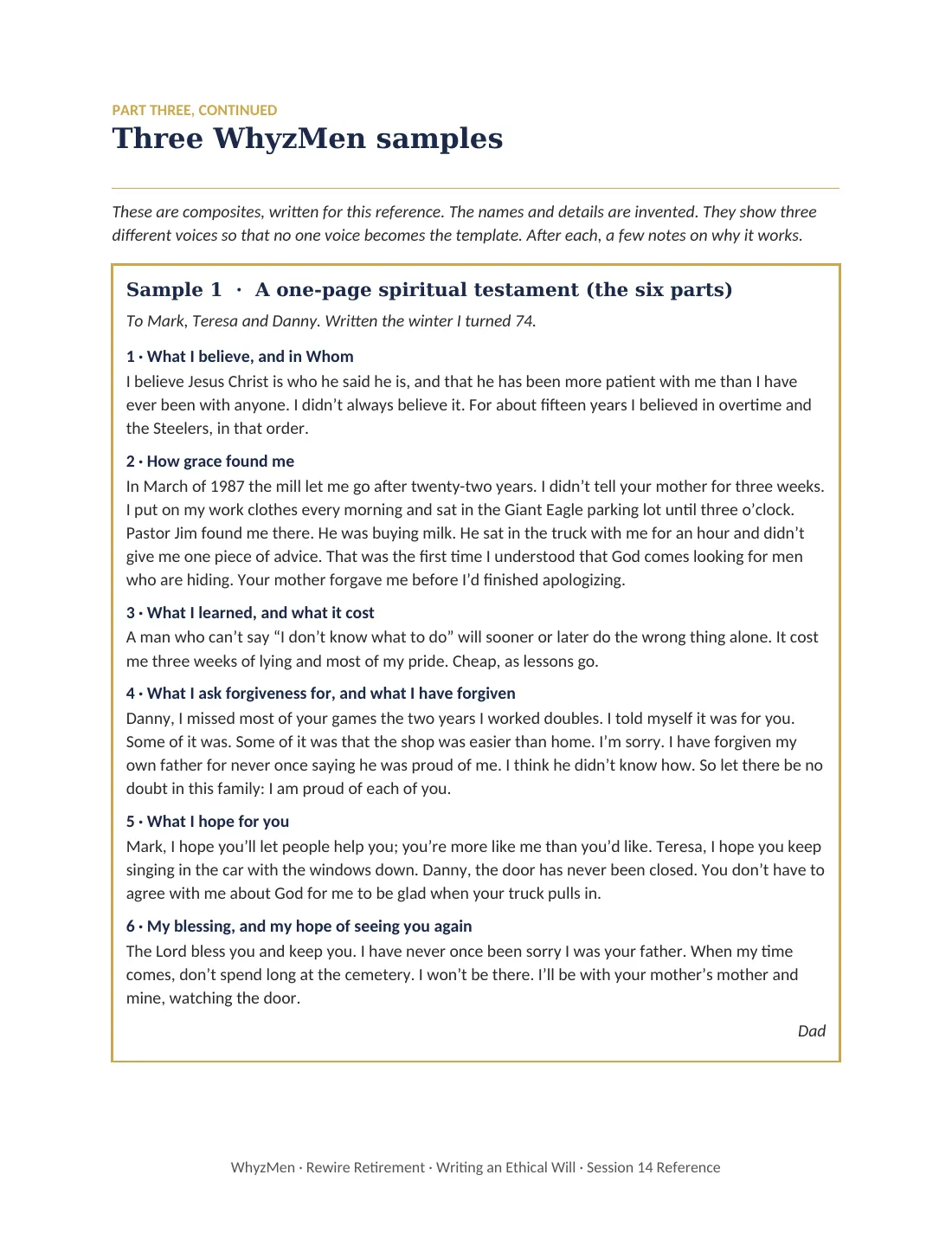
PART THREE, CONTINUED
Three WhyzMen samples
These are composites, written for this reference. The names and details are invented. They show three
different voices so that no one voice becomes the template. After each, a few notes on why it works.
Sample 1 · A one-page spiritual testament (the six parts)
To Mark, Teresa and Danny. Written the winter I turned 74.
1 · What I believe, and in Whom
I believe Jesus Christ is who he said he is, and that he has been more patient with me than I have
ever been with anyone. I didn’t always believe it. For about fifteen years I believed in overtime and
the Steelers, in that order.
2 · How grace found me
In March of 1987 the mill let me go after twenty-two years. I didn’t tell your mother for three weeks.
I put on my work clothes every morning and sat in the Giant Eagle parking lot until three o’clock.
Pastor Jim found me there. He was buying milk. He sat in the truck with me for an hour and didn’t
give me one piece of advice. That was the first time I understood that God comes looking for men
who are hiding. Your mother forgave me before I’d finished apologizing.
3 · What I learned, and what it cost
A man who can’t say “I don’t know what to do” will sooner or later do the wrong thing alone. It cost
me three weeks of lying and most of my pride. Cheap, as lessons go.
4 · What I ask forgiveness for, and what I have forgiven
Danny, I missed most of your games the two years I worked doubles. I told myself it was for you.
Some of it was. Some of it was that the shop was easier than home. I’m sorry. I have forgiven my
own father for never once saying he was proud of me. I think he didn’t know how. So let there be no
doubt in this family: I am proud of each of you.
5 · What I hope for you
Mark, I hope you’ll let people help you; you’re more like me than you’d like. Teresa, I hope you keep
singing in the car with the windows down. Danny, the door has never been closed. You don’t have to
agree with me about God for me to be glad when your truck pulls in.
6 · My blessing, and my hope of seeing you again
The Lord bless you and keep you. I have never once been sorry I was your father. When my time
comes, don’t spend long at the cemetery. I won’t be there. I’ll be with your mother’s mother and
mine, watching the door.
Dad
WhyzMen · Rewire Retirement · Writing an Ethical Will · Session 14 Reference
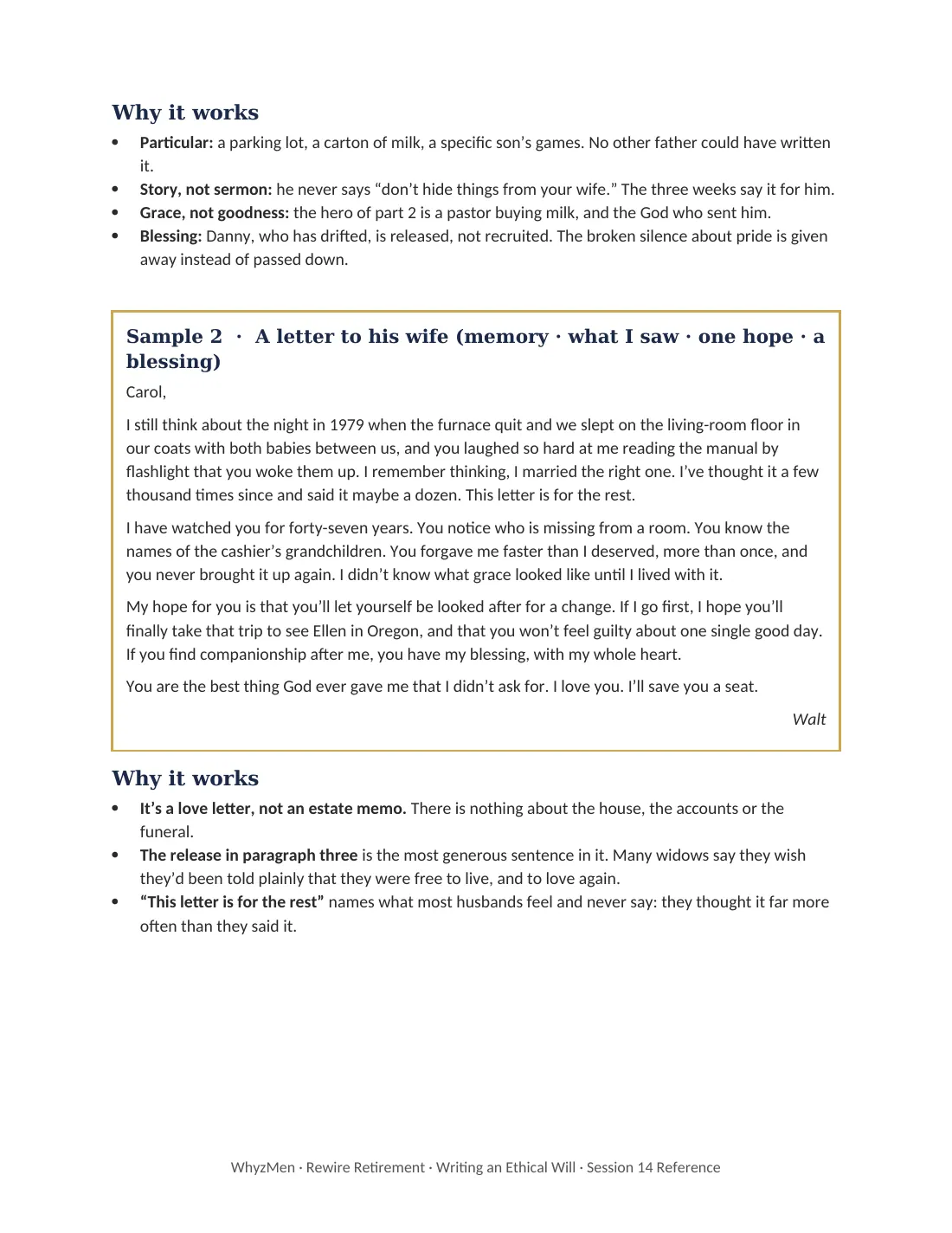
Why it works
Particular: a parking lot, a carton of milk, a specific son’s games. No other father could have written
it.
Story, not sermon: he never says “don’t hide things from your wife.” The three weeks say it for him.
Grace, not goodness: the hero of part 2 is a pastor buying milk, and the God who sent him.
Blessing: Danny, who has drifted, is released, not recruited. The broken silence about pride is given
away instead of passed down.
Sample 2 · A letter to his wife (memory · what I saw · one hope · a
blessing)
Carol,
I still think about the night in 1979 when the furnace quit and we slept on the living-room floor in
our coats with both babies between us, and you laughed so hard at me reading the manual by
flashlight that you woke them up. I remember thinking, I married the right one. I’ve thought it a few
thousand times since and said it maybe a dozen. This letter is for the rest.
I have watched you for forty-seven years. You notice who is missing from a room. You know the
names of the cashier’s grandchildren. You forgave me faster than I deserved, more than once, and
you never brought it up again. I didn’t know what grace looked like until I lived with it.
My hope for you is that you’ll let yourself be looked after for a change. If I go first, I hope you’ll
finally take that trip to see Ellen in Oregon, and that you won’t feel guilty about one single good day.
If you find companionship after me, you have my blessing, with my whole heart.
You are the best thing God ever gave me that I didn’t ask for. I love you. I’ll save you a seat.
Walt
Why it works
It’s a love letter, not an estate memo. There is nothing about the house, the accounts or the
funeral.
The release in paragraph three is the most generous sentence in it. Many widows say they wish
they’d been told plainly that they were free to live, and to love again.
“This letter is for the rest” names what most husbands feel and never say: they thought it far more
often than they said it.
WhyzMen · Rewire Retirement · Writing an Ethical Will · Session 14 Reference
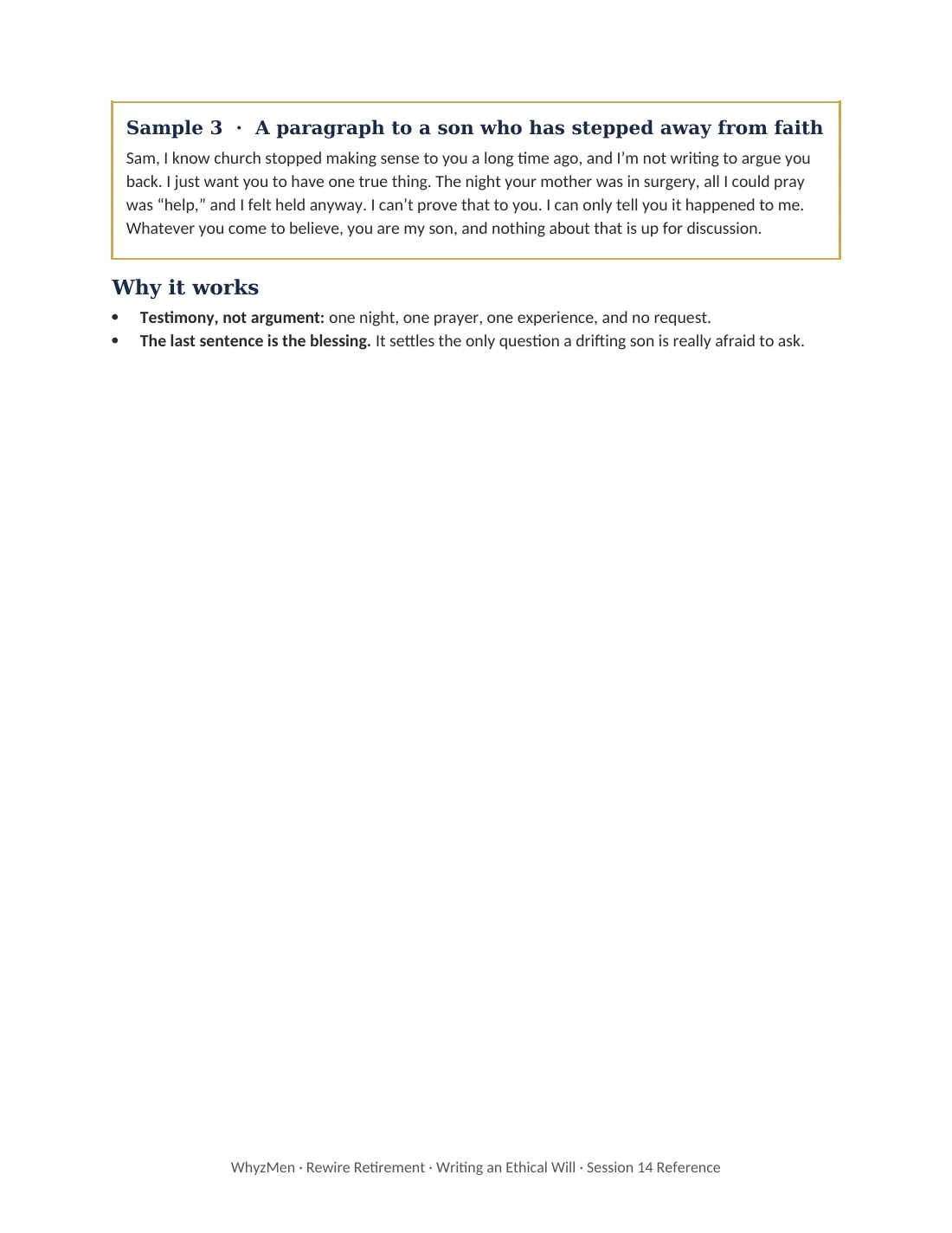
Sample 3 · A paragraph to a son who has stepped away from faith
Sam, I know church stopped making sense to you a long time ago, and I’m not writing to argue you
back. I just want you to have one true thing. The night your mother was in surgery, all I could pray
was “help,” and I felt held anyway. I can’t prove that to you. I can only tell you it happened to me.
Whatever you come to believe, you are my son, and nothing about that is up for discussion.
Why it works
Testimony, not argument: one night, one prayer, one experience, and no request.
The last sentence is the blessing. It settles the only question a drifting son is really afraid to ask.
WhyzMen · Rewire Retirement · Writing an Ethical Will · Session 14 Reference
PART FOUR
Letters to those I love: what to say, and what
not to
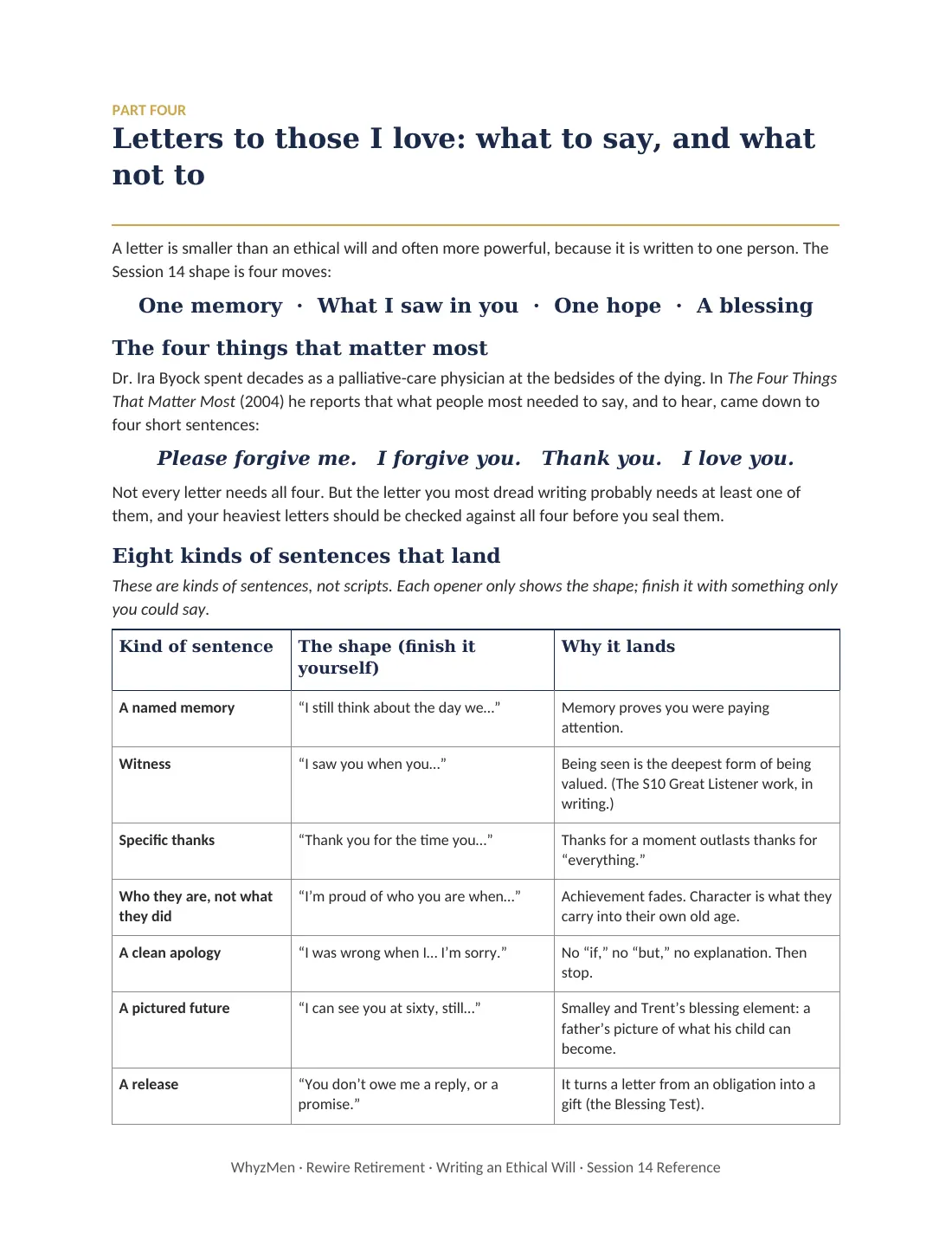
A letter is smaller than an ethical will and often more powerful, because it is written to one person. The
Session 14 shape is four moves:
One memory · What I saw in you · One hope · A blessing
The four things that matter most
Dr. Ira Byock spent decades as a palliative-care physician at the bedsides of the dying. In The Four Things
That Matter Most (2004) he reports that what people most needed to say, and to hear, came down to
four short sentences:
Please forgive me. I forgive you. Thank you. I love you.
Not every letter needs all four. But the letter you most dread writing probably needs at least one of
them, and your heaviest letters should be checked against all four before you seal them.
Eight kinds of sentences that land
These are kinds of sentences, not scripts. Each opener only shows the shape; finish it with something only
you could say.
Kind of sentence The shape (finish it Why it lands
yourself)
A named memory “I still think about the day we…” Memory proves you were paying
attention.
Witness “I saw you when you…” Being seen is the deepest form of being
valued. (The S10 Great Listener work, in
writing.)
Specific thanks “Thank you for the time you…” Thanks for a moment outlasts thanks for
“everything.”
Who they are, not what “I’m proud of who you are when…” Achievement fades. Character is what they
they did carry into their own old age.
A clean apology “I was wrong when I… I’m sorry.” No “if,” no “but,” no explanation. Then
stop.
A pictured future “I can see you at sixty, still…” Smalley and Trent’s blessing element: a
father’s picture of what his child can
become.
A release “You don’t owe me a reply, or a It turns a letter from an obligation into a
promise.” gift (the Blessing Test).
WhyzMen · Rewire Retirement · Writing an Ethical Will · Session 14 Reference
Kind of sentence The shape (finish it Why it lands
yourself)
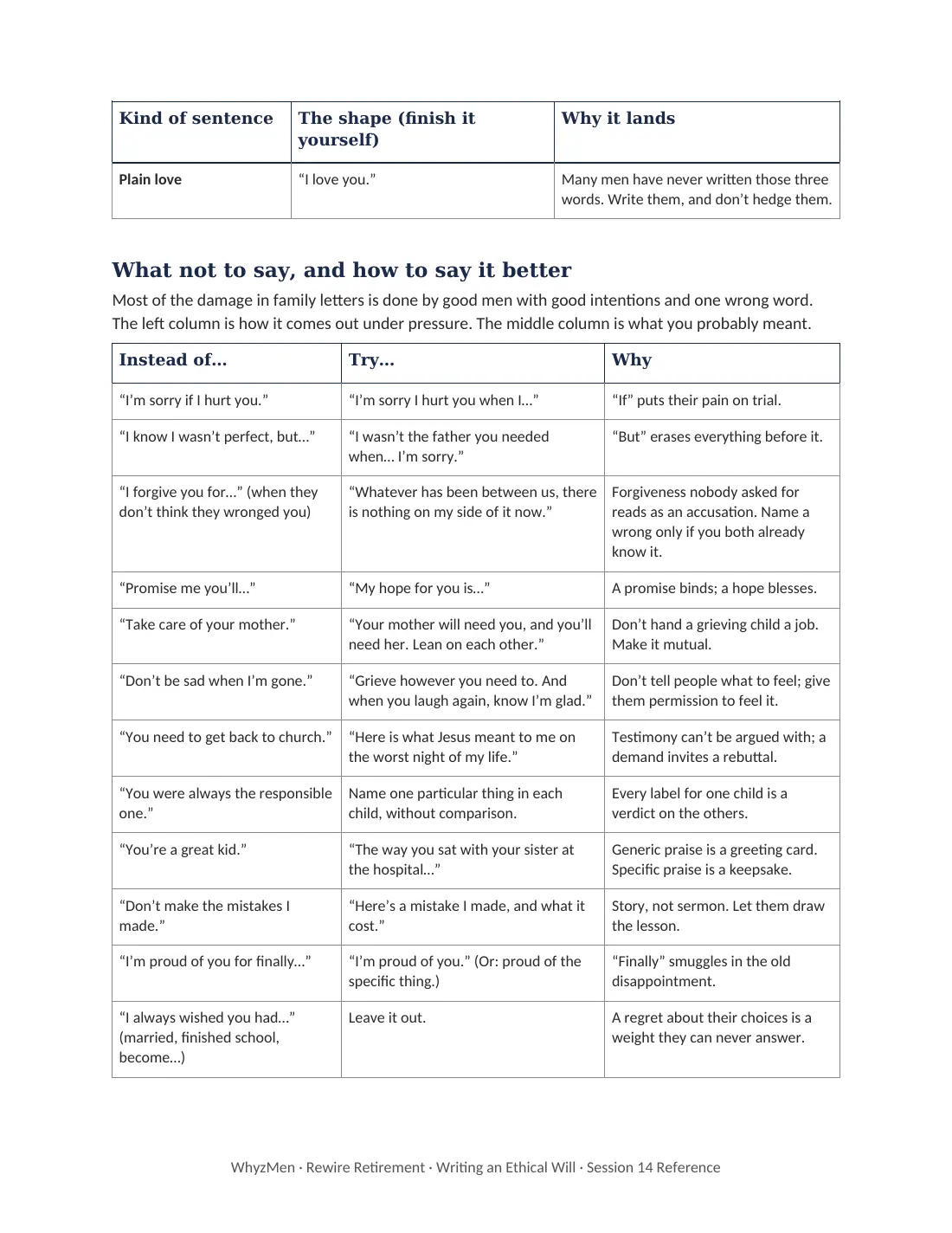
Plain love “I love you.” Many men have never written those three
words. Write them, and don’t hedge them.
What not to say, and how to say it better
Most of the damage in family letters is done by good men with good intentions and one wrong word.
The left column is how it comes out under pressure. The middle column is what you probably meant.
Instead of… Try… Why
“I’m sorry if I hurt you.” “I’m sorry I hurt you when I…” “If” puts their pain on trial.
“I know I wasn’t perfect, but…” “I wasn’t the father you needed “But” erases everything before it.
when… I’m sorry.”
“I forgive you for…” (when they “Whatever has been between us, there Forgiveness nobody asked for
don’t think they wronged you) is nothing on my side of it now.” reads as an accusation. Name a
wrong only if you both already
know it.
“Promise me you’ll…” “My hope for you is…” A promise binds; a hope blesses.
“Take care of your mother.” “Your mother will need you, and you’ll Don’t hand a grieving child a job.
need her. Lean on each other.” Make it mutual.
“Don’t be sad when I’m gone.” “Grieve however you need to. And Don’t tell people what to feel; give
when you laugh again, know I’m glad.” them permission to feel it.
“You need to get back to church.” “Here is what Jesus meant to me on Testimony can’t be argued with; a
the worst night of my life.” demand invites a rebuttal.
“You were always the responsible Name one particular thing in each Every label for one child is a
one.” child, without comparison. verdict on the others.
“You’re a great kid.” “The way you sat with your sister at Generic praise is a greeting card.
the hospital…” Specific praise is a keepsake.
“Don’t make the mistakes I “Here’s a mistake I made, and what it Story, not sermon. Let them draw
made.” cost.” the lesson.
“I’m proud of you for finally…” “I’m proud of you.” (Or: proud of the “Finally” smuggles in the old
specific thing.) disappointment.
“I always wished you had…” Leave it out. A regret about their choices is a
(married, finished school, weight they can never answer.
become…)
WhyzMen · Rewire Retirement · Writing an Ethical Will · Session 14 Reference
Instead of… Try… Why
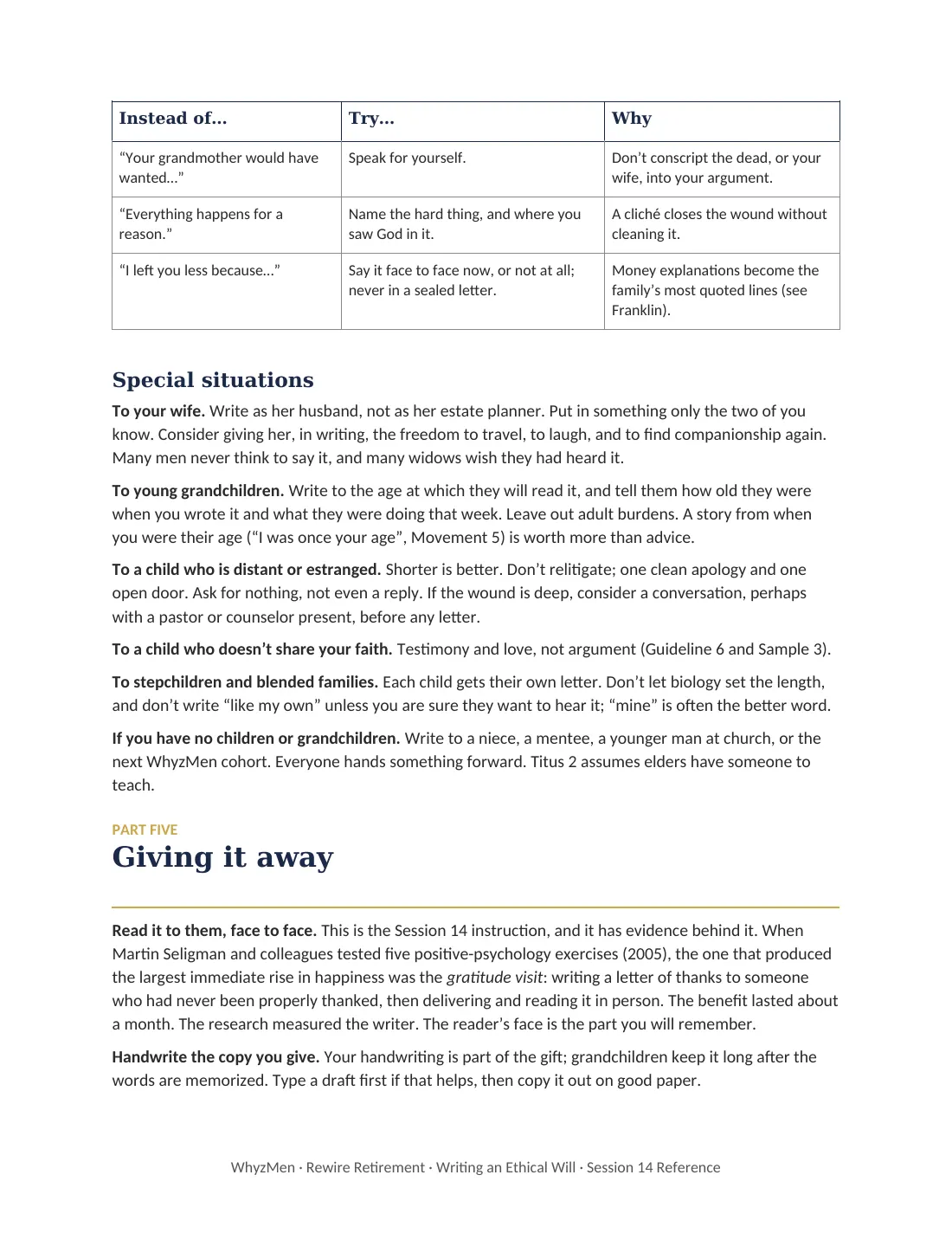
“Your grandmother would have Speak for yourself. Don’t conscript the dead, or your
wanted…” wife, into your argument.
“Everything happens for a Name the hard thing, and where you A cliché closes the wound without
reason.” saw God in it. cleaning it.
“I left you less because…” Say it face to face now, or not at all; Money explanations become the
never in a sealed letter. family’s most quoted lines (see
Franklin).
Special situations
To your wife. Write as her husband, not as her estate planner. Put in something only the two of you
know. Consider giving her, in writing, the freedom to travel, to laugh, and to find companionship again.
Many men never think to say it, and many widows wish they had heard it.
To young grandchildren. Write to the age at which they will read it, and tell them how old they were
when you wrote it and what they were doing that week. Leave out adult burdens. A story from when
you were their age (“I was once your age”, Movement 5) is worth more than advice.
To a child who is distant or estranged. Shorter is better. Don’t relitigate; one clean apology and one
open door. Ask for nothing, not even a reply. If the wound is deep, consider a conversation, perhaps
with a pastor or counselor present, before any letter.
To a child who doesn’t share your faith. Testimony and love, not argument (Guideline 6 and Sample 3).
To stepchildren and blended families. Each child gets their own letter. Don’t let biology set the length,
and don’t write “like my own” unless you are sure they want to hear it; “mine” is often the better word.
If you have no children or grandchildren. Write to a niece, a mentee, a younger man at church, or the
next WhyzMen cohort. Everyone hands something forward. Titus 2 assumes elders have someone to
teach.
PART FIVE
Giving it away
Read it to them, face to face. This is the Session 14 instruction, and it has evidence behind it. When
Martin Seligman and colleagues tested five positive-psychology exercises (2005), the one that produced
the largest immediate rise in happiness was the gratitude visit: writing a letter of thanks to someone
who had never been properly thanked, then delivering and reading it in person. The benefit lasted about
a month. The research measured the writer. The reader’s face is the part you will remember.
Handwrite the copy you give. Your handwriting is part of the gift; grandchildren keep it long after the
words are memorized. Type a draft first if that helps, then copy it out on good paper.
WhyzMen · Rewire Retirement · Writing an Ethical Will · Session 14 Reference
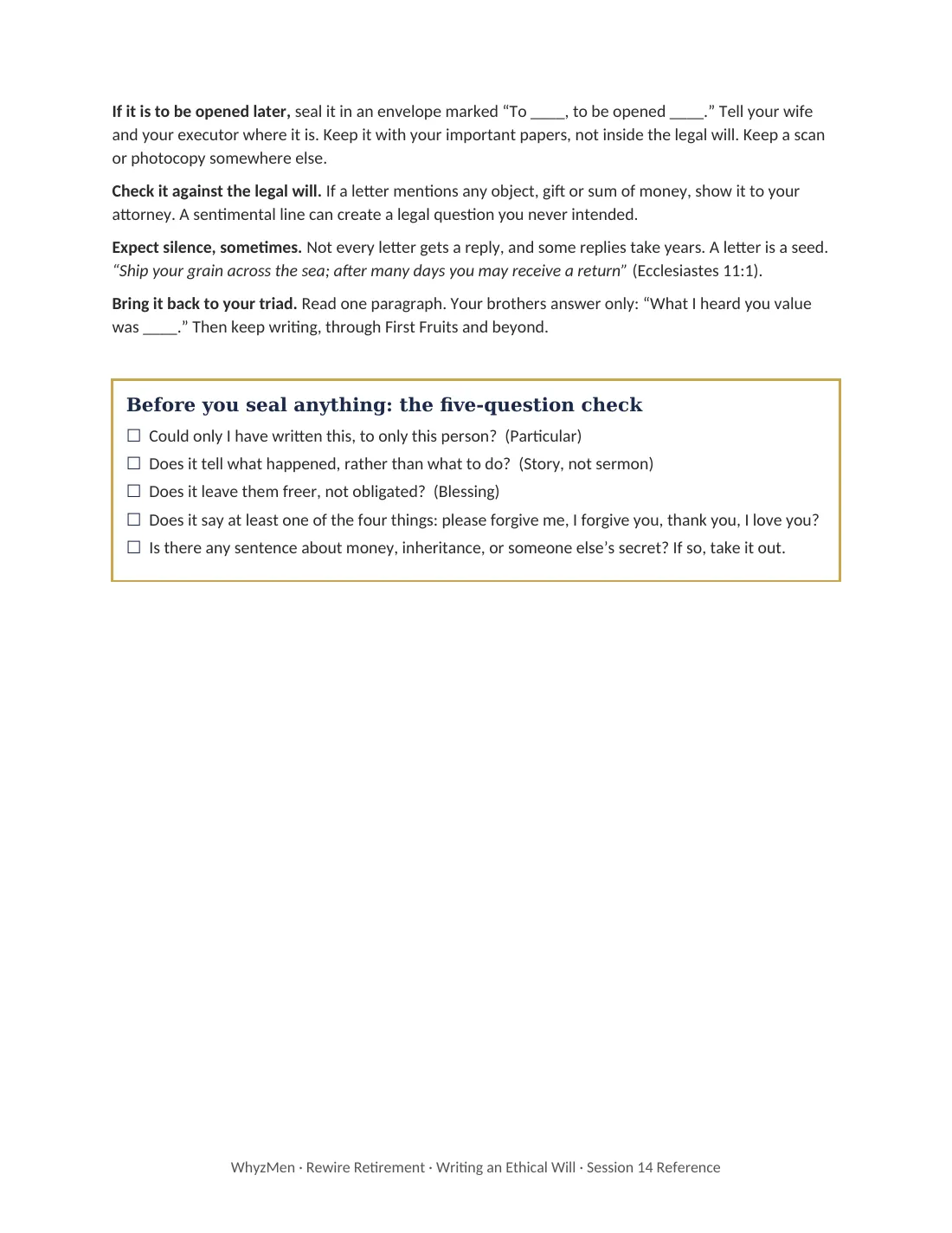
If it is to be opened later, seal it in an envelope marked “To ____, to be opened ____.” Tell your wife
and your executor where it is. Keep it with your important papers, not inside the legal will. Keep a scan
or photocopy somewhere else.
Check it against the legal will. If a letter mentions any object, gift or sum of money, show it to your
attorney. A sentimental line can create a legal question you never intended.
Expect silence, sometimes. Not every letter gets a reply, and some replies take years. A letter is a seed.
“Ship your grain across the sea; after many days you may receive a return” (Ecclesiastes 11:1).
Bring it back to your triad. Read one paragraph. Your brothers answer only: “What I heard you value
was ____.” Then keep writing, through First Fruits and beyond.
Before you seal anything: the five-question check
☐ Could only I have written this, to only this person? (Particular)
☐ Does it tell what happened, rather than what to do? (Story, not sermon)
☐ Does it leave them freer, not obligated? (Blessing)
☐ Does it say at least one of the four things: please forgive me, I forgive you, thank you, I love you?
☐ Is there any sentence about money, inheritance, or someone else’s secret? If so, take it out.
WhyzMen · Rewire Retirement · Writing an Ethical Will · Session 14 Reference
PART SIX
The short shelf: an annotated bibliography
None of these is required. Start with the first two. The rest are here for the man who finds he wants
more, and for facilitators.
Start here
Baines, Barry K. Ethical Wills: Putting Your Values on Paper. 2nd ed. Da Capo / Balance, 2006. The
standard how-to, by a hospice medical director who co-founded The Legacy Center. Exercises,
worksheets and real samples. The best single book for the process.
Riemer, Jack, and Nathaniel Stampfer, eds. So That Your Values Live On: Ethical Wills and How to
Prepare Them. Jewish Lights, 1991. An anthology of real ethical wills from the Middle Ages to the 20th
century, with a guide to writing your own. Read it for voice and form; the texts are Jewish and should be
read as such.
For facilitators
Baines, Barry K. The Ethical Will Resource Kit. The Legacy Center. Workshop materials for leading a group
through the process. Dave’s copy is the program’s facilitator reference.
Abrahams, Israel, ed. and trans. Hebrew Ethical Wills. Jewish Publication Society, 1926; facsimile ed.
2006. The classic scholarly collection, including Judah ibn Tibbon. The historical root of the form.
Going further on ethical wills
Riemer, Jack, and Nathaniel Stampfer, eds. Ethical Wills: A Modern Jewish Treasury. Schocken, 1983.
The companion anthology; more modern voices, including Holocaust-era wills.
Turnbull, Susan B. The Wealth of Your Life: A Step-by-Step Guide for Creating Your Ethical Will. Benedict
Press, 2005. Short and practical. Source of the line “What you have learned is as important as what you
have earned.” Good on connecting an ethical will to charitable giving.
Freed, Rachael. Your Legacy Matters. Minerva Press, 2013. Broader legacy writing across life stages;
useful later for the WhyzQuest women’s and couples’ tracks.
Letters and the blessing
Byock, Ira. The Four Things That Matter Most: A Book About Living. Free Press, 2004. A palliative-care
physician on the four sentences people most need to say. The best single book for the hard letters.
Smalley, Gary, and John Trent. The Blessing. Thomas Nelson, 1986; revised editions since. The five
elements of a biblical blessing. The basis for Movement 6 of Appendix K and for the Session 15
commissioning.
Nerburn, Kent. Letters to My Son: A Father’s Wisdom on Manhood, Life, and Love. New World Library,
1994; rev. ed. 1999. A model letter voice: particular, warm, rarely preachy.
Edelman, Marian Wright. The Measure of Our Success: A Letter to My Children and Yours. Beacon Press,
1992. A short book-length letter of hard-won lessons, rooted in faith and family history.
WhyzMen · Rewire Retirement · Writing an Ethical Will · Session 14 Reference
Pausch, Randy, with Jeffrey Zaslow. The Last Lecture. Hyperion, 2008. Written by a dying father for three
children too young to remember him. A study in writing for the age at which they will read it.
Franklin, Benjamin. The Autobiography. Begun 1771; public domain. Begun as a letter to his son. Read its
opening beside the story of how the two men ended.
Faith models
Scripture: Genesis 49; Deuteronomy 32–33; 1 Kings 2:1–4; John 13–17; Acts 20:17–38; 2 Timothy 4; 2
Peter 1:13–15. The testaments behind every other book on this shelf.
Bonhoeffer, Dietrich. Letters and Papers from Prison. Dietrich Bonhoeffer Works, vol. 8. Fortress Press,
2010. Includes “Thoughts on the Day of Baptism,” May 1944, to his infant godson.
The craft of writing about your life
Zinsser, William. Writing About Your Life: A Journey into the Past. Marlowe, 2004. Write small, write
particular, write it in your own voice. Already on the WhyzMen shelf.
Pennebaker, James W., and Joshua M. Smyth. Opening Up by Writing It Down. 3rd ed. Guilford Press,
2016. The research on why writing about hard things heals the writer (Pennebaker & Beall, 1986, is
cited in Session 14).
Seligman, Martin E. P., Tracy A. Steen, Nansook Park, and Christopher Peterson. “Positive Psychology
Progress: Empirical Validation of Interventions.” American Psychologist 60, no. 5 (2005): 410–421.
The gratitude-visit study cited in Part Five.
Heath, Chip, and Dan Heath. The Power of Moments. Simon & Schuster, 2017. Why a letter read aloud
becomes a defining moment, and how to mark one on purpose.
Palmer, Parker J. Let Your Life Speak: Listening for the Voice of Vocation. Jossey-Bass, 1999. The spine of
Session 14: the letter you write and the letter you are.
Scripture quotations taken from The Holy Bible, New International Version®, NIV®. Copyright © 1973, 1978, 1984,
2011 by Biblica, Inc.™ Used by permission. All rights reserved worldwide. Historical quotations: Abrahams, Hebrew
Ethical Wills (1926); Shakespeare’s will (1616), original spelling; Franklin, Autobiography (1771) and last will (1788).
Samples in Part Three are composites written for WhyzMen; names and details are invented.
WhyzMen · Rewire Retirement · Writing an Ethical Will · Session 14 Reference